Adaptations of effective exchange surfaces in all organisms
In Having more than one cell. organisms, surfaces and body organs are specialised for exchanging materials.
The effectiveness of exchange surfaces in plants and animals is increased by having:
A large surface area:
- the flattened shape of structures such as leaves
- the Tiny air sacs in the lungs, where gas is exchanged during breathing. in the respiratory system
- the Finger-like projections in the small intestine that provide a large surface area for the absorption of food. in the digestive system.
A short distance required for diffusion:
- the membranes of cells
- the flattened shape of structures such as leaves
- the walls of blood Tiny blood vessels with walls one-cell thick where exchange of materials occurs. are one cell thick
- the A cell that forms part of an epithelium. of alveoli in the respiratory system and the villi in the small intestine are only one cell thick
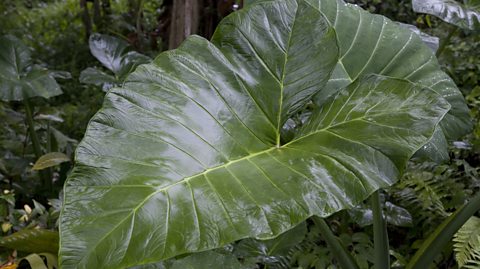
Large, flat leaves like this green taro leaf have an effective exchange surface
Animals have additional adaptations to ensure effective exchange surfaces
An efficient blood supply to transport molecules to and from the exchange surface increases effective exchange. Examples of this include:
- the network of blood capillaries that surrounds each alveolus in the lungs
- the network of blood capillaries in each villus in the small intestine
In the lungs, the process of breathing, or Breathing in and out., brings air to, and removes air from the exchange surface - the alveoli.
The moving blood and ventilated surfaces mean that a steep The difference in the concentration of a chemical across a membrane. can be maintained.
