The 1945 general election
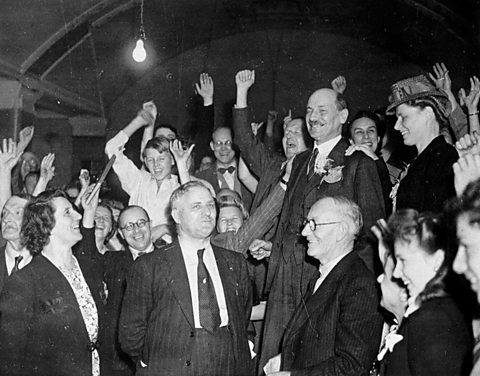
An election was called for 5 July 1945. Voting closed on 19 July to allow enough time for soldiers stationed abroad to vote. The two leading parties were Clement Attlee’s Labour Party and Winston Churchill’s Conservative Party. The Liberal Party were in decline at this stage.
The election result was a surprise to many. Winston Churchill was a successful wartime leader and a hero. Clearly, many observers would have fancied a Churchill victory due to his war role and his popularity. However, Labour secured a landslide victory.
Causes of the 1945 election victory
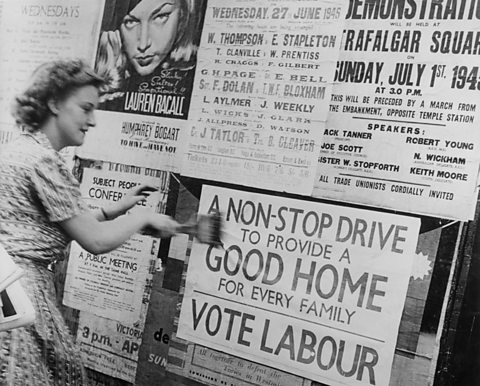
Perhaps the British people wished to see a period of change and believed Labour would bring a break from the 1930s Depression. The Conservatives had under-estimated this mood. Despite Churchill’s popularity, the Conservative party struggled to win new supporters.
The Conservative Party’s campaign focused on Churchill’s World War Two role. It could be argued that this made them less appealing to voters who intended to move on from the war. As this was the first election since 1935, an unusually high number of people were voting for the first time. The slogan Help him finish the ‘job’
hardly eased voters’ fears.
There was a confidence that Labour would bring about great political and economic change. By promising to embrace and act upon the A government report, presented by Sir William Beveridge to the British parliament in November 1942, which led to the establishment of a system of social security and the National Health Service after the end of the war. they were able to win over voters.
Labour benefitted from the change in attitudes towards the class system and social mobility that had emerged due to the disruption to traditions during the war, alongside an increasing belief in access to opportunities for all.
The Conservative party was blamed by many for the recent Depression and the failure to stand up to Adolf Hitler in the 1930s Giving in to the demands of another country to avoid war.. The Labour campaign focused on these issues and weaknesses.
Furthermore, Churchill mistakenly compared Labour’s planned socialism to tyrannical A country ruled by someone who has complete authority., and even made reference to the The Nazis’ secret police force..
The Daily Express newspaper, a supporter of the Conservatives, used the headline ‘GESTAPO IN BRITAIN IF SOCIALISTS WIN’, and this horrified many voters.
Attlee understood the desire for change in Britain, as seen in the slogan Let us face the future together
. The promises of a A state (or country) where the government provides welfare benefits, such as education, health care and unemployment payments, to its population free at the point of use, although they are paid for by general taxation., based on the Beveridge Report, and immediate nationalisation of the Bank of England, coal, power, transport and iron and steel industries attracted voters to Labour.