Protein synthesis - Higher
Greg Foot explains how the structure of DNA affects the proteins made in DNA synthesis
The production of proteins from amino acids, which happens in the ribosomes of the cell. consists of two stages – transcription and translation. In transcription the DNA code is read, and in translation the code is used to build up Organic compound made up of amino acid molecules. One of the three main food groups, proteins are needed by the body for cell growth and repair. molecules.
DNA is a triplet code. Each triplet, a group of three bases, codes for a specific amino acid.
Transcription and translation
DNA is often called the genetic code. It is the code to make proteins.
DNA remains in the The nucleus controls what happens inside the cell. Chromosomes are structures found in the nucleus of most cells. The plural of nucleus is nuclei. but during transcription a copy is made from mRNA. This moves from the The nucleus controls what happens inside the cell. Chromosomes are structures found in the nucleus of most cells. The plural of nucleus is nuclei. to a The site of protein synthesis. in the The living substance inside a cell (not including the nucleus)..
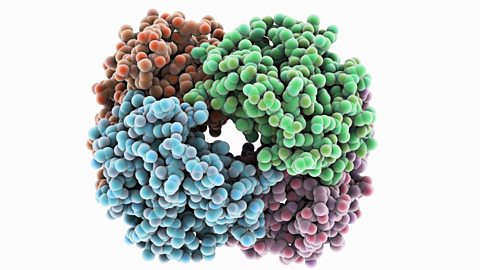
During translation, proteins are synthesised in ribosomes. During this process, carrier molecules, called tRNA, bring specific amino acids to add in the correct order to the growing protein. There are only about 20 different naturally-occuring amino acids. Each protein molecule has hundreds, or even thousands, of amino acids joined together in a unique sequence. It is then folded into a unique shape. This is very important, as it allows the protein to do its job. Enzymes and hormones are proteins and their correct shapes are crucial to their functions.
The protein produced depends on the DNA code used, and if this sequence changes a different protein could be made.
Image caption, Different amino acid sequences result in proteins folding into different shapes, with protein one functioning as an enzyme
1 of 2
Learn more about protein synthesis with Dr Alex Lathbridge.
Listen to the full series on BBC Sounds.
Learn about how proteins are made during the processes of transcription and translation.
