Indian and African trade and Irish famine, 19th and 20th Century
The East India Company and the growth of the British Empire
In 1600, Queen Elizabeth I granted the East India Company a A royal licence which gave individuals the sole right to manufacture or sell a product. of trade to East Asia. These 218 merchants established trading posts across India; trading money and goods for products that were valued highly in Europe such as spices, jewels and fine cloths.
There was fierce competition with other European nations for the right to trade in India. This forced the East India Company to employ a large army to guard their profits against Indian princes and rival European traders.
By 1858 the East India Company was no longer considered capable of safeguarding British interests in India, particularly after the Great Rebellion of 1857 when a large part of the Indian army rebelled against Company rule. The British government assumed direct control of their business and gradually expanded British influence across the continent.
Thousands of white Britons boarded boats destined for India to make their fortune or to help administer the British India, which became known as the Rule of the British Crown in the Indian subcontinent between 1858 and 1947.. Many women also travelled to India, usually to find a suitable husband among the Britons making their fortunes. However people also travelled from India to Britain, notably Indian sailors, known as Lascars, working on board British vessels. Communities of Lascars could be found in most of Britain’s major ports in the 18th and 19th centuries.
Britain’s profitable presence in India gave them the means to conquer territory in Africa. South Africa was the primary destination for Britons who migrated in order to mine for gold and diamonds. After the opening of the A man made canal dug in Egypt to connect the Mediterranean Sea with the Indian Ocean in the 19th century. in 1869, the journey time to India was halved to just six weeks which meant that Britain’s African and Indian territories were now much more closely connected.
Britain encouraged further connections between India and Africa through British use of A servant that worked for a specific time, usually five or seven years, to pay off a debt. Indian workers to work in South African mines.
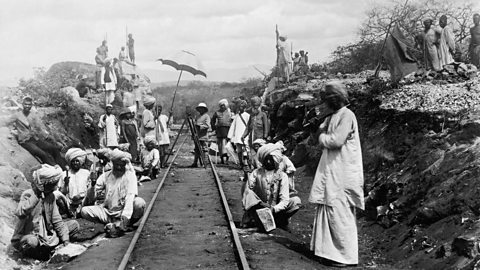
The Kenya to Uganda railway was also built by Indian indentured servants and after the railway was completed, they settled in East Africa. Around 50,000 Indians migrated to British East Africa in the late 19th and early 20th century.
White Britons were mainly driven by economic factors in their decisions to When a person leaves a country to move permanently somewhere else. to distant parts of the All the territory across the world that was ruled by Britain. At its height in the 1920s it covered near a quarter of the world's land and included one fifth of the world's population..
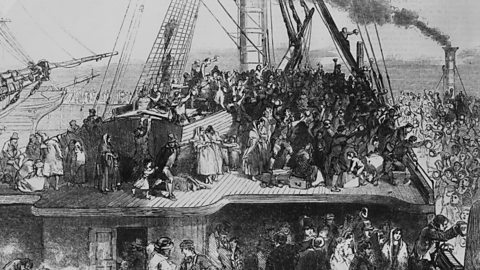
- In the mid-19th century, as a result of the The period in the 1840s when disease hit the potato crop in Ireland, killing about one million people and forcing another million to emigrate. of 1845-52, over one million Irish people left the British Isles to seek a better life in the Americas.
- At the same time, thousands of Scottish tenant farmers were evicted from their villages in the Highlands and they also chose to emigrate. They settled across North America but also in Australia and New Zealand.
The Great Irish Famine
In the 19th century, the British government believed very strongly in The belief that nations should be able to trade without imposing restrictions upon one another. and limited government interference with the economy.
This meant that when Ireland suffered severe An extreme lack of food that leads to large numbers of people starving to death. during the Great Famine in the 1840s, the British government followed a policy that led to death, misery and migration.
- In 1845, Ireland had stores of grain that could have been used to feed the starving people, but the British government officials would not release the stocks of grain to the people. The British insisted that the grain had to be sold for export to other places and at a full market price, which the Irish could not afford.
- In 1847, millions of Irish people suffered from hunger and disease, and over a million left the country, mostly for the USA.
- By 1861 there were over 800,000 Irish-born A person who moves from one country to another, often to find work. living in Britain. This was the time when the railway system was being expanded all over England, and Irish men often found jobs as Labourers, in particular someone who builds roads, canals or railways. working on the construction of these new railways.
White Settlers in British East Africa
- In the early 20th century, Kenya became a popular destination for white Britons that wanted to establish permanent settlements there.
- The new railway built by indentured Indian workers opened up much of the Kenyan interior to European settlement and thousands of Britons migrated to Kenya via the newly established city of Nairobi, over the next few decades.
More guides on this topic
- Britain, migration and empire overview, c790 - present day
- Motives for migration to and from Britain - religion and ideas
- Motives for migration to and from Britain - war and government
- Motives for migration to and from Britain - geographical summary
- Migration's effect on Britain - economics and commerce
- Migration's effect on Britain - religion and ideas
- Migration's effect on Britain - government
- How Britain gained an empire - economics and commerce
- How Britain gained an empire - religion and ideas
- How Britain gained an empire - war
- How Britain gained an empire - government
- How Britain gained an empire - geographical summary
- How Britain lost an empire - ideas, race and culture
- How Britain lost an empire - war and government
- How Britain lost an empire - geographical summary
- Britain: Migration, empires and the people - exam preparation
