Reactions of alkali metals with water
All the alkali metals react vigorously with cold water. In each reaction, hydrogen gas is given off and the metal hydroxide is produced. The speed and violence of the reaction increases as you go down the group. This shows that the reactivity of the alkali metals increases as you go down Group 1.
Note that you are expected to know some of the key safety points for these reactions. These include:
- use of a plastic safety screen
- using small pieces of the metal
- using a large volume of water
- using tweezers to hold the metal
- wearing thick rubber gloves
Lithium
When lithium is added to water, lithium floats. It fizzes steadily and becomes smaller, until it eventually disappears.
lithium + water → lithium hydroxide + hydrogen
2Li(s) + 2H2O(l) → 2LiOH(aq) + H2(g)
Sodium
When sodium is added to water, the sodium melts to form a ball that moves around on the surface. It fizzes rapidly before it disappears.
sodium + water → sodium hydroxide + hydrogen
2Na(s) + 2H2O(l) → 2NaOH(aq) + H2(g)
Potassium
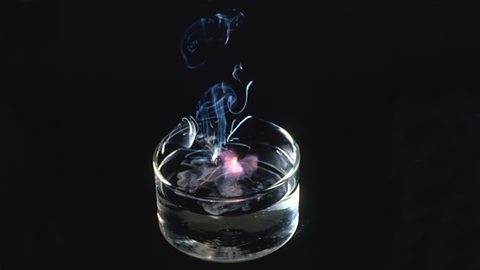
When potassium is added to water, the metal melts and floats. It moves around very quickly on the surface of the water. The metal self-ignites, which also ignites the hydrogen gas. This results in sparks and a lilac flame. There is sometimes a small explosion at the end of the reaction.
potassium + water → potassium hydroxide + hydrogen
2K(s) + 2H2O(l) → 2KOH(aq) + H2(g)
Test for hydrogen gas
To identify the gas given off by these reactions as hydrogen, it is necessary to test the gas:
- Collect the gas in a test tube.
- Put the flame from a burning splint into the top of the test tube.
- The gas will burn quickly and give off a squeaky ‘pop’.
Strong alkalis
The hydroxides formed in all of these reactions dissolve in water to form Having a pH greater than 7. solutions. These solutions turn Paper stained with universal indicator, a chemical solution that produces many different colour changes corresponding to different pH levels. purple, showing they are strongly alkaline. Strong alkalis are Able to damage metal, stonework, clothes and skin. Strong acids and alkalis are corrosive.. Care must be taken when they are used – goggles and gloves should be worn.
