Get listening
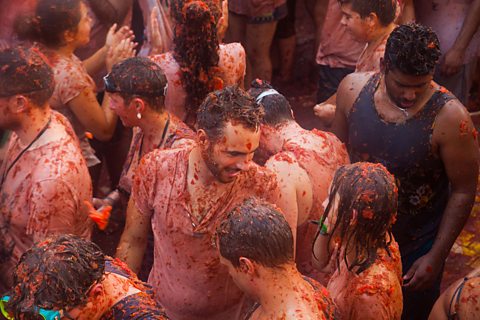
One of the most admirable things about Spain and Spanish people is their variety of celebrations throughout the year and the level of participation across the country.
There are a ton of festivals all over the country. Though their origins are often religious, a party is a party, and most of them can get pretty crazy.
Question
Listen to the following passage about 'La Tomatina' and select the correct four statements.
| A. The Tomatina is celebrated in a Valencian town. |
| B. This festival happens at the end of August. |
| C. The participants throw tomatoes at each other. |
| D. 10,000 tomatoes are thrown during this popular festival. |
| E. A fight between some youngsters started this tradition. |
| F. Thanks to this festival, more vegetable shops have opened in Buñol. |
| A. The Tomatina is celebrated in a Valencian town. |
| B. This festival happens at the end of August. |
| C. The participants throw tomatoes at each other. |
| D. 10,000 tomatoes are thrown during this popular festival. |
| E. A fight between some youngsters started this tradition. |
| F. Thanks to this festival, more vegetable shops have opened in Buñol. |
The correct answers are A, B, C and E.
Transcript:La Tomatina es una fiesta que se celebra en Buñol, en la Comunidad Valenciana, el último miércoles del mes de agosto. Durante esta celebración, los participantes se tiran tomates unos a otros con la única finalidad de divertirse. Esta extraña batalla reúne cada año a unos diez mil visitantes que, durante dos horas, pueden lanzar hasta dos toneladas de tomates. La tradición se realiza desde 1944, aunque no se sabe con certeza cómo comenzó. Una teoría muy popular dice que surgió durante un desfile en las fiestas de Buñol, cuando unos jóvenes quisieron colarse para participar en él y otros intentaron impedirlo. Lo que comenzó como una simple discusión, acabó siendo una batalla de tomates, debido a que cerca había un puesto de verduras.
Translation: 'La Tomatina' is a festival celebrated in Buñol, in the Valencian Region, on the last Wednesday in August. During this celebration, the participants throw tomatoes at each other with the sole purpose of having fun. This strange battle gathers every year around ten thousand visitors who, for two hours, can throw up to two tonnes of tomatoes. The tradition started in 1944, although it is not known with certainty how it started. A very popular theory tells that it commenced at a parade during the Buñol’s festival, when some youngsters wanted to sneak in to participate in it and others tried to stop them. What started as a simple argument ended up as a battle of tomatoes due to the fact that there was a vegetable stall nearby.
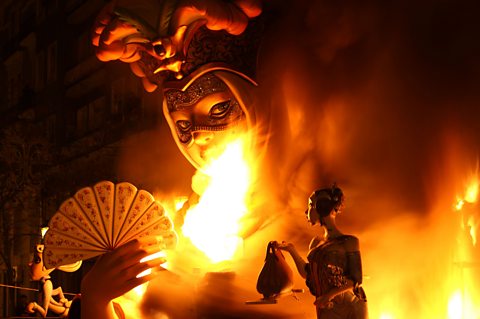
Listen to this passage about 'Las Fallas' and answer the questions which follow in English.
Question
What do Valencians use to decorate the streets of their city during the 'Fallas' festival?
Enormous monuments made of wood and cardboard.
Question
Mention three events which take place during the 'Fallas' festival.
The events mentioned are: parades, dances, bullfights and fireworks.
Transcript:Las Fallas son la celebración más importante de Valencia. Durante una semana inmensos monumentos de madera y cartón, que representan la vida actual política o de las celebridades decoran las calles de la ciudad. A ello se le une una gran lista de eventos, como desfiles, donde destaca la belleza de los trajes folclóricos femeninos; bailes; corridas de toros y extraordinarios fuegos artificiales.
Translation: The 'Fallas' is the most important celebration in Valencia. For a week, enormous monuments made of wood and cardboard, representing the current political and celebrity life decorate the streets of the city. To this you have to add a long list of events, such as parades, where the beauty of the traditional female costumes stands out; dances; bullfights and amazing fireworks.
Question
What happens on the 19th of March?
The wood and cardboard monuments are burnt on bonfires.
Question
What is the meaning of the word 'falla'?
Explosion and fire.
Transcript:El 19 de marzo, día de San José y último día de esta fiesta, los monumentos de madera y cartón se queman en impresionantes hogueras. Esta es la manera de recibir el comienzo de la primavera, con explosión y fuego (que es lo que la palabra falla significa).
Translation: On the 19th of March, Saint Joseph Day and the last day of this festival, the wood and cardboard monuments are burnt on magnificent bonfires. This is the way to welcome the beginning of the spring season, with explosion and fire (which is what the word 'falla' really means).
