Developing country case study: Rio de Janeiro
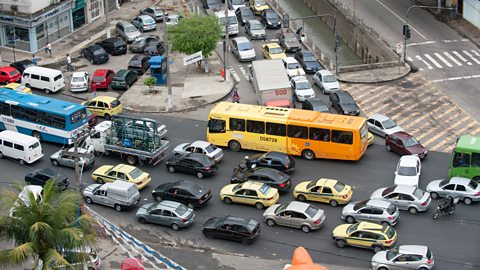
Rio de Janeiro is located on the south east coast of Brazil and is the country’s second largest city with a population of over 6 million people. The city is surrounded by mountains and this makes traffic management difficult. A large volume of traffic is forced along a few main roads causing severe congestion, accidents and, noise and air pollution.
In 2020, nearly eight out of ten households in Brazil owned a car and twenty-four per cent of households owned both a car and a motorcycle. The number of vehicles in Rio de Janeiro has grown considerably making it the most congested city in South America.
In the past, most of the journeys in Rio were taken by bus or private car, with only a small percentage of journeys made via the metro system and rail network. This has changed in recent years after efforts to improve transport in the city.
Officials worked hard to improve the city’s transport system for hosting the 2014 FIFA World Cup and the 2016 Olympics. An integrated control centre was built in 2010 and allows more than thirty city agencies monitor what is happening across the city in real time. Brazil continues to invest in expanding train and subway lines and improving road infrastructure as it works to cut down on Rio's infamous congestion.
A recent study showed that an average drive through Rio takes fifty per cent longer at peak times, compared to off-peak times. For example, commuters traveling to or from Barra da Tijuca during evening rush hour, suffer long delays daily. Alternative forms of transport are therefore significant to improving the congestion problems in Rio de Janeiro.
The Maestro System: Managing Traffic in Real Time
The Maestro System consists of cameras, speed checks, radio links, street light control and a control centre. Cameras capture live images of roads and traffic junctions in real time and supply information to Rio’s operation centre. This information allows for real time adjustments of traffic signals, which are synchronised to help commuters catch green lights to increase traffic flow.
Cameras also pick up broken down vehicles quickly and send recovery to remove the vehicle and minimise the build-up of congestion. Speed checks are conducted to decrease collisions and police are quickly alerted to accidents by local officers working in the control centre.
Investment in infrastructure – roads and bridges
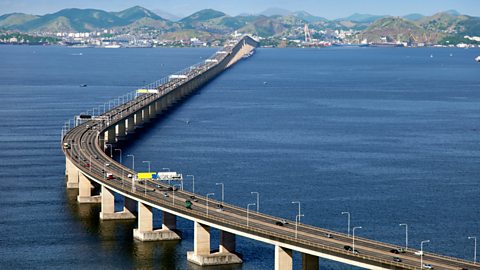
The Rio Niteroi Bridge is 14 km long and was one of the longest in the world when it opened in 1974.
It connects Rio with the city of Niteroi across Guanabarra Bay, providing a shorter alternative to an 80 km road journey or a one-hour ferry crossing. However, due to rising levels of car ownership, each end of the bridge is completely jammed at rush hour causing major congestion.
The Yellow Line Expressway (motorway)
The 21 km 'Yellow Line' expressway was opened in 1997 and connects Barra da Tijuca in the West Zone with Rio's North Zone and the international airport.
It is a toll road, as Rio's authorities did not have enough money to cover the cost of building it. Seventy thousand vehicles use the road each day, thirteen thousand more than expected. So far, the road has been successful in removing around forty per cent of traffic from local roads in the area.
Elevado do Joá Dual Carriageway
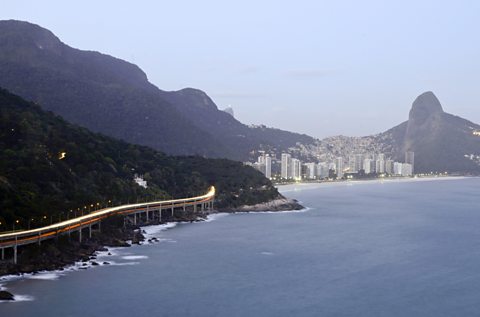
A new 5km two-lane elevated road was built parallel to an existing two-level road that bestrides the ocean in the area of Joá. Two new tunnels were constructed through the hills that separate the neighbourhood of Barra da Tijuca, home to the Olympic Park, from the rest of the city.
The road connecting the CBD to Barra da Tijuca increased traffic capacity and receives approximately 85,000 vehicles per day. It has also reduced journey times by as much as 60%. To ease congestion further the road operates as a one-way system during peak rush hour times. In the morning towards the CBD where commuters are heading to work and in the evening towards Barra when they are travelling back home.
