Why do Hindus believe in life after death?
Ancient Hindu scriptures refer to the atman (soul) being reborn many times. The The Bhagavad Gita is one of the most revered and important Hindu texts. The Gita tells the story of Krishna’s incarnation as a chariot driver to Prince Arjuna and forms part of the Mahabharata. states the following:
As a person casts off worn-out clothes and puts on new ones, so does the atman cast off worn out bodies and enter new ones.
The Bhagavad Gita also explains that death is something that we can neither stop nor grieve about:
For certain is the death of all that comes to birth, certain is the birth of all that dies. So in a matter that no one can prevent do not grieve.
Most Hindus believe that good merit is achieved by following your This word has various meanings which have to be understood from the context in which it is used. It can mean religious duty. In Buddhism it is most widely used to mean the Buddha’s teaching. It can also mean ‘the truth’.. The Bhagavad Gita details four different ways that Escape from the cycle of reincarnation. Term used in the Hindu religion. can be achieved:
- karma yoga - a type of Hindu religious practice that involves selfless service to others
- bhakti yoga - the path of loving devotion, aimed at developing pure love of god
- jnana yoga - a type of Hindu meditation, the path of knowledge that aims at liberation
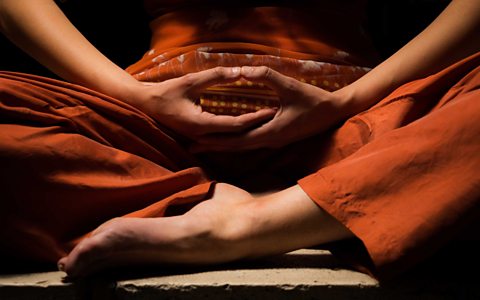
- meditation - thinking quietly as a spiritual or religious exercise
What happens after moksha?
There are two main beliefs about what happens after moksha.
Some Hindus believe that the atman is absorbed into For Hindus, Brahman is the ultimate reality – one 'Supreme Spirit' in many forms. Brahman is male, female and even animal.. This is because the atman and Brahman are the same.
Other Hindus believe that the atman and Brahman are different and that after moksha they remain separate. They believe that the atman will be in the presence of Brahman, as a personal god, but will remain unique and individual.
