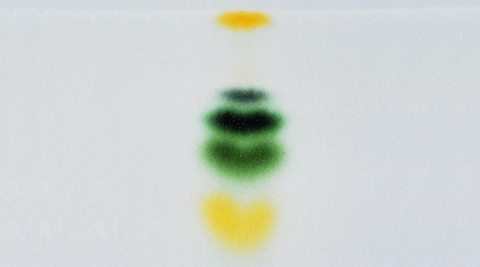
Required practical - separating substances using chromatography
Big Manny demonstrates how paper chromatography can be used to separate coloured inks with a GCSE Chemistry practical experiment
Aims
To investigate how paper Chromatography is used to separate different substances dissolved in a liquid. can be used to separate and tell the difference between coloured substances.
Method
- Draw a pencil line across the chromatography paper, 1 to 2 cm from the bottom.
- Use a pipette or capillary tube to add small spots of each ink to the line on the paper.
- Place the paper into a container with a suitable The liquid in which the solute dissolves to form a solution. in the bottom.
- Allow the solvent to move through the paper.
- Before the solvent reaches the top of the paper, mark the height reached by the solvent with a pencil. It's best to do this on both the left hand side, and right hand side, of the paper.
- Remove the The results of separating mixtures by chromatography. immediately.
- Allow the chromatogram to dry, then measure the distance travelled by each spot and by the solvent.
Results
Record your results in a suitable table. For example:
| Ink | Spot colour | Distance travelled by spot (mm) |
| Ink | |
|---|---|
| Spot colour | |
| Distance travelled by spot (mm) |
| Ink | |
|---|---|
| Spot colour | |
| Distance travelled by spot (mm) |
| Ink | |
|---|---|
| Spot colour | |
| Distance travelled by spot (mm) |
Analysis
1. Calculate the Rf value of each spot:
Rf = \(\frac{\textup{distance~travelled~by~substance}}{\textup{distance~travelled~by~solvent}}\)
2. Compare the Rf values and colours of each spot in the inks. Describe their similarities and differences.
Evaluation
Question
Explain why the distances travelled by each spot were measured in mm, rather than in cm.
Measurements in millimetres are more precise than those in centimetres. They will give more precise Rf values.
Hazards, risks and precautions
It is important in this practical activity to use appropriate apparatus and methods. This includes the safe use and careful handling of substances. Eye protection must be worn.
Evaluate the hazards and the precautions needed to reduce the risk of harm. For example:
| Hazard | Possible harm | Possible precaution |
| Harmful solvent | Skin irritation | Avoid skin contact, eg wear gloves |
| Harmful solvent | Breathing difficulties | Ensure adequate ventilation or carry out the chromatography in a fume cupboard |
| Hazard | Harmful solvent |
|---|---|
| Possible harm | Skin irritation |
| Possible precaution | Avoid skin contact, eg wear gloves |
| Hazard | Harmful solvent |
|---|---|
| Possible harm | Breathing difficulties |
| Possible precaution | Ensure adequate ventilation or carry out the chromatography in a fume cupboard |
Separation of photosynthetic pigments by chromatography
Contains the green pigment chlorophyll; the site of photosynthesis. usually contain two types of The green chemical inside the chloroplasts of plant cells. It enables photosynthesis to take place.. They also contain several other types of A coloured chemical. that capture light falling on leaves.
Mixtures of these pigments from chloroplasts can be separated using paper chromatography.
The pigments can be extracted from leaves by grinding the leaves in organic solvents with a pinch of sand to break up the plant cells.
The pigments can be separated using a mixture of A substance that contains carbon joined to atoms of other elements by covalent bonds. solvents.