Homeostasis and water balance
Osmoregulation is the control of water levels and mineral salts in the blood.
Water levels and mineral salts in the blood are controlled to protect cells by stopping too much water from entering or leaving them.
If body cells lose or gain too much water by osmosis, they do not function efficiently.
If the concentration of water is the same inside and out the cells, they remain in their normal state. If the water concentration is too high outside, water enters the cell by The movement of water molecules across a selectively permeable membrane from a region of higher water concentration to a region of lower water concentration. and they may burst.
On the other hand, if the water concentration is too low outside compared with the inside of the cells, water will leave by osmosis and the cells may shrivel. If body cells lose or gain too much water by osmosis, they do not function efficiently.
Plants also undergo the process of osmosis, in the same way that animals cells do, but they do not burst when placed in distilled water, because of their cell walls.
Plant cells are Enlarged and swollen with water. Having turgor. Description of a plant cell in which the vacuole has swollen due to water gain by osmosis. or firm, when they are full of water.
If cell walls lose water, they become flaccid and the cytoplasm shrinks away from the cell wall. The cell is said to be Description of a plant cell in which the vacuole has shrunk and the membrane has pulled away from the wall due to water loss by osmosis..
Human excretory organs
The organs of excretion in humans include the skin, lungs and kidneys.
Most of the water is lost from the body as:
- urine from the kidneys
- sweat from the skin
- water vapour, from the lungs when we exhale
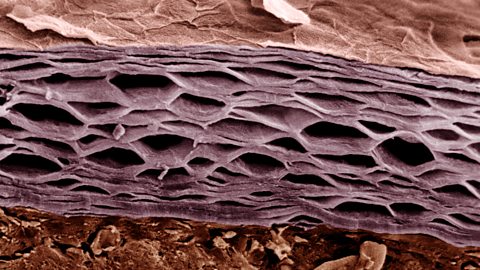
Skin
Sweat glands in the skin produce sweat. Water, ions and urea are lost from the skin as the body sweats.
Lungs
Water leaves the body via the lungs when we The process of breathing out. as well as the carbon dioxide produced during The chemical change that takes place inside living cells, which uses glucose and oxygen to release the energy that organisms need to live. Carbon dioxide is a by-product of respiration..
We cannot control the level of water, ion or urea loss by the lungs or skin. For example, in a hot climate, your body sweats to help keep you cool. In the same way, when we breathe out, we lose water vapour, and we cannot alter the amount we lose.
Kidneys
The kidneys are organs of the urinary system, which removes excess water, salts and urea.
Learn more about water and nitrogen balance with Dr Alex Lathbridge.
Listen to the full series on BBC Sounds.
In this podcast, learn the key facts about water and nitrogen balance. Listen to the full series on BBC Sounds.
