Animal transport and exchange systems
In mammals, blood consists of plasma, red blood cells and white blood cells.
Nutrients (eg glucose and amino acids), oxygen and carbon dioxide are transported around the body in the blood.
Red blood cells
The blood cell which contains the pigment haemoglobin responsible for the transport of oxygen. transport oxygen around the body. They are specialised to carry oxygen because they:
- contain large quantities of a protein called The red protein found in red blood cells that transports oxygen round the body., which can bind oxygen.
- don't have a nucleus, so there is more room for haemoglobin.
- have a biconcave disc shape, which maximises the surface area of the cell membrane for oxygen to diffuse across.
- are tiny and flexible so can squeeze through the narrowest of blood Tiny blood vessels with walls one-cell thick where exchange of materials occurs. to deliver oxygen.
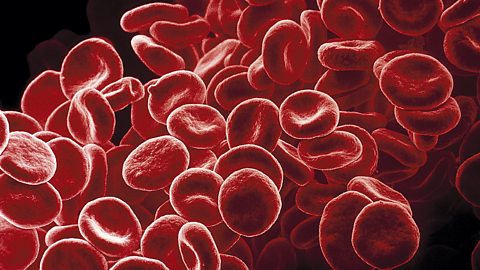
Haemoglobin
Haemoglobin binds with oxygen in body locations where the oxygen concentration is high (in the lungs) and forms oxyhaemoglobin.
Blood with a high concentration of oxygen is described as oxygenated.
\(Haemoglobin + oxygen \to oxyhaemoglobin\)
This makes the blood a bright red colour.
In locations where the oxygen concentration is low (body tissues) haemoglobin releases oxygen.
\(Oxyhaemoglobin \to haemoglobin + oxygen\)
The oxygen then diffuses into the cells. Blood that has a low oxygen concentration is a dark red colour and is described as deoxygenated.
White blood cells
White blood cells are part of the immune system and are involved in destroying pathogens (disease-causing micro-organisms bacteria, viruses and fungi).
There are 2 main types of cells involved:
- Phagocytes which carry out phagocytosis by engulfing pathogens and digesting them (breaking them down).
- Lymphocytes which produce antibodies which destroy pathogens.
Antibodies are specific to particular pathogens.
