The Harrying of the North
The winter of 1069 - 1070 is remembered in England as the most notorious period in the whole of King William’s reign.
Faced with local rebellions in northern England that were encouraged by the Scots and the Danes, William set about systematically destroying large parts of the north.
According to A person who records events for historical record., Orderic Vitalis:
‘he made no effort to restrain his fury and punished the innocent with the guilty. In his anger he commanded that all crops, herds and food of any kind be brought together and burned to ashes so that the whole region north of the [river] Humber be deprived of any source of sustenance’.
William’s ‘scorched earth’ policy came to be known as the ‘Harrying of the North’.
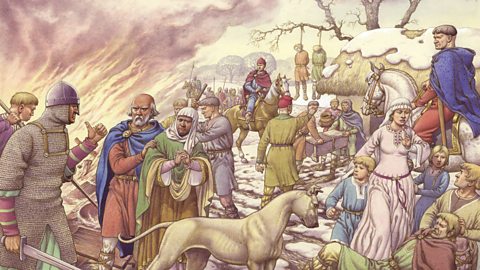
What drove William to this level of cruelty?
- When William and his fellow Normans began to take land and increase taxation the people of the north probably felt they had more to gain from rebelling than from submitting. They were used to acting relatively independently.
- The Scots and the Danes supported the rebels in the north. Both wanted to take some or all of England for themselves.
- William did try to deal with the people of the north peacefully just after his conquest, but hostility towards Norman rule grew strong when he left England in the hands of his A person who acts in the place of a ruler, governor, or sovereign., Odo and William FitzOsbern. Fighting all over the country and facing foreign invasion, William believed the safest way to control the north was to depopulate it.
Consequences of the Harrying of the North
Refugees (long term)
Many people fled from William’s army and settled in other parts of the country. Some escaped to live in southern Scotland.
Resistance (short term)
Some of these refugees joined up with resistance struggles in the Welsh Marches and the rebellion of Hereward the Wake in East Anglia.
Ruin (long term)
In 1086 the Domesday Book recorded that large areas of Yorkshire were ‘waste’ and many manors of northern England had lost over half their wealth and population since 1066.
The origins of the Domesday Book
