Radiating pattern
A pattern that is arranged around a central point is called a radiating pattern. It seems to radiate out in all directions. Radiating patterns result in designs that feel balanced. They can be an effective way to create a focal point at the centre of the pattern.
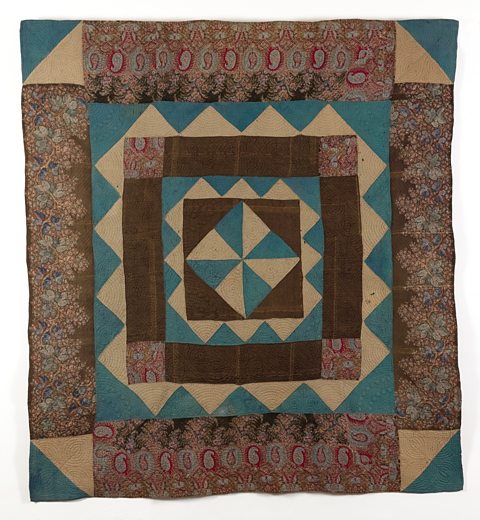
This Welsh patchwork quilt has a radiating pattern that is arranged around the centre in a series of squares.
At the centre is a pinwheel design made from contrasting blue-green and pale brown triangles.
Similarly-coloured triangles spread out in a series of bands that alternate with dark brown and patterned strips of fabric. Triangles at the corners act as arrows that lead our eyes out to the edges of the design.
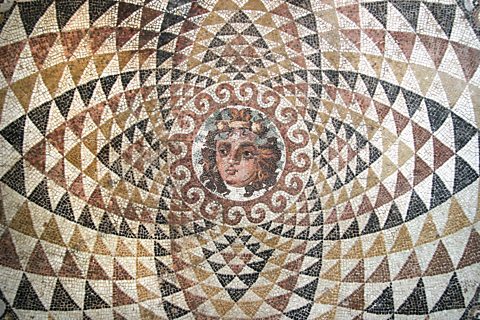
Mosaic of Dionysos from the floor of a Roman villa (c.2nd Century BC) has a radiating pattern. Small squares of tiles form coloured triangles. These triangles create petal shapes.
The sides of the triangles also make circles that spread out from the centre. These help emphasise the portrait of the god Dionysus in the middle of the pattern.
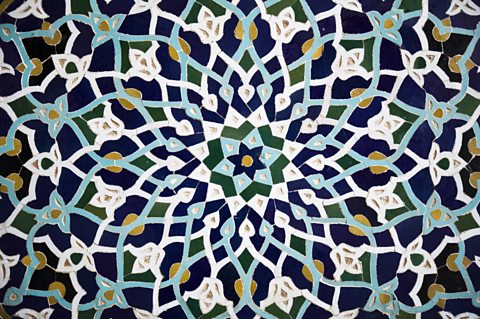
Islamic art is often based on Relating to geometry and featuring straight lines and regular mathematical shapes and forms such as squares, circles, triangles, cubes and spheres. shapes and patterns that suggest flowers and plants.
This tile pattern from inside the Jāmeh Mosque of Yazd, Iran (12th – 14th Century) has star or petal shapes that spread out from a central circle.
These radiate out to an A design based on intertwined flowing lines that originated in Islamic art. design of twisting and overlapping lines that create a complicated pattern of leaf and flower shapes.
