The recovery of the Republic, 1924–29
Gustav Stresemann and economic recovery
In 1923, the The name given to the German republic between 1919 and 1933. was on the verge of collapse socially and economically. But surprisingly, this crisis was followed by a period of relative stability and success. The period 1924-1929 was a time when the Weimar economy recovered and cultural life in Germany flourished.
This dramatic turnabout happened in large part because of the role played by Gustav Stresemann who became In the Weimar Republic, the Chancellor was the head of the government, appointed by the President. in August 1923 during the Very rapid and high increase in the level of prices, combined with a fall in the value of money. crisis. This was a time when prices in Germany went up quicker than people could spend their money and the German currency lost its value. Stresemann was Chancellor for only three months but continued to serve as Foreign Minister, rebuilding and restoring Germany’s international status until his death in October 1929, ironically just weeks before the The economic downturn on the American stock market in 1929. that would end Weimar’s period of greater prosperity and stability.
The end of hyperinflation
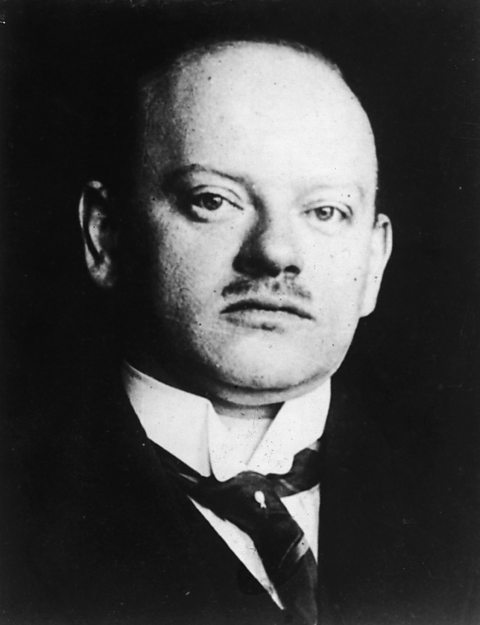
Stresemann’s single greatest achievement as Chancellor was to end hyperinflation. He did this in just three months by:
- Calling off the ‘To resist something by not cooperating, or refusing to follow instructions without using violence.’ of German workers in the The main industrial area of Germany.. This helped Germany’s economy because goods were back in production and the Government could stop printing money to pay striking workers.
- Promising to begin Monetary compensation from an individual, group or state to compensate victims. payments again. This persuaded France and Belgium to end the occupation of the Ruhr by 1925.
- Introducing a new currency called the Rentenmark. This stabilised prices as only a limited number were printed meaning money rose in value. This helped to restore confidence in the German economy both internally and internationally.
- Reducing the amount of money the government spent (700,000 government employees lost their jobs) so that its budget When a government spends more money than it collects in taxes. reduced.
Gustav Stresemann's Nobel Peace Prize speech
Renegotiating reparations
The payment of reparations, which had caused the hyperinflation crisis in the first place, had to resume, but Stresemann’s decisive actions in the autumn of 1923 gained Germany the sympathy of the During World War One, from 1917, the Allies were Great Britain, France, Russia, Italy, Japan and the USA. In World War Two the Allies initially included France, Poland and the UK but they were joined by USSR and USA. France was defeated in 1940 and further nations joined the group. However, Italy and Japan were enemies.. They agreed to renegotiate payments and this led to two new repayment plans in the next 5 years:
| The Dawes Plan | The Young Plan | |
| Date | Proposed April 1924, agreed September 1924 | Proposed August 1929, agreed January 1930 |
| Amount of reparations to be paid | Stayed the same overall (50 billion Marks) but Germany only had to pay 1 billion Marks per year for the first 5 years and 2.5 billion per year after that | Reduced the total amount by 20 per cent. Germany was to pay 2 billion Marks per year, two thirds of which could be postponed each year if necessary |
| Amount of time over which they would be paid | Indefinite | 59 years, with payments to end in 1988 |
| Loans made available to Germany | Germany was loaned 800 million Marks from the USA | US banks would continue to loan Germany money, coordinated by J P Morgan, one of the world’s leading bankers |
| Date | |
|---|---|
| The Dawes Plan | Proposed April 1924, agreed September 1924 |
| The Young Plan | Proposed August 1929, agreed January 1930 |
| Amount of reparations to be paid | |
|---|---|
| The Dawes Plan | Stayed the same overall (50 billion Marks) but Germany only had to pay 1 billion Marks per year for the first 5 years and 2.5 billion per year after that |
| The Young Plan | Reduced the total amount by 20 per cent. Germany was to pay 2 billion Marks per year, two thirds of which could be postponed each year if necessary |
| Amount of time over which they would be paid | |
|---|---|
| The Dawes Plan | Indefinite |
| The Young Plan | 59 years, with payments to end in 1988 |
| Loans made available to Germany | |
|---|---|
| The Dawes Plan | Germany was loaned 800 million Marks from the USA |
| The Young Plan | US banks would continue to loan Germany money, coordinated by J P Morgan, one of the world’s leading bankers |
Did the Weimar Republic economy really recover?
The years 1924 to 1929 have been referred to as Weimar’s ‘Golden Years’, but historians disagree as to just how much the German economy recovered from the effects of World War One and hyperinflation.
| Signs of recovery | Signs of continued weakness |
| By 1928 industrial production levels were higher than those of 1913 (before World War One) | But… agricultural production did not recover to its pre-war levels |
| Between 1925 and 1929 exports (sending goods or services abroad) rose by 40 per cent | But… it spent more on imports than it earned from exports, so Germany was losing money every year |
| Hourly wages rose every year from 1924 to 1929 and by 10 per cent in 1928 alone | But… unemployment did not fall below 1.3 million and in 1929 increased to 1.9 million |
| IG Farben, a German chemical manufacturing company, became the largest industrial company in Europe | But… German industry became dependent upon loans from the USA |
| Generous pension, health and unemployment insurance schemes were introduced from 1927 | But…The government ended up spending more than it received in taxes and so continued to run deficits from 1925 onwards |
| Signs of recovery | By 1928 industrial production levels were higher than those of 1913 (before World War One) |
|---|---|
| Signs of continued weakness | But… agricultural production did not recover to its pre-war levels |
| Signs of recovery | Between 1925 and 1929 exports (sending goods or services abroad) rose by 40 per cent |
|---|---|
| Signs of continued weakness | But… it spent more on imports than it earned from exports, so Germany was losing money every year |
| Signs of recovery | Hourly wages rose every year from 1924 to 1929 and by 10 per cent in 1928 alone |
|---|---|
| Signs of continued weakness | But… unemployment did not fall below 1.3 million and in 1929 increased to 1.9 million |
| Signs of recovery | IG Farben, a German chemical manufacturing company, became the largest industrial company in Europe |
|---|---|
| Signs of continued weakness | But… German industry became dependent upon loans from the USA |
| Signs of recovery | Generous pension, health and unemployment insurance schemes were introduced from 1927 |
|---|---|
| Signs of continued weakness | But…The government ended up spending more than it received in taxes and so continued to run deficits from 1925 onwards |
More guides on this topic
- Weimar Germany overview - Edexcel
- QUIZ: A History of the Weimar Republic
- Hitler's rise to power, 1919-1933 - Edexcel
- QUIZ: Rise of the Nazi Party
- Nazi control and dictatorship 1933-1939 - Edexcel
- QUIZ: Creation of a dictatorship
- Life in Nazi Germany, 1933-1939 - Edexcel
- QUIZ: Women, minorities and living standards in Nazi Germany
- Weimar Germany - exam preparation - Edexcel
