Collecting data – capture/recapture technique (Higher tier only)
The quadrat method is not practical when attempting to estimate the population of animals in an area. They are sometimes fast moving and can be scared off by quadrats landing nearby.
A better way to estimate the population size of an animal species is the capture-mark-recapture method:
- animals are captured, eg using pitfall traps
- they are counted and marked in a harmless, inconspicuous way and then released
- traps are used again a few days later to recapture a sample of animals
- the numbers of marked and unmarked animals caught in the traps are recorded
Once the data has been collected, the following equation can be used to estimate the population of insects in a particular habitat.
\(\frac{{\text{Number~found~in~1st~sample}}\times{\text{Number~found~in~2nd~sample}}}{\text{Number~found~in~2nd~sample~which~were~already~marked}}\)
Question
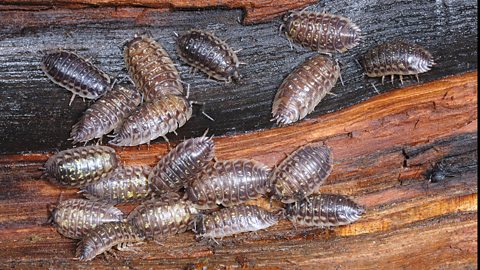
Alistair is attempting to estimate how many woodlice are living at the bottom of his garden. He sits for one hour collecting every woodlouse he sees. He counts 26 and marks their backs with a small amount of paint. He releases them where he found them. A week later he repeats the exercise at the same time of day for one hour. He recaptured 25 woodlice, 15 of which were marked with a small spot of paint.
Using the equation, what is the estimate number of woodlice in the area?
\(\frac{{26}\times{25}}{15}={43}\)
Question
What must Alistair assume for this result to be deemed accurate (close to the true value)?
- There was no immigration or emigration during the time between the samples being taken.
- The marking of the organism neither directly harmed the organism nor made it easier for it to be seen by predators.
More guides on this topic
- Cell division and stem cells – WJEC
- Interactive activity: Mitosis - WJEC
- DNA and inheritance – WJEC
- Variation – WJEC
- Mutation – WJEC
- Evolution – WJEC
- The nervous system – WJEC
- Homeostasis – WJEC
- The role of the kidneys in homeostasis – WJEC
- Micro-organisms and their applications – WJEC
- Disease, defence and treatment – WJEC
- Video playlist
