Chemical properties of the group 1 elements
The smallest part of an element that can exist. of The first vertical column of elements in the periodic table, starting with lithium and ending with francium. Also called the alkali metals.A substance made of one type of atom only. all have one Subatomic particle, with a negative charge and a negligible mass relative to protons and neutrons. in their outer shell. This means that the alkali metals all have similar A description of how a substance reacts with other substances. For example, flammability, pH, reaction with acid, etc..
Reaction with moist air
Group 1 elements react with moist air. They are stored in oil to stop air and water vapour coming into contact with them. Moist air reacts with potassium to form potassium oxide. This creates a layer over the surface of the metal.
Reactions with water
The alkali metals react with water to produce a metal hydroxide and hydrogen. For example, sodium reacts with water:
sodium + water → sodium hydroxide + hydrogen
2Na(s) + 2H2O(l) → 2NaOH(aq) + H2(g)
Sodium hydroxide is an A base which is soluble in water.. It is a A substance that reacts with an acid to neutralise it and produce a salt. that When a substance breaks up and mixes completely with a solvent to produce a solution. in water to form an Having a pH greater than 7.Mixture formed by a solute and a solvent.. This solution:
- has a Scale of acidity or alkalinity. A pH (power of hydrogen) value below 7 is acidic, a pH value above 7 is alkaline. greater than 7
- turns A chemical solution that produces many different colour changes corresponding to different pH levels. solution blue or purple
Question
Write the An equation in which only the names of the reactants and products are used to model a reaction. and A chemical equation written using the symbols and formulae of the reactants and products, so that the number of units of each element present is the same on both sides of the arrow. for the reaction of potassium with water.
potassium + water → potassium hydroxide + hydrogen
2K(s) + 2H2O(l) → 2KOH(aq) + H2(g)
Reactions compared
The table shows the main observations when lithium, sodium and potassium are added to water.
These observations may be used to find a pattern in the A measure of how vigorously a substance will react. The more reactive it is, the greater its reactivity and the more vigorous its reactions will be. of the group 1 elements.
These observations show that the reactivity of these metals increases going down the group.
| Group 1 element | Observations |
| Lithium, Li | Fizzes steadily, and slowly becomes smaller until it has all reacted |
| Sodium, Na | Melts to form a ball, fizzes rapidly, and quickly becomes smaller until it disappears |
| Potassium, K | Quickly melts to form a ball, burns violently with sparks and a lilac flame, and reacts rapidly, often with a small explosion |
| Group 1 element | Lithium, Li |
|---|---|
| Observations | Fizzes steadily, and slowly becomes smaller until it has all reacted |
| Group 1 element | Sodium, Na |
|---|---|
| Observations | Melts to form a ball, fizzes rapidly, and quickly becomes smaller until it disappears |
| Group 1 element | Potassium, K |
|---|---|
| Observations | Quickly melts to form a ball, burns violently with sparks and a lilac flame, and reacts rapidly, often with a small explosion |
Example
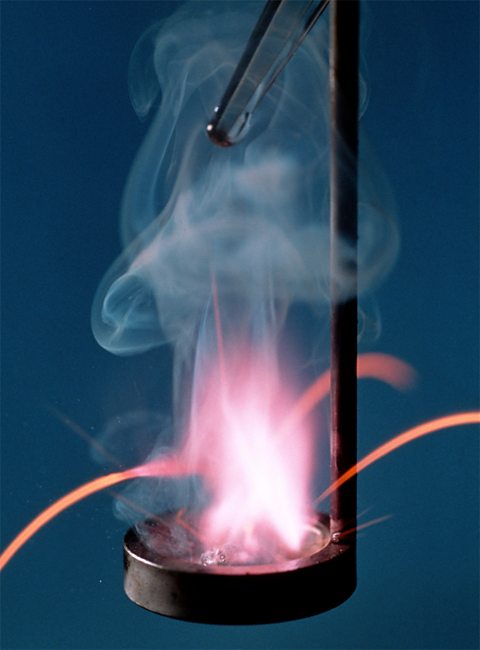
Rubidium is placed below potassium in group 1. Predict what is seen when rubidium is added to water.
Rubidium should melt very quickly. It should burn very violently, and react almost instantly with an explosion.
Reaction with chlorine
The group 1 metals all react with chlorine to produce chlorides. The chlorides are all white solids at room temperature, and dissolve in water to make a When a substance is neither acidic nor alkaline, and has a pH of 7.Mixture formed by a solute and a solvent..
Sodium + chlorine → sodium chloride
2Na(s) + Cl2(g) → 2NaCl(s)
The reactions get more vigorous going down the group.
