Refraction and angle of incidence
When a ray of light is incident at normal incidence, (at right angles), to the surface between two optical materials, the ray travels in a straight line.
When the ray is incident at any other angle, the ray changes direction as it refracts.
The dotted line is the normal (perpendicular) to the surface. In refraction calculations, angles are always measured between rays and the normal.
The change in direction of a ray depends on the change in the speed of the light and can be used to calculate the refractive index.
For the example above the refractive index \(n\) of the glass is given by \(n=\frac{sin\theta _{1}}{sin\theta _{2}}\)
When you use this relationship, angle \(\theta _{1}\) must always be the angle in a vacuum (or air).
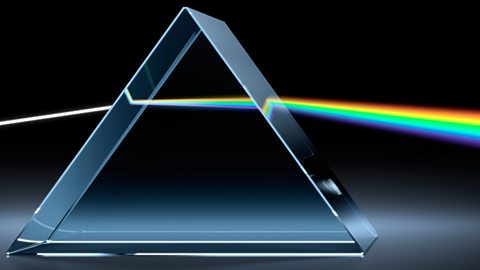
Refractive index depends on the frequency or colour of light. Light of higher frequency has a greater refractive index than lower frequency light. This explains why a prism can disperse white light into different colours.
The change in refraction is quite small and is only significant for some geometries.
Question
A ray of light is incident on the surface of water as shown in the diagram.
State whether the light travels faster in air or water.
The light travels faster in air as the angle of incidence \(50^\circ\) is greater than the angle of refraction \(\theta\).
Question
Now calculate the angle of refraction of the ray.
We know that:
\(\theta _{1}=50^\circ\)
\(n_{water} = 1.33\)
And:
\(n=\frac{sin\theta _{1}}{sin\theta _{2}}\)
\(1.33=\frac{sin50^\circ}{sin\theta}\)
Therefore \(\sin \theta =0.5759732\)
\(\theta =35.1678\)
Angle of refraction \(=35^\circ\)
