Gear systems
A wheel with teeth that can change the speed of a mechanism. are wheels with Projecting part of a component such as a gear. around the outside, the simplest form of which is a spur gear. When several wheels are interlocked, they can transfer motion from one place to another, eg in some hand whisks or on bikes.

Gears can change the direction or the speed of movement. As there are teeth around the edge of the gears they grip together and so can withstand a greater force, enabling them to move large items such as cars or bicycles.
Gear trains
Two or more gears interlocking together. are when two or more gears are joined together. In a simple gear train, the The starting gear in a gear train that causes all other movement. causes the Transfers motion from the drive gear. to turn in the opposite direction.
Smaller gears with fewer teeth turn faster than larger gears with more teeth. This difference in speed is called the The number of turns the driven gear will make for every turn of the drive gear..
Example - Gearing down
The drive gear has 15 teeth and the driven gear has 60 teeth.
The gear ratio is calculated by
Teeth on driven gear ÷ Teeth on drive gear
= 60 ÷ 15
= 4
This means that every time the drive gear turns four times, the driven gear would rotate once.
Gear ratio = 4:1
This is known as A gear arrangement where the driven gear rotates fewer times than the drive gear. because the driven gear rotates fewer times than the drive gear
Example - Gearing up
The reverse of A gear arrangement where the driven gear rotates fewer times than the drive gear. is called A gear arrangement where the driven gear rotates more times than the drive gear.. Here, the driven gear rotates more than the drive gear.
The drive gear has 60 teeth and the driven gear has 15 teeth.
Gear ratio = Teeth on driven gear ÷ teeth on drive gear
= 15 ÷ 60
= 0.25
This means that every time the drive gear turns a quarter (0.25), the driven gear turns once.
The gear ratio is then expressed as:
Rotations of a drive gear : Rotations of a driven gear
0.25:1
Multiply both sides of the ratio by four to avoid having a decimal in our ratio. The ratio is then 1:4.
Question
If a cyclist is pedalling with a driven gear of 50 teeth and a drive gear of 25 teeth, what is the gear ratio?
Gear ratio = 50 ÷ 25
= 2
Gear ratio = 2:1
If the drive gear and the driven gear are separated by another gear, called the A gear that can be placed between two other gears to ensure the input and output gears rotate in the same direction., they will move in the same direction.
Rack and pinion
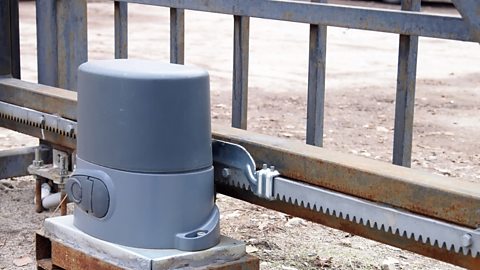
The A rack is a horizontal rail with teeth that fit the teeth of the round pinion. This arrangement turns rotary motion into linear. is a gear system that changes rotary motion to linear. The pinion is fixed onto a shaft and when it rotates the rack moves in a straight line.
A good example of a rack and pinion gear system is in electric sliding garden gates. The pinion is fixed in place on a motor and the rack runs along the base of the gate. Each time the motor turns the pinion, the gate passes over the top. As the motor can turn in two different directions, the gate can both open and close.