Testing for alkanes and alkenes
Bromine water
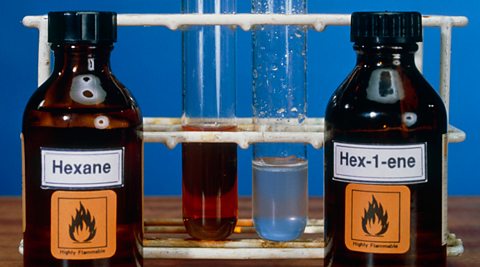
You can use bromine water, which is an orange solution, to distinguish between alkanes and alkenes.
Addition reactions with different reactants
Alkenes can react with different types of chemicals during addition reactions.
Alkene + hydrogen → alkane
This process is called hydrogenation, and it requires a catalyst.
For example:
propene + hydrogen → propane
Alkene + water (steam) → alcohol
This process is called Chemical reaction in which water reacts with a substance.. It requires a temperature of approximately 300°C and a A substance that increases the rate of a chemical reaction without being used up..
For example:
ethene + water (steam) → alcohol
Chlorine, bromine or iodine can be added to an alkene. These reactions are usually spontaneous. Here are some examples (you would not be expected to name the product of any of these reactions but you would be expected to draw it or write its formula)
ethene + chlorine → 1,2-dichloroethane
ethane + iodine →1,2-diiodoethane
