Local area network hardware
To connect a computer or device to a A group of interconnected computers/devices., several The physical parts of a computer system, eg a graphics card, hard disk drive or CD drive. components are required:
- a A circuit board that is installed in a computer so it can be connected to a network. or A connection that does not need wires and transmits data through radio signals. network interface controller
- a transmission Physical devices that are used to transfer data., either A connection that needs wires or cables to transmit data. or wireless
- a point to connect to, such as a A device for connecting computers and other network capable devices together to form a network., A piece of hardware used in computer networks used to connect multiple devices., A device for connecting computers and other network capable devices together to form a network. or A device that connects computers to a network using Wi-Fi.
Network interface cards
A network interface card (NIC) offers an interface port for a wired connection. A wireless NIC provides a radio A device that transmits and receives messages. for connecting wirelessly.
Most modern PCs come with a NIC and wireless NIC built-in, providing the option of either connection method. However, mobile devices such as tablets, smartphones and many embedded devices only feature a wireless NIC, giving only wireless connection.
Network connection devices
A network connection device allows computers to connect to a network. There are two types of connection device to consider:
- switches
- routers
Switches
Switches are network devices that record which computers are connected to which ports. When traffic is received, the switch forwards the traffic to its intended recipient only. This improves network performance by cutting down on unnecessary transmissions from older style networks.
Routers
Routers are one of the most commonly used connection devices. They are used to send Units of information. In computing there can be different data types, including integers, characters and Boolean. Data is often acted on by instructions. signals across the internet. Routers work by collecting knowledge of available routes to transmit data. They then determine the most suitable route for sending data.
Routers are also commonly used in homes. These types of router usually contain additional hardware that allows a network to be formed. Additionally, they contain a Meaning 'modulator/demodulator'. Allows computers to connect to a network over a telephone line., which allows users to connect to the internet.
Transmission media
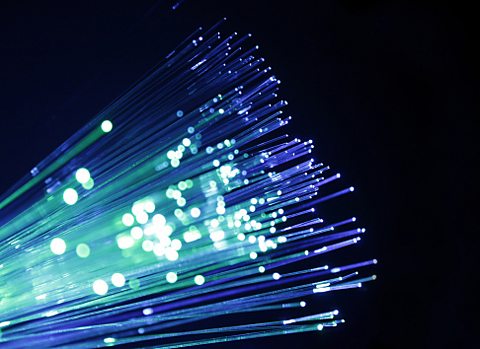
Transmission media carry data signals from one computer to another. Media are either wired or wireless.
In modern networks, wired media use either twisted copper wiring, or Cable that carries data transmitted as light..
Each wired medium has differing characteristics.
| Twisted copper wire | Fibre-optic cable | |
| Cost | Cheaper to purchase and install | More expensive to purchase and install |
| Maximum transmission speed | Up to 10 gigabits per second | Up to 100 gigabits per second |
| Maximum distance for reliable communication | Up to 100 metres | Over 2 kilometres |
| Cost | |
| Twisted copper wire | Cheaper to purchase and install |
| Fibre-optic cable | More expensive to purchase and install |
| Maximum transmission speed | |
| Twisted copper wire | Up to 10 gigabits per second |
| Fibre-optic cable | Up to 100 gigabits per second |
| Maximum distance for reliable communication | |
| Twisted copper wire | Up to 100 metres |
| Fibre-optic cable | Over 2 kilometres |
Wireless access points
A wireless access point (WAP) uses a radio transceiver to allow wireless connections to a network. In effect, the WAP creates its own wireless network, which devices connect to. The WAP then sends the wireless traffic it receives on to the main wired network.
WAPs can also be used to extend the range of a wireless network. In this case, the WAP can either receive or transmit traffic to other WAPs, or it can be connected via a cable to the main network.
More guides on this topic
- Computer systems - AQA
- Classification of programming languages and translators - AQA
- Systems architecture - AQA
- Network topologies, protocols and layers - AQA
- Fundamentals of cyber security - AQA
- Relational databases and structured query language (SQL) - AQA
- Ethical, legal and environmental impacts of digital technology - AQA
