The crucifixion (Matthew 27:32-44)
A man from Cyrene named Simon was forced to carry Jesus’ cross. They came to a place called Golgotha, which means ‘the place of the skull’. There they offered Jesus wine mixed with a bitter substance - but after tasting it, he would not drink it.
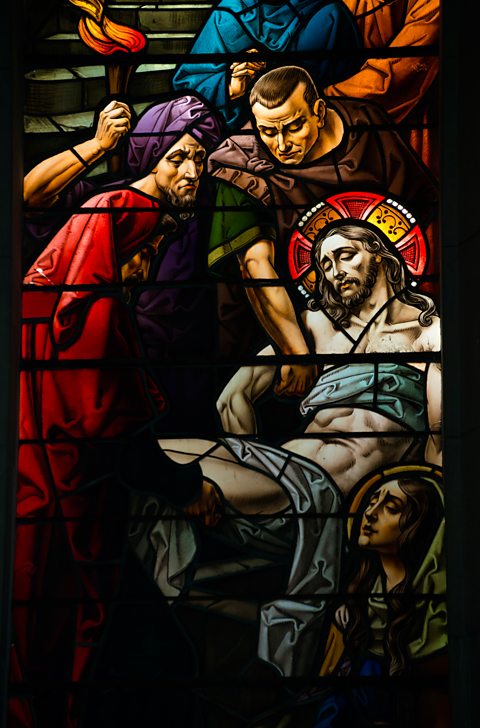
They crucified him and then divided his clothes among them by throwing dice. Above his head they put a sign saying, “This is Jesus, the King of the Jews.” Then they crucified two bandits with Jesus.
People passing by hurled insults at Jesus. The chief priests and the teachers of the law and the elders made fun of him, “He saved others, but he cannot save himself! He trusts in God and claims to be God's Son. Well, then, let us see if God wants to save him now!” Even the bandits who had been crucified with Jesus insulted him.
Background
Crucifixion was widely used by the Romans at the time of Jesus as a means of execution. It must have been one of the cruellest and most degrading forms of death. As it was also a public spectacle, it was intended to deter others from committing similar crimes.
The methods of crucifixion varied, but the principal was always the same. The prisoner was attached to a wooden cross by means of nails through the hands and feet or the wrists and ankles. Sometimes rope was used as well as nails to secure the victim. The outstretched arms, taking most of the weight of the body, put great strain on the ribcage. This meant that the prisoner, already weak from loss of blood, died slowly from suffocation. Sometimes the victim’s legs were broken to speed up their death, but this was not necessary in Jesus’ case.
Understanding the text
It was usual to force the prisoner to carry the cross-beam to the site of crucifixion. Jesus, however, had to have help. This was probably because he was already so weak from the torturing and whipping. The soldiers forced Simon of Cyrene to carry the cross to Golgotha – the place of the skull.
The drink of wine and gall (a bitter plant-based substance) which Jesus was offered was a type of painkiller, but he refused it.
It was the custom for the prisoner’s crime to be written on a sign and attached to the cross. Jesus’ sign said “This is Jesus, the King of the Jews”. The letters INRI appear in traditional pictures of the crucifixion. These are the four initial letters from the Latin translation of the sign – Iesus Nazerenus Rex Iudaeorum.
Jesus’ crucifixion has fulfilled The first part of the Christian Bible which corresponds to the Hebrew Bible but is arranged differently. prophecies. As the soldiers cast lots for Jesus’ clothes, Matthew’s readers would remember the words of Psalm 22:18, “They divided my garments among themselves and cast lots for my clothing.”
Jesus was crucified with two thieves, fulfilling a prophecy of A prophetic book within the Hebrew Bible. that God’s suffering servant would be treated like a criminal.
As Jesus was dying on the cross he was mocked by the people passing by, the Jewish leaders and the two robbers also being crucified. They laughed at his weakness and reminded him about his claims to have the power of God.
