Evolution by natural selection
An adaptation is a characteristic of an organism that improves its chances of surviving and/or reproducing.
Organisms are generally well adapted to the abiotic and biotic conditions of the environment in which they live.
An organism’s A feature of an organism's body which helps it to survive. are a result of the genes the organism inherits from its parents.
The proportion of well-adapted organisms in a population can increase over the generations by the process of evolution by natural selection.
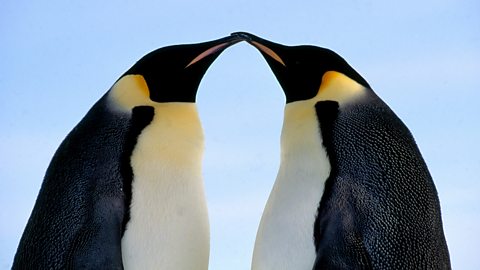
Two emperor penguins
There are three different types of adaptations:
- The way an animal acts or behaves to improve its chance of survival and reproduction. - responses made by an organism that help it to survive/reproduce
- Physiological - a body process that helps an organism to survive/reproduce
- Structural - a feature of an organism’s body that helps it to survive/reproduce
Example
The Emperor Penguin lives in the Antarctic environment which is very cold. The ground is covered in ice and snow and food is only available in the sea.
