Reactions of alkenes
Like the Saturated hydrocarbon. A compound of hydrogen and carbon only, with no C=C bonds., the Unsaturated hydrocarbon with a double bond between the carbon atoms. undergo The process of burning by heat.. However, alkenes are less likely to combust Burning in a plentiful supply of oxygen or air. Complete combustion of a hydrocarbon produces water vapour and carbon dioxide., so they tend to burn in air with a smoky flame due to Burning when there is a limited supply of air or oxygen..
Addition reactions of alkenes
The An atom, or group of atoms, that determines the main chemical properties of an organic compound., C=C, allows alkenes to undergo addition reactions. For example, ethene reacts with bromine to form 1,2-dibromoethane:
CH2=CH2 + Br2 → CH2BrCH2Br
It is easier to see what happens using structures with all their A bond between atoms formed when atoms share electrons to achieve a full outer shell of electrons.:
The reaction is an ‘addition’ reaction because one A collection of two or more atoms held together by chemical bonds. combines with another molecule, forming one larger molecule and no other A substance formed in a chemical reaction..
Alkanes cannot take part in addition reactions.
Worked example
Propene, CH3CH=CH2, reacts with bromine. Predict the structure of the product formed.
The structure will be: CH3CHBrCH2Br.
Question
But-1-ene, CH2=CHCH2CH3, reacts with bromine. Predict the structure of the product formed.
The structure will be: CH2BrCHBrCH2CH3.
Testing for alkanes and alkenes
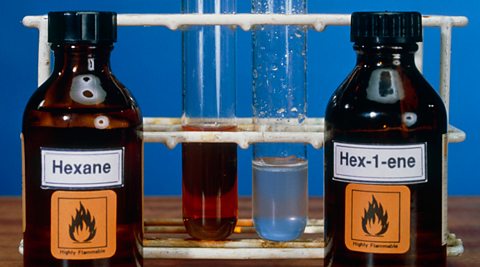
An orange-brown solution of bromine dissolved in water, called bromine water, is used to distinguish between alkanes and alkenes:
- there is no change when bromine water is mixed with an alkane
- the bromine water becomes colourless when it is mixed with an alkene
Addition reactions with different reactants
Alkenes can react with different types of chemicals during addition reactions.
Alkene + hydrogen → alkane
This is called An addition reaction in which diatomic hydrogen molecules are added across carbon to carbon double bonds., and it needs a A person or thing that causes an event or change..
For example:
Propene + hydrogen → propane
Alkene + water (steam) → alcohol
This is called Chemical reaction in which water reacts with a substance., and it needs a temperature of approximately 300°C and a catalyst.
For example:
Butene + water → butanol
Alkene + halogen → halogenoalkane
Chlorine, bromine or iodine can be added to an alkene. These reactions are usually spontaneous. Here are some examples:
Ethene + chlorine → dichloroethane
Ethene + iodine → diiodoethane
