Jazz
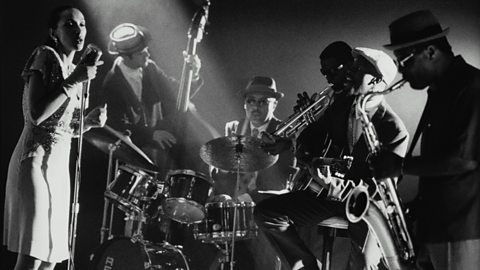
Jazz emerged as a new style of music in the early twentieth century in the African American communities of New Orleans. Jazz has its origins in blues and ragtime.
Jazz features lots of improvisation, which requires musicians to:
- creatively explore and experiment with sound
- express themselves
- listening carefully to themselves and the people they make music with
- respond to the improvisation of people they are playing with
All of this is done spontaneously, with musicians having to react in real time to what is going on around them.
Syncopation is a common feature in the rhythm. This is where emphasis is put on rhythms that are off the beat.
There are many different styles of jazz, eg:
- trad, New Orleans or Dixieland jazz - style originating from music played in New Orleans in the early 20th Century
- bebop - style from the 1940s featuring fast The speed or pace of performance in speech, dance or music., complex harmonies and lots of improvisation
- cool jazz - a more laid back style from the late 1940s
- Latin jazz - jazz featuring rhythms from Latin American music
- jazz fusion - style from the late 1960s that mixes jazz with blues, funk, rock and other styles
The original New Orleans trad jazz style would have typical instrumentation of:
- trumpet or cornet
- trombone
- clarinet
- banjo
- double bass or tuba
- drum kit
The texture in New Orleans, or Dixieland, jazz was very With two or more melodies playing together and contained lots of improvisation. This means that there were lots of parts weaving in and out of each other.
Trombone glissando - sliding between notes - was a feature in this style of jazz and was known as ‘tailgate trombone’.
When the Saints Go Marching In performed by Louis Armstrong
Blues notes
Some notes used in jazz music may be flattened by a semitone. These are normally the third, fifth or seventh notes of the scale.
Musicians playing jazz sometimes use pentatonic scales and blues scales to play improvisations.
Jazz music can be played by lots of different types of instruments and by different sizes of band. A twenty-piece big band is made up of trumpets, trombones, saxophones, rhythm section and sometimes a vocalist. A jazz trio often contains a piano or other instrument to play the melody, with double bass and drums providing the rhythm.
Listen to the Soweto Kinch trio - comprising of saxophone, drum kit and double bass - perform the jazz standard 'A Night in Tunisia'.
This track features improvisation and, although remaining in simple time throughout, alternates from a straight feel to a swing feel. Listen out for when it changes from one to the other.
Soweto Kinch playing ‘A Night in Tunisia’, which features Jazz improvisation
