Punishment in early modern England
A range of punishments were used in early modern England. These were intended to humiliate criminals, act as A punishment inflicted on someone for a crime or wrong doing, revenge, or ‘paying the criminal back' for their crimes. or The action of discouraging someone from doing something or preventing something from happening - often by creating a fear of the consequences. inflict pain on the criminal, or remove the criminal altogether - much as had been the case since the Anglo-Saxon period.
Continuity in punishments
Many punishments from medieval England continued to be used:
- Fines continued to be the most common punishment given. Fines were used to punish swearing, gambling and failure to attend church. They acted as a form of deterrence.
- The A wooden frame with holes to hold the feet of someone convicted of a crime. and A wooden frame with holes to hold the head and hands of someone convicted of a crime. continued to be used to publicly shame and humiliate those accused of cheating at games, persistent swearing, selling underweight bread and repeated drunkenness. If the crowd were angry about the crime, they would throw rotten food and perhaps stones at the offender.
- Corporal punishment, in the form of whipping in public, continued to be used to humiliate and deter criminals. Whipping was often used to punish Homeless, unemployed person who wandered the streets. and those who had been convicted of petty theft.
- The death penalty continued to be used to punish the most serious crimes. These included murder, To betray or plot against the government or monarchy.Illegal hunting or fishing.Moving goods illegally from one place to another.In a historical context, this was thought to be a kind of magic that could be used to cause harm to people or property. Witches were often accused of obtaining their power from the Devil. and Deliberately setting fire to something, which is a crime.
- The crime of To disagree with, or refuse to follow the religious views of the monarch or the state. was punished by burning at the stake.
- Prisons continued to be used to house offenders awaiting trial or for those who had failed to pay off a debt. They were often a secure room in the local castle or gatehouse. Prisons were rarely used as a punishment on their own.
The ‘Tyburn Tree’. Here, gallows were built in 1571 so that several criminals could be hanged at once
Change in punishments
New punishments were introduced in early modern England:
- By the late 1500s, houses of correction were being built in towns to punish vagrants and repeat offenders with hard Work. and whipping. The first was established in 1556 in Bridewell Palace, London. It was used to punish poor people who had broken the law and to house poor homeless children and orphans. Conditions were very bad and ‘prisoners’ paid their own keep. It was believed that hard work would persuade offenders to change their behaviour. By the 17th century, similar prisons had been established in London and across the country. They were often called Bridewells, after the first house of correction.
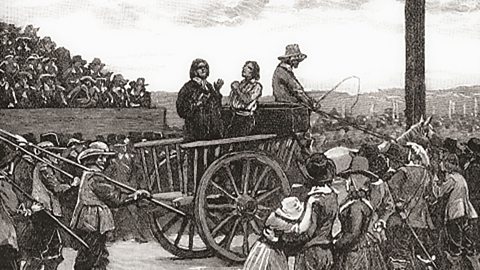
- Carting was used to punish those convicted of vagrancy and Sexual intercourse between a married person and another person who is not their spouse. The offender was dragged around the streets on a cart to humiliate them and deter any further crime.
- To send a convicted criminal to a prison camp overseas, such as in America or Australia. was used as a punishment from the 1660s. It was an effective deterrent at a time when formal prisons did not exist. It was also a form of community retribution. Those convicted of murder escaped death but were sent to the new colony of America to help build settlements. Once their sentence was completed, they were forbidden to return to England. As many as 80,000 people were transported to America, including men, women and children. In 1618 James I gave permission for vagrant children to be transported because the homeless were seen as a source of A very infectious disease. and criminality. It was argued that these children, known as ‘duty boys’, could start a new life in America. However, many died as conditions on the ships and in the colonies were extremely harsh.
- In 1688 there was a change to the law and the Bloody Code was introduced. This increased the number of capital crimes - crimes that were punished with the death penalty. In 1688 there were 50 capital crimes. Some of them seem minor today, such as poaching rabbit or fish to feed a family. The number increased to 160 by 1765 and 225 by 1815.
