Maths questions
Don't forget to take a ruler and scientific calculator into the exam.
Maths questions often start with the command word 'calculate'. You need to use numbers given in the question to work out the answer.
When an answer to a maths question is marked:
- full marks are given for the right answer
- marks may be given for working, including substitution and rearrangement
- calculation errors carried forward are worked through to give credit for later working
Make sure you give answers to a suitable number of significant figures.
Maths questions might ask you to plot or complete a graph or table. When you draw a graph, make sure you:
- plot each point accurately
- draw a best fit straight line or curve, where appropriate
You may be given a grid with axes labelled and scales already given. Sometimes you may be given an empty grid for you to supply your own axes. When you do this:
- put the independent variable on the x-axis and the dependent variable on the y-axis
- choose even scales and make sure that the points cover at least half the given grid
- label the axes with their quantity and unit, eg time (s)
Take extra care when converting between units.
This page contains AQA material which is reproduced by permission of AQA.
Sample question 1 – Foundation
Question
Scientists investigated the effect of light intensity on the rate of photosynthesis.
The graph below shows the scientists' results.
Describe the effect of increasing light intensity on the rate of photosynthesis.
You should include numbers from the graph in your description. [3 marks]
These terms should be used to gain all marks:
- increases [1]
- levels off / reaches a maximum / remains constant / stays the same / plateaus [1]
- goes up to / reaches a maximum / levels off at 200 (arbitrary units) or levels off at 225-240 light units [1]
Sample question 2 – Foundation
Question
An athlete is running on a treadmill.
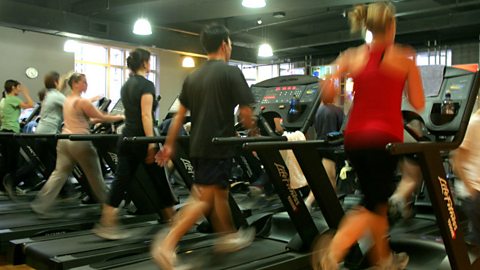
After running for several minutes, the athlete's leg muscles began to ache.
This ache was caused by a high concentration of lactic acid in the muscles.
Scientists investigated the production of lactic acid by an athlete running at different speeds.
In the investigation:
- the athlete ran on the treadmill at 4 km per hour
- the scientists measured the concentration of lactic acid in the athlete's blood after 2 minutes of running
The investigation was repeated for different running speeds.
The scientists' results are presented in the graph below.
How much more lactic acid was there in the athlete's blood when he ran at 14 km per hour than when he ran at 8 km per hour? [2 marks]
4.4 mmol per dm3 [2]
Correct readings from graph in the ranges of 6.7 to 6.9 and 2.3 to 2.5, but no answer or a wrong answer gains 1 mark.
Question 3 – Higher
Question
The nervous system allows humans to respond to their surroundings.
The figure below shows two nerve pathways.
Nerve pathway A is 92 cm long.
A nerve impulse travels along pathway A at 76.2 m/s.
Calculate how long it takes for the nerve impulse to travel the length of the pathway.
Use the equation:
distance = speed × time
0.92 = 76.2 × time [1]
time = 0.92 ÷ 76.2 [1]
= 0.012 s/sec/seconds [1]
Question 4 – Higher
Two students compare their reactions using a ruler.
This is the method used.
- Student A sits with his elbow on a table top.
- Student B holds the ruler so the bottom of the ruler is level with the top of student A's thumb.
- Student B drops the ruler.
- Student A catches the ruler.
- Record the drop distance.
- Repeat steps 1 to 5 four more times.
- Repeat the whole experiment with student A dropping the ruler and student B catching it.
Both students are right-handed.
The students are testing the hypothesis:
The drop distance of the ruler is smaller when a right-handed person uses their right hand to catch the ruler.
Student A uses his right hand to catch the ruler.
Student B uses her left hand to catch the ruler.
The table shows the students' results.
The drop distance is measured in mm.
| Test 1 | Test 2 | Test 3 | Test 4 | Test 5 | |
| Student A – right hand | 203 | 167 | 140 | 156 | 163 |
| Student B – left hand | 230 | 211 | 279 | 215 | 264 |
| Student A – right hand | |
|---|---|
| Test 1 | 203 |
| Test 2 | 167 |
| Test 3 | 140 |
| Test 4 | 156 |
| Test 5 | 163 |
| Student B – left hand | |
|---|---|
| Test 1 | 230 |
| Test 2 | 211 |
| Test 3 | 279 |
| Test 4 | 215 |
| Test 5 | 264 |
Question
a) What is the range of student A's results? [1 mark]
140 – 203 [1]
Question
b) Student A's mean reaction time was 0.19 s.
Mean reaction time can be calculated using the equation:
\(\text{Mean reaction time} = \sqrt{\frac{2 \times \text{mean drop distance in mm}}{9.8 \text{m/s}^{2}}}\)
Calculate the mean reaction time for student B.
Give your answer to 2 significant figures. [4 marks]
Mean drop distance = (230 + 211 + 279 + 215 + 264) ÷ 5 = 239.8 [1]
239.8 mm = 0.2398 m
mean reaction time = \( \sqrt{\frac{2 \times 0.2398}{9.8}}\) [2]
= 0.221 seconds [1]
