This article was first published in May 2021.
He’s the life and soul of the party, the happy-go-lucky reality star who has entertained us on screen for years.
But away from the camera, Joey Essex has been dealing with something incredibly difficult since his childhood. When he was just 10 years old, his mother passed away suddenly.
A new BBC Three documentary Joey Essex: Grief and Me will see Joey explore the impact his mother’s death had upon him and why he struggled to ever really process it.
Joey spoke to BBC Bitesize about the programme and why he wants to show other young people in similar situations that they’re not alone.
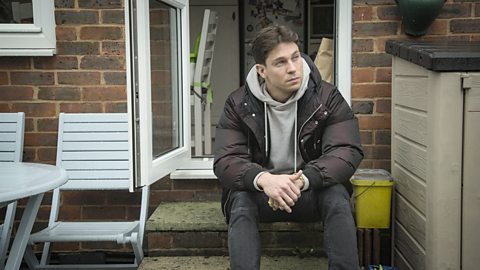
School days
Starting secondary school is a big deal for any child.
But that change was tougher for Joey than most, following his mother’s death.
Joey said: “I know there's never a good time. But it was a time in my life where a big transition was happening.
“[I was] a mummy’s boy. And then all of a sudden, that’s disappearing out of your life, then [you’re] having to start something else.
“How are you supposed to deal with it? There is no way to deal with it.”
Joey recalls walking into school for the very first time, seeing everyone else trying to make new friends and feeling like the odd one out: “I felt like I was different from everyone else. I knew that everyone else was excited, and that I wasn't.” The thought of what had happened at home, says Joey, was always at the back of his mind.
Struggling to process his thoughts and feelings, Joey chose to ignore them – something he now acknowledges wasn’t necessarily the right choice and led to his school life being incredibly tough. School was something Joey did “because I had to. And that was it.
“Everything that probably would have upset me in school didn't upset me,” he said. “The only thing I was upset about is my mum. It was just I had that mental state of mind.”

Where to find support
Losing someone can be extremely difficult and grief can affect your mental health. If you are struggling, you can access simple steps to help you cope with your feelings at Child Bereavement UK. You can also find counselling and support at Young Minds.
Joey bottled up his feelings and internalised his grief, something which continued into his adult life. He found it difficult to talk about his mum and couldn’t even have pictures of her in his house.
He found himself feeling very angry, which wasn’t typical Joey. He says he used those feelings to keep going, particularly around typical classroom banter.
“I'm very strong minded. It’s like an anger, to be honest.
“I keep saying I'm not an angry person, but I had this anger in me as a kid, and it was like a strength. I used it as a strength in the fight.”
Processing emotions
In the documentary, Joey speaks with a clinical psychologist to help him come to terms with his grief.
One of the main things he has learned, is just how different things could have been, if he’d spoken about his feelings, rather than hide them away.
He said: “I suffered for a long time when I probably didn't need to, but at the time that was my only way.
“It's like anything isn't it? It's like being truthful with life, with anyone, with relationships, your girlfriend or with your family, just be honest and be truthful.
“And it's not that my family isn't close to me. I didn't want to open up, I didn't want talk even with my family. It was just a closed situation.”

Joey said bottling things up probably caused him more pain than necessary. Around 41,000 young people lose a parent each year – Joey is keen to encourage some of those people to take a different path in the face of tragedy, if they’re able to.
“I feel like you've got to be as open as possible," he said.
“It hurts. Of course it does, but it will never stop hurting until you fully understand. It might be very painful to start but it'll only get better.
“If you hold it in, it'll just be painful for a longer time and then you'll end up meeting that point in your life where you will end up having to open up anyway. Just like [me] now.
“I've just dealt with pain for a long time, I could have dealt with it for a much shorter time but I was just too scared and too worried to admit to myself.”
After opening up in the course of the filming of the documentary, Joey feels in a much better place. He now embraces having pictures of his mother in his home and says he wants to support young people who have experienced similar pain.
“It's like a mission. You've got to just go to that one person, just say ‘I need to talk to you, I need to say everything and I want you to talk to me about it’."
Joey added: “It’s only going to get easier, the quicker you start the mission. Once you start the mission, things will only get better because you start telling the truth and opening up and admitting to yourself that you are hurt, that you are scared.
“If I can help others? For me, I feel like I'm the best example of how to deal with it because I dealt with it the most painful way possible.
“I’ve been to hell and back but I’ve survived it. Whatever situation you’re in, there will be someone who will talk to you about it.”
If you need support
You should always tell someone about the things you’re worried about. You can tell a friend, parent, guardian, teacher, or another trusted adult. If you're struggling with your mental health, going to your GP can be a good place to start to find help. Your GP can let you know what support is available to you, suggest different types of treatment and offer regular check-ups to see how you’re doing.
If you’re in need of in-the-moment support you can contact Childline, where you can speak to a counsellor. Their lines are open 24 hours a day, 7 days a week.
There are more links to helpful organisations on the BBC Bitesize Action Line page for young people.
Dear Younger Me: How letter-writing can help your mental health
Writing a letter to a younger version of you that went through a hard time can really help you - here's how.
How to train your brain to not compare yourself with others
If you find yourself thinking that everyone has it better than you, give this a read.

How to support a friend with their mental health
Katie Thistleton with advice from Young Minds on how to support a friend with their mental health.