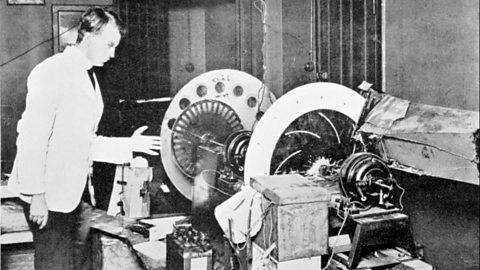
Not everything that reaches its 100th birthday receives a telegram from the King.
What it does mean, however, it that it has officially reached antique status - the benchmark used by experts to declare something old enough for the description.
BBC Bitesize takes a look at five well-known things which become antique in 2025, ranging from novels and magazines to influential pieces of cinema - and a football team.
The New Yorker: A regular slice of The Big Apple
When Harold W Ross edited the very first edition of The New Yorker magazine, its focus was on the city’s society, culture and attractions. Since it hit American newsstands for the very first time on 21 February 1925, the publication has grown to include more news-focused pieces, reports from around the world, reviews of films and theatre and short works of fiction.
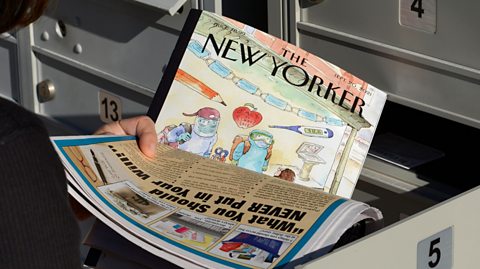
The magazine has also had some famous names as contributors. In the past 99 years, writers such as the poet Ogden Nash, Dorothy Parker - the magazine’s book reviewer in its early days - and JD Salinger, author of Catcher in the Rye, all had work published in its pages.
As well as words, The New Yorker is well known for its imagery. A character called Eustace Tilley, a figure in top hat, high collar and holding a monocle, featured as a cartoon on the very first cover and has since become the New Yorker’s mascot. The front cover of each edition of the New Yorker can be seen as an artwork in itself, with some finding a new life as framed prints in people’s homes. Different artists provide the covers for each edition, and an archive of the stories behind these diverse images can be found on the magazine’s website.
The Great Gatsby: Jay in the jazz age
Another New York icon that officially becomes an antique in 2025 is F Scott Fitzgerald’s novel The Great Gatsby.
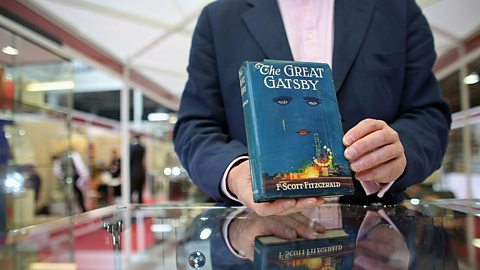
The US state is the setting of a story narrated by the university graduate Nick Carraway. He talks of the millionaire Jay Gatsby, who is in love with Daisy Buchanan, a woman he fell for when they were young. The story has an unusual structure as it is told through flashbacks, which are not always presented in the order in which they happened.
The novel has been turned into a film multiple times in the 100 years since publication. The first was in 1926, when the story was still new in the public’s mind. The most recent was 2013, with Leonardo DiCaprio as Gatsby and Tobey Maguire as Nick. Carey Mulligan played Daisy.
A musical version of The Great Gatsby is due to open at the London Coliseum theatre in the spring of 2025 - just in time for its big birthday.
Rotherham United FC: Bringing two teams together
Preparations are already underway at the AESSEAL New York Stadium for the 100th anniversary of Rotherham United.

May 2025 marks the centenary of the merger of two clubs; Rotherham Town and Rotherham County - to form Rotherham United FC, also known as The Millers - a name derived from the town’s long industrial history of milling flour. The original kit was black and amber, but The Millers have played in red and white since the early 1930s.
Their longest serving manager is Reg Freeman, who coached the team from 1934 to 1952. Under Reg’s stewardship, The Millers won the Third Division North title in 1951 and earned promotion to football’s second division. They currently play in English Football League One and won the EFL Trophy in 2022, beating Sutton United 4-2 after extra time at Wembley.
Paul Chuckle, of Chuckle Brothers fame, is a Millers fan and helped deliver the match ball (via moped) on to the pitch before his team kicked off in the historic cup final clash.
Battleship Potemkin: Cinema and politics collide
If you have ever studied film as a subject, there’s a good chance you will know all about Sergei Eisenstein’s 1925 feature based on true events.
The 75-minute silent film is based on a mutiny by sailors on board the Russian battleship Potemkin in 1905. It depicts them taking the ship to Odesa, which is now part of Ukraine, where the citizens show solidarity with the sailors.
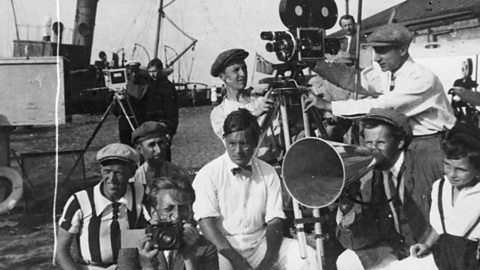
Eisenstein’s film is political in that it supports the idea of revolution. The section set on the Odesa steps is an early example of how the montage technique can be used to create an impactful action sequence, by cutting between the emotion shown on close-ups of people’s faces and wider shots of crowds on the steps themselves. It went on to influence many future film directors.
This wasn’t the only major film released in 1925. Charlie Chaplin’s The Gold Rush was based on stories of gold-diggers who headed to the Klondike region in north west Canada where they expected to find their fortune by unearthing gold there. It was critically acclaimed as one of Chaplin’s greatest films and the actor himself viewed it among his favourite works.
In 1958 at the World Expo in Brussels, hundreds of film critics were asked - for the first time - to officially rank the greatest films in cinema history.
The Gold Rush was second - just behind Battleship Potemkin.
Plaid Cymru: A political movement for Wales
The 1924 General Election saw a large majority for Stanley Baldwin’s Conservative government, who beat the ruling Labour party led by Ramsay MacDonald.
The Liberals were the third largest party in the country, but over in Wales, something was happening which would eventually add another voting option to the ballot papers.
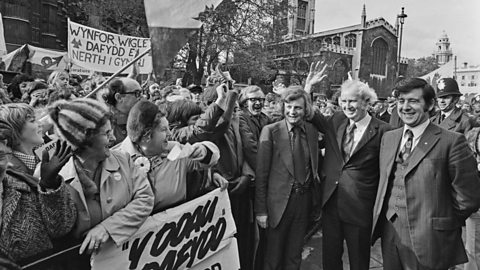
Plaid Cymru was founded in 1925, although it wasn’t strictly a political party in its early years. It was seen more as a social movement, promoting Welsh language and culture at a time of increased use of English as an official language in the country.
When World War Two ended in 1945, Plaid Cymru began to address issues regarding the Welsh economy.
Gwynfor Evans was the very first Plaid Cymru MP, winning the Carmarthen seat in a by-election in 1966. Later on, Evans played an active role in the establishment of the Welsh-language TV station S4C, even threatening to protest if the UK government did not go ahead with its plans for the channel. It began broadcasting in November 1982, one day before the launch of Channel 4.
At the 2024 General Election, Plaid Cymru was the second-largest party in Wales, winning four seats.
This article was published in December 2024
Looking for quizzes, amazing stories and fun facts?
Bitesize Topical has it all!

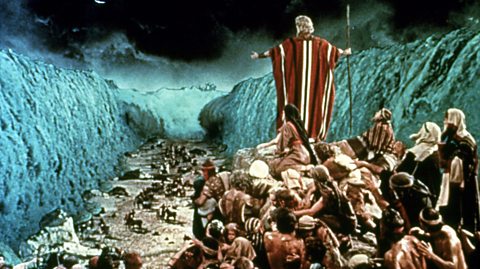
Pre-CGI special effects that were nothing short of magic
How the Red Sea was parted in 1956 and Charlie Chaplin avoided a nasty fall on roller skates
The origins of football jargon
From hat-trick to volley, learn where some of the most popular football lingo comes from.

Four things that turn 100 in 2024
The Winter Olympics and TV pictures are about to hit their century