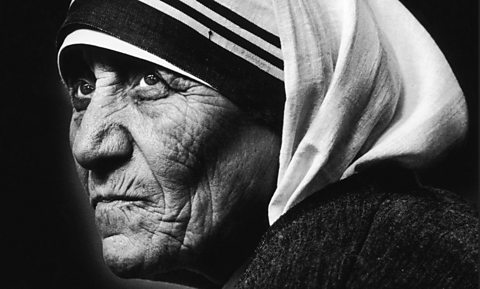
Mother Teresa was a A member of the Catholic Church. Catholics believe in having a hierarchy of priests and bishops beneath the Pope, who is the Head of the Church. Members of the Catholic Church also believe in devotion to the saints and the Virgin Mary, Jesus' mother, and in holding Mass. nun who believed God called her to work with the poor and dying in A city of commerce, transport, and manufacture in the urban centre of eastern India.. Calcutta is now known as Kolkata.
She was born on 26 August 1910 in Skopje, North Macedonia - a country to the east of Albania and to the north of Greece. She was called Gonxha Agnes at the time.
It is believed that she decided she wanted to become a A missionary is someone who is sent to a foreign country to share and teach their religious beliefs with people who live there. in India as early as the age of 12.
In September 1928, aged 18, she left home and started her mission. She joined the Institute of the Blessed Virgin Mary in Ireland. Here she received the name Sister Mary Teresa after St Thérèse of Lisieux.
Moving to India
In December 1928, she left Ireland to travel to India, arriving in Calcutta in January 1929 to teach in a girls' school.
From 1937 onwards she became known as Mother Teresa.
A train ride on 10 September 1946 changed her life forever. Here she received her "inspiration" to carry out what she described as the work of God, devoting herself to helping people who lived in the slums of Kolkata.
On 17 August 1948, she stepped out for the first time in her white and blue A women's garment from the Indian subcontinent, that consists of an un-stitched stretch of woven fabric arranged over the body as a robe, with one end attached to the waist, while the other end rests over one shoulder as a shawl., for which she became widely recognised by.
In 1950, she founded an organisation called the Missionaries of Charity. This was a sisterhood dedicated to helping the poor.
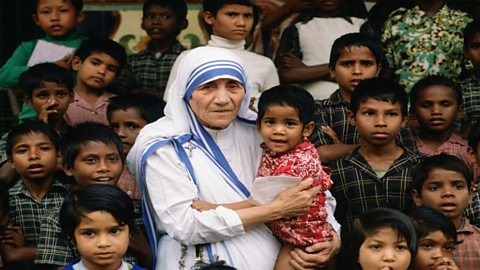
It expanded internationally and to this day has around 4,500 nuns and 400 brothers across 87 countries, looking after the poor and sick in the slums of around 160 cities across the world.
Nobel Peace Prize
Mother Teresa's work with the poor continued for decades.
She won numerous awards for her charity work. The most notable being the The most prominent award given to any person who has worked to encourage peace among countries or groups of people anywhere in the world. in 1979.
Upon receiving the prize, she said she was "happy to receive it in the name of the hungry, the naked and the homeless."
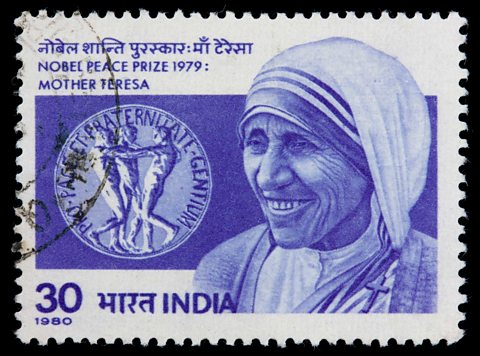
She asked that the celebration dinner organised to mark her winning the award be cancelled, and for all the money to be given to the poor people of Kolkata instead.
Legacy
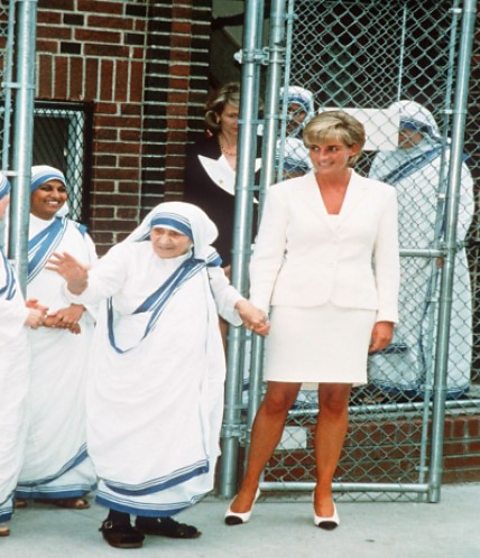
Mother Teresa died on 5 September 1997 at the age of 87 and was given a A state funeral is a public funeral ceremony, observing the strict rules of protocol, held to honour people of national significance. in India.
Her The long-lasting impact of particular events, actions, etc. that took place in person’s life. has faced criticism in some circles for her opposition to contraception and abortion.
But she is widely remembered as a selfless person who wanted to help those less fortunate than herself.
With special authorisation from Pope John Paul II, the process to declare Mother Teresa a Catholic saint began less than two years after her death.
She was Beatification is the step right before sainthood. By beatifying someone, the Church proclaims that the person in question is a) definitely in Heaven, and b) definitely able to plead to God on your behalf if you pray to him. on the 19th October 2003, and then The canonisation process is a Church law procedure by which the Church through the Pope solemnly declares a Catholic to be united with God in heaven, an intercessory to God on behalf of the living, and worthy of public and universal veneration. at a ceremony in St. Peter's Square in Vatican City on 4th September 2006.
Watch: Mother Teresa's legacy
This 2016 BBC News India video explores Mother Teresa's legacy
MOTHER TERESA: It is not how much we do, but how much love we put into doing it that makes all the difference.I am very happy to receive it in the name of the hungry, the naked, and the homeless throwaway of the society, people who have become a burden to the society.
Quiz time!
More on Historical figures
Find out more by working through a topic
- count7 of 7

- count1 of 7

- count2 of 7

- count3 of 7

