Welcome to The Regenerators.
Introduction
You might love paddling or swimming at the beach. Maybe you love checking out colourful sea anemones in a rock pool.
It could be that you dream of dolphins, splashing around in the deep blue sea. Or maybe you just love fish fingers.
The ocean is beautiful and gives us food and fun. But most important of all, it keeps us alive.
Even if you're miles from the beach, the ocean is always with you. The water you drink and the air you breathe both come to you from the sea.
Why are oceans important?
Find out about some to the incredible things that our oceans do to keep our planet healthy.
Narrator: The five oceans on Earth play a huge part in keeping our planet healthy.
They produce half of the world's oxygen and absorb half of all man-made carbon dioxide. The waters are constantly moving around in patterns called currents, which cycle water from one place to another, over and over again.
This is important in regulating the Earths climate and weather. But water doesn't move around just in the oceans. It also moves around through the air. The sun heats up the water in the oceans, rivers, lakes and seas, turning it into tiny droplets called water vapour.
These tiny water vapour droplets rise into the air and gather together to from clouds. The rain that falls on land, washes into the lakes and rivers. Which eventually makes its way back to the sea. This happens over and over which is why it's called the water cycle.
The oceans are home to millions of species, with more being discovered every day. But our actions are putting the health of our oceans at risk. Air pollution and poisonous waste from things like pesticides, sewage, plastics and metals, end up in the oceans and coastal waters.
With the oceans doing so much for our planet and billions of people rely on them for food and jobs, we need to return the favour and do some thing for our oceans.
The water cycle
Water on Earth is constantly moving. It is recycled over and over again in a process called the The journey water takes as it moves from the land to the sky and back again..
The sun heats up water on land, in rivers, lakes and seas and turns it intoan invisible gas called water vapour. This process is called The process by which a liquid changes state and becomes a gas. .
The warm water vapour rises high into the sky. Up there, the air is cold and so the vapour begins to cool down again. As it cools, it The process by which a gas changes state and becomes a liquid. , which means it turns back into liquid water drops again.
These water drops float around the sky in clouds, blown by the wind. The drops join together to make bigger, heavier drops.
When they get big and heavy enough, they fall back to the earth again as rain. Sometimes, the drops get so cold that they freeze and fall as snow or hail.
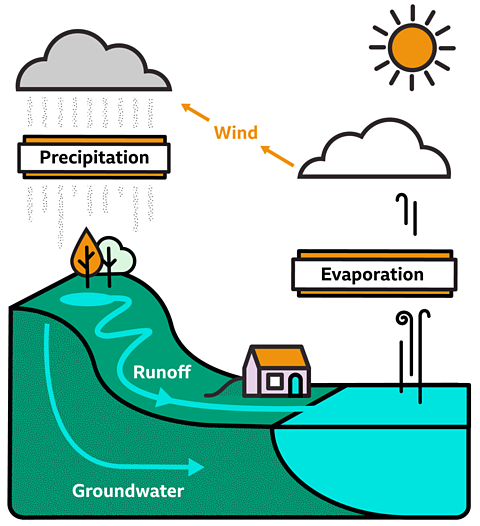
Rain that falls on hills and mountains runs down towards the sea, making streams and rivers. On lower ground, rain fills up lakes, pools and puddles.
Plants soak up the rainwater through their roots, whereas animals and people drink the water.
Most of the rainwater ends up back in the sea. At any moment, 97% of all the water on the earth is in the ocean.
But wherever the rain falls, when the sun comes out from behind the clouds and shines, water vapour begins to evaporate again. It heads back to the sky in an endless journey.
Let's go to the beach
Join Liliah and Jayden as they find out from Lauren, a marine biologist, why oceans are important and discover some fun facts about seaweed!
(UPBEAT MUSIC)
Liliah: I am Liliah.
Jayden: And I'm Jayden.
Liliah: We are at Ogmore Beach in South Wales.
Liliah And Jayden: Hi!
Jayden: We are super excited to meet Lauren, who is a marine biologist, that means she's a scientist who looks at things which live in the sea.
Liliah: We are pleased Lauren is here because we want to find out why the ocean is such an important place for us to look after.
Lauren: The UK is an island, which means we have lots of ocean nearby. And we must protect it because we have some amazing marine wildlife living here. Can you think of any?
Jayden: Octopus, whale, shark.
Liliah: Dolphin, squid.
Jayden: Crab.
Lauren: That's right and if we don't protect them, then we might not be able to see these things in years to come. Come on, let's go.
Jayden: We really want to help look after the sea like Lauren does, so we are off to learn more.
Lauren: Now something that we have in this area is seaweed, and seaweed is very important. You only find it in oceans. Seaweed is a habitat, which means that it's a place where other creatures can live and eat. Also, seaweed is like plants, it takes in carbon dioxide and gives out oxygen. This helps to make the seawater cleaner.
Liliah: We are really excited to hear that seaweed is important, because we have definitely seen seaweed here before.
Lauren: Okay, kids, I have a mission for you.
Jayden: Your mission is to find as many species of seaweed as you can and discover some fun facts about them.
Liliah: Yay, let's go!
(LIVELY MUSIC)
Lauren: So kids, when we do our fun sea weed hunting missions, we must stay with our grown-ups so we can be safe near the sea. An we also need to be really careful when we're walking across the rocks. The seaweed can be quite slippery can't it?
(UPBEAT MUSIC)
Liliah And Jayden: We found some!
Lauren: So this one is called Egg Wrack, you can tell the age of it by looking at how many air bladders it has. One air bladder is one year of growth, so, if you start counting the air bladders, you can tell how old it is. And this is a really good seaweed for other animals to hide in.
(UPBEAT MUSIC)
Jayden: Lauren, I found some.
Lauren: Wow, guys, this is amazing. So you have just found a type of seaweed here, a green seaweed, because it looks really bright green, doesn't it? And this is called Gut Weed. What you can see is this one is really thin, can you see that?
Jayden: Yeah.
Lauren: It looks a bit like hair, doesn't it?
Liliah: Yeah, maybe some fish could eat it.
Lauren: Yeah, definitely. What have you found? Can you see on the edges here, it looks a bit like a knife, doesn't it?
Liliah And Jayden: Yeah.
Lauren: It's really jagged. And so this one is called Serrated Wrack.
(UPBEAT MUSIC)
Kids, you did an amazing job! I hope next time that you come to the beach, you'll remember that seaweed is ever so special, and that each different type that you find will be helping lots of different species. Shall we go and find some more?
Liliah: Yeah.
Lauren: Yay, come on, let's go!
Jayden: We have learned so much today and when we know special things about nature, it helps us to look after plants and animals around us.
Liliah: And also that seaweed is super duper awesome!
Did you know?
We breathe in an invisible gas called oxygen from the air around us. And we breathe out an invisible gas called carbon dioxide or CO₂.
On land, trees and other plants take in this CO₂ and give out oxygen again for us to breathe. And in the sea, tiny microsopic organisms, called plankton, do exactly the same thing.
Plankton in the ocean soak up between 20% and 30% of all the CO₂ we make. And they give it back to us as the oxygen we need to live.
Why our oceans matter
The ocean covers over 70% of the earth’s surface and play an important role in keeping our planet’s temperature and weather in balance. Find out some more reasons why are oceans are important in the slideshow below.
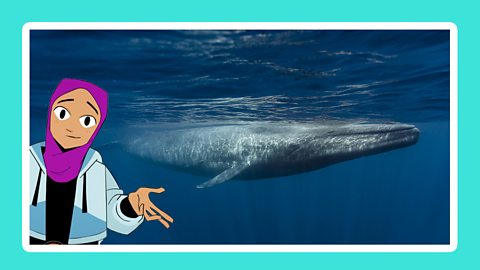
Image caption, Life
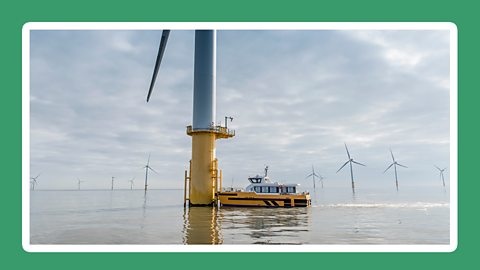
Our oceans are home to an incredible diversity of life. Scientists think there could be more than 2 million species living in their waters, from tiny plankton, which form the foundation of many ocean food chains, to the biggest creature that has ever lived – the blue whale.
1 of 3
Changing our oceans
Without the oceans, our planet would be much warmer. Water is really good at storing heat, and there’s lots of water it in the oceans.
As human activity produces more greenhouse gases and the earth’s climate is warming, the oceans are absorbing more heat from the atmosphere. In fact, 90% of the excess heat from global warming is being absorbed by the oceans.
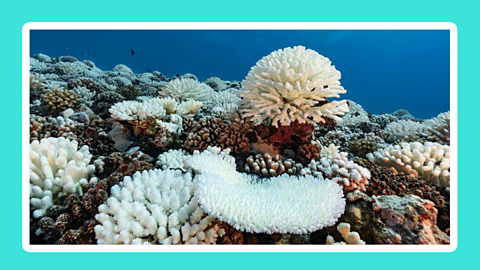
This might sound like a good thing, but warmer oceans come at a big cost for lots of marine ecosystems. Particularly coral reefs, which are very delicate and prone to damage from changing temperatures.
Our oceans also soak up carbon dioxide from the atmosphere. Again, this might sound like a good thing, because carbon dioxide is a greenhouse gas. However, it’s changing the chemistry of the oceans in a way that is a problem for marine wildlife.
The seawater is becoming more acidic which makes it difficult for sea creatures, such as like plankton, molluscs and coral, to build their shells and skeletons.
Lesson complete!
Well done Regenerator, you've completed this lesson. Now let's see what you can remember.
Investigation
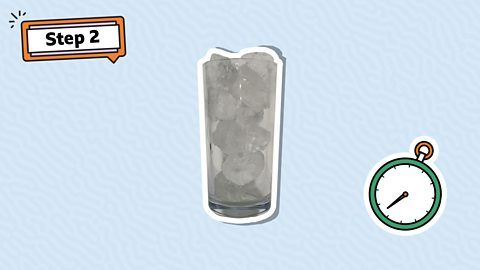
There is water vapour in the air around us. Here's a simple experiment you can do to prove it.
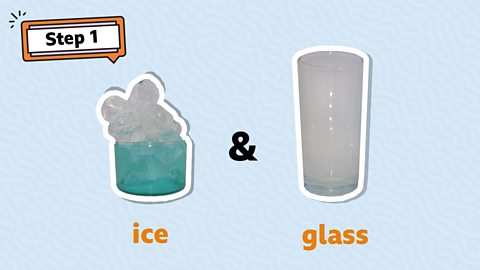
Image caption, You will need
For this investigation you will need a glass and some ice from the freezer. Remember to ask permission
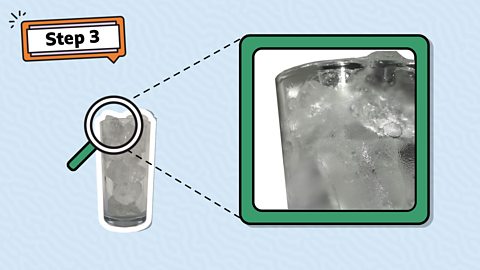
1 of 3
There's more to learn
Explore more lessons and content from around the BBC.
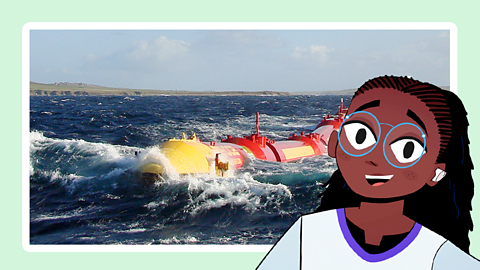
How can we generate electricity from the sea?
GREEN CLASSROOM
What is the problem with plastic?
GREEN CLASSROOM
Year 3 - 6 and P4 - P7
GREEN CLASSROOM
More from The Regenerators
BBC BITESIZE