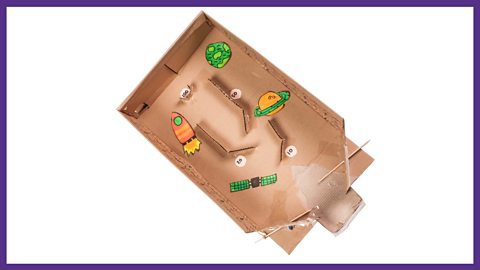
Help your child make a simple pinball machine from just a cardboard box and some ice lolly sticks!
This fun STEM activity, brought to you in partnership with the Science Museum Group, will help your child explore and start to understand the science of forces and motion.
In this activity you will need to cut up a cardboard box and other materials, so please supervise your child and help them out when they're using scissors.
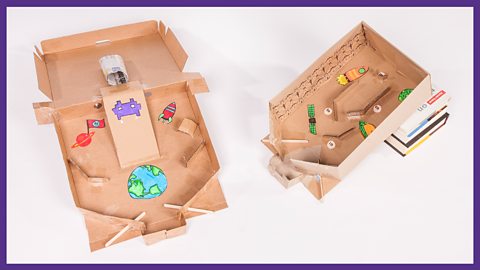
Instructions for you and your child to follow…

You will need
- A small or medium-sized cardboard box, like a shoe or pizza box
- Two wooden ice lolly sticks
- Scissors
- Sticky tape
- A marble or small ball
- Extra cardboard and paper
- Coloured pens, for decorating
Let's get started
Step 1
Unfold one end of your box, so that two flaps come free.
Step 2
Cut a small slit in each flap, but don't cut further than halfway across.
Step 3
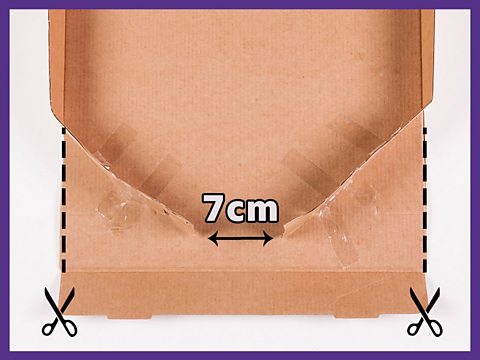
Cut down the sides of the box, where the dotted lines are in the picture.
Step 4
Angle your new longer flaps to face each other and leave a 7cm gap between them. Stick them down with tape.
Step 5
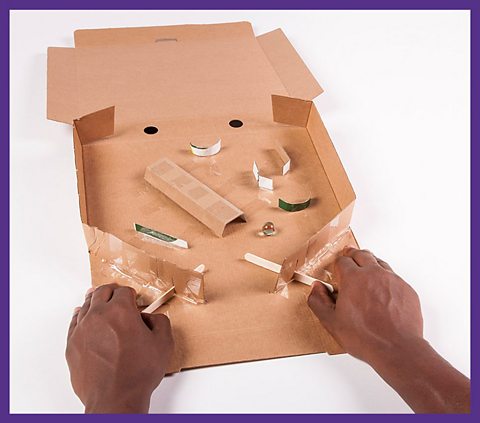
Slide the lolly sticks into the slits – these will be your pinball flippers.
Step 6
Make an obstacle course or maze on your board by adding curves, arches, ramps and tunnels.
Step 7
Your pinball machine is now ready to play! Prop it up on a pile of books to help the ball roll.
Get creative
Once you've made your pinball machine, you can decorate it however you want.
Why not have a go at changing its layout entirely by adding new obstacles?
Talk about the changes you've made and how it affects how the game works:
- What do you think would happen if the box didn’t slope?
- What would happen if you used a smaller or a bigger ball?
- Which parts of the pinball board are hardest to reach?
Science in your world
When you ride a bike, contact forces between your feet and the pedals turn the wheels, and friction between the wheels and the road will make your bicycle move. Friction between the brakes and the wheel rim will help you to slow down and stop your bike. Gravity can do that too if you’re cycling uphill!

The Science Museum Group is a group of museums in the UK who share objects, stories and hands-on activities to engage more people in science, technology, engineering and maths.
Images © Science Museum Group
More from BBC Bitesize Parenting…
Bitesize Parenting
Fun activities, real-life stories, wellbeing support and loads of helpful advice - we're here for you and your child.



Fun activities for smaller children
Four to five-year-olds can have fun and learn new skills with these videos. From Tiny Happy People.

Seven skills a teenager can learn in one month
If your teen wants to shake up their free time, here are seven skills they can try.

Rob Biddulph's five tips to help you confidently draw with your kids
Rob Biddulph, author and official illustrator for World Book Day, has some great tips and tricks to share to help you draw with your kids.