The Bitesize Guide to AI team have picked a selection of interesting AI moments from 2025. We've looked at areas you care about the most, from entertainment news to sustainability breakthroughs, education updates, pastimes to careers.

1. Google commence project to host data centres in space
In November, to solve future storage and energy needs arising from the mass adoption of AI tools, Google announced it had started foundational work on a scalable AI infrastructure system design that aims to draw energy from the most powerful source there is, the sun!
In a blog post they said they were "exploring how an interconnected network of solar-powered satellites, equipped with Tensor Processing Unit (TPU) AI chips, could harness the full power of the sun."
The prototype satellites are due to be launched early 2027 with the intention of helping our already-burdened data-processing resources down here on Earth.
2. Tilly Norwood, first AI-generated actor launched
Tilly Norwood, a common-sounding name for a human being, right? But she was unveiled this year at the Zurich Film Festival as the world’s first AI‑generated actor! The twenty‑something character actor was created by the AI-arm of UK-based production company Particle6.
Creator, Eline Van der Velden, emphasised that humans would still write, direct and edit the content that goes out through Tilly’s work and feeds, while AI is mainly being used to generate her face, body, voice and images.
The project received a mixed response. Norwood's TikTok and Instagram accounts have grown substantially since the news, but the unveiling also sparked doubts from actors' unions towards audience interest in "watching computer-generated content untethered from the human experience."

3. Scientists discover a new type of lion roar
University of Exeter researchers used machine learning to identify a previously unknown lion's roar. While it was initially thought lions had only one full-throated roar, the study has found a new 'intermediary roar', which is also a feature in spotted hyenas.
According to the World Wildlife Fund (WWF), the lion population has dropped significantly since the beginning of the millennia, with numbers of those remaining in the wild being possibly as low as 20,000.
The study lead, Jonathan Growcot, said that the shift in wildlife monitoring to using AI tools is a "large-scale change to using passive acoustic techniques." He said such improvements in bioacoustics (the study of sound in living organisms) would be "vital for the effective conservation of lions and other threatened species."
The AI system, is said to be 94 percent accurate in sorting lion roars into different types, and researchers hope to use the method to identify lions and track lion populations.
4. Almost half of UK teens say they use AI for homework or coursework
The annual BBC Bitesize and 5 Live Teen Summit Survey conducted by Survation, revealed in September that 47% of 2,200 teenagers surveyed that summer said they had used AI for homework or coursework. The result was an increase from the 36% in 2024 and 29% in 2023.
The announcement followed a Department for Education (DfE) policy paper published in August 2025 which noted that schools have now started issuing guidance on the responsible use of AI tools and Generative AI (GenAI) in a marked shift away from banning it altogether.
Effective prompt engineering (designing and refining instructions for AI programs) and knowing how to use AI for homework and revision is now emerging as a top skill for independent study in an AI-driven world.
5. Stars sign deals to create AI-generated versions of their voice
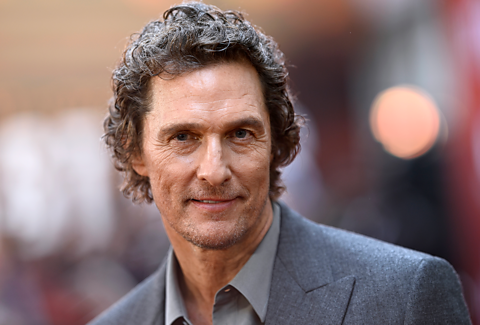
In November it was announced that Oscar-winning Hollywood actors Matthew McConaughey and Michael Caine signed license deals with ElevenLabs, granting the audio company permission to use their voices to create AI-generated versions of their voices.
The Guardian reported that McConaughey wanted to partner with ElevenLabs to "reach and connect with even more people." Michael Caine also released a statement, saying "For years, I’ve lent my voice to stories that moved people – tales of courage, of wit, of the human spirit. Now, I’m helping others find theirs…[it's] not about replacing voices; it’s about amplifying them."
6. Robot vacuums walked so Neo could run
Have you ever wished you had something to help you tidy your room? Or maybe you’ve fancied a drink from the fridge, but can’t be bothered to go and get one?
With humanoid robot, Neo, this kind of assistance may be close to hand. 1X, the Norwegian company responsible for developing the robot, promises that Neo will take on boring household tasks so you can spend more time focusing on "what matters to you." But bear in mind, this type of assistance will set you back a hefty £15,000!
While Neo has been all over TikTok and YouTube this past year, the 5’6” robot still requires human operators donning VR headsets to carry out some of its more complex tasks, such as loading a dishwasher.
Neo is comprised of a number of advanced AI systems, including fisheye cameras for eyes and a large language model for a brain. 1X has said an early version of the robot will be available for purchase in the UK in early 2026.
7. McAfee announce Taylor Swift as the UK's most impersonated celebrity by scammers
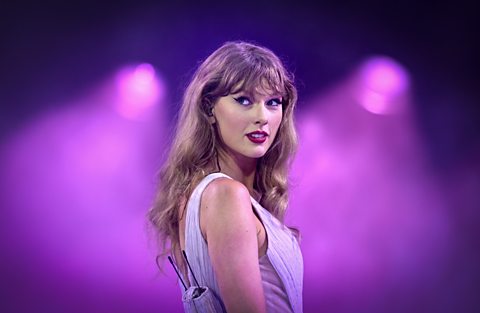
In November, computer security company McAfee, released their Deepfake Deception List 2025. The list exposes the top 10 famous names used by cybercriminals to trick people into falling for scams, fake endorsements, giveaways and deepfakes.
Songwriter and pop star Taylor Swift topped the UK list as the most targeted celeb, with Emma Watson placing 2nd, David and Victoria Beckham placing 5th and 6th respectively, and Strictly's Claudia Winkleman at number nine.
In McAfee’s first global influencer list, titled ‘2025’s Top 10 Most Dangerous Influencers Online’, Twitch streamer Pokimane was named as the most common deepfake bait. Following closely behind Pokimane was Mr Beast in second place.
You can learn more about AI and social media with the Bitesize Guide to AI, and quiz yourself on your ability to identify AI or real content here.
8. Research by the BBC finds AI chatbots unable to accurately summarise news
In February, the BBC announced findings of research it had carried out that four major AI chatbots (OpenAI's ChatGPT, Microsoft's Copilot, Google's Gemini and Perplexity AI) were inaccurately summarising news stories. Examples of inaccuracies were linked to News pieces on the NHS, outgoing politicians and the Middle East.
While AI summaries will likely improve as the technology develops, you can find out how to check your news sources with help from the Other Side of the Story.

9. University of Derby announce AI-powered UK railway inspection project
In January, the University of Derby announced an "innovative railway inspection project using AI". The three-year pilot - a collaboration between the university and Sperry Rail, funded by Innovate UK - will investigate the use of AI to automatically detect railway track defects.
In-person rail inspections are a painstaking process, often carried out in challenging terrains and tricky, claustrophobic spaces like tunnels. Dr Alaa AlZoubi, Senior Lecturer in Computer Science at the University of Derby, said the benefits of turning to AI-enabled models include "reducing false detection and minimising service disruptions, increasing the overall lifespan of railway assets."
10. Will AI take your job? Youth Employment UK says 'No'
The Youth Voice Census 2025, a large-scale anonymous survey of 11-30-year olds by Youth Employment UK, revealed that a third of the 8,200 survey participants are excited about AI, but more than half are concerned about AI taking jobs away.
In an October article written to address young people’s main concerns, Youth Employment UK said that "AI will likely replace some jobs. We’ve seen this happen before with other technological developments like large machinery in factories. However, many more jobs will likely be created or changed by AI, instead of being completely replaced by AI… Being able to confidently and safely use AI may be a skill you need to use in your job, but a world where all jobs are replaced by AI and robots is still science fiction."
This is just a small selection of the ways in which AI is shaping our modern world and making headlines in 2025. With further advances in technology being investigated in other important fields like medicine, it remains to be seen how much this ever-expanding breakthrough technology will exactly shape the future. One this is for certain - AI in 2026 is set to be extremely interesting.
More from the BBC Bitesize Guide to AI
Can you speak dolphin? How AI is being used in conservation
Marine biologists have been recording dolphins off the south coast of England. Discover how they use AI to help classify dolphin noises.
How AI is being used to support positive mental health
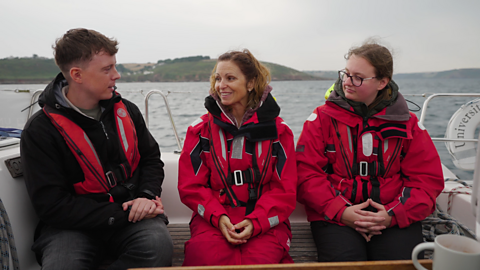
Meet Anya Aggarwal, a mental health clinician who helps people using the Wysa AI chatbot.

How AI is transforming the fashion industry
How are AI tools impacting the fashion design process? And what sort of skills do aspiring young designers need to have?