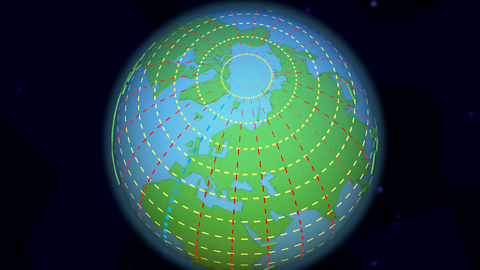
Watch: Introducing time zones
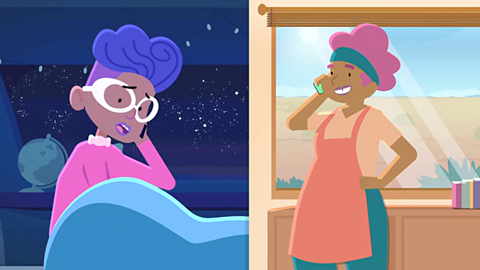
Auntie Joyce: Happy Birthday Sue!
Sue Venir: Oh, err… thank you Auntie Joyce, it’s so kind of you to ring. It’s actually 11pm here on the day before my birthday, but it’s still lovely to hear from you.
Auntie Joyce: Oh sorry! I forgot about the time difference. I’ll let you sleep dear, nighty-night!
Sue Venir: Auntie Joyce always rings me very late at night. It’s because she forgets that we live on different sides of the planet.
I’m in the UK but Auntie Joyce lives all the way round the other side of the planet in Australia.
The sun is shining on her side of the Earth at the moment, which means it’s daytime there, but because I’m on the shady side of the planet, it’s night-time here.
The Earth is steadily turning on its axis all the time. Which means in a few hours, the Sun will shine on my side of the planet, making it daytime.
And her side of the planet will become shaded, making it night-time.
Because the time is different depending on where you are in the world, everyone has agreed to split the world up into time zones.
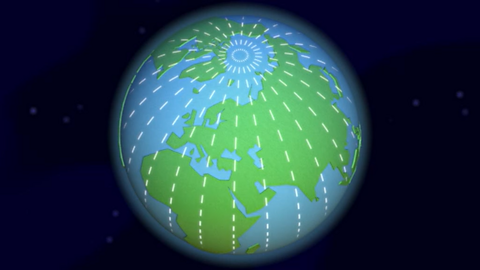
They are divided by imaginary lines called meridians which run from the North to the South Pole.
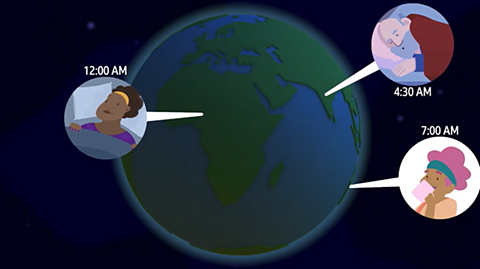
It’s 7am where Auntie Joyce is in Australia, but Uncle Fred lives in India, where it’s 4.30am.
Aunty Sandra lives in Nigeria, where it’s midnight.
And Uncle Terry lives way over in Mexico where it’s 5pm.
Anyway, if I’m to look my best for my birthday party, I’d better get some sleep.
Why are there time zones?
- Time zones are divided by imaginary lines called meridians.
- They run from the North Pole to the South Pole.
- There are 24 time zones. One for each hour of the day.
There is an imaginary line running through the UK called the Prime Meridian. It is also known as the Greenwich Meridian.
It runs through a place in London called Greenwich.
The Greenwich Meridian splits the world into eastern and western hemispheres.
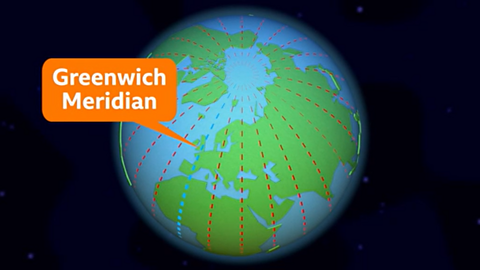
Time in countries to the east of the Greenwich Meridian is always in front of that in the UK.
Time in countries to the west of the Greenwich Meridian is always behind that of the UK.
Why is the time different on the other side of the world?
As the Earth rotates on its axis, the Sun only shines on the side of the Earth that it is facing. This means:
- It is daytime for the parts of the Earth that have the Sun shining on them
- It is night-time for places that are on the opposite side of the Earth and are in the shade
- Different places in the world have different times.
- This is why the world is divided into 24 different time zones.
- One for each hour in a day.
- Very large countries such as Australia or the USA can have many time zones.
- Most smaller countries have the same time zone, even if part of them falls outside a meridian line.
Activity: Quiz – Time zones
SATs preparation resources. activity
Get ready for the SATs papers with videos, activities, quizzes and games to refresh your knowledge and practise your skills.

More on Geography skills
Find out more by working through a topic
- count9 of 10
- count10 of 10
- count1 of 10

- count2 of 10