Why are bees so important?
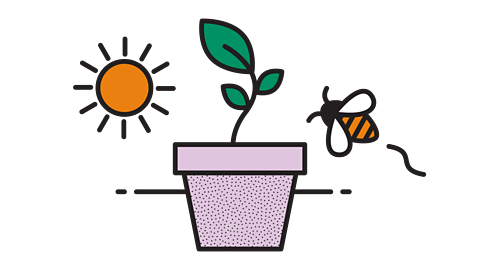
How hard can it ‘bee’ to look after pollinators?
Bees are amazing creatures. Not only do they make tasty honey, but they are also involved in pollinating lots of our food and wild flowers.
The honeybee is just one species. Did you know that there are about 270 species of wild bee in the UK? As they look out for us, we need to make sure we help protect them, too.
However, UK bee populations have reduced by about a third in the last 30 years. Bees might be under threat, but we can all do our bit to make the world a bee-friendly place.
Show Me the Honey!
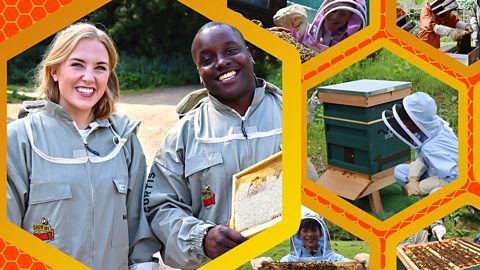
Head to Bee School with CBBC’s Show Me the Honey! Presenter, Maddie Moate, and professional beekeeper, Curtis Thompson, lead five kids from across the UK on a honey-making adventure as they learn how to care for their own beehives.
Rocco, Darcey-Mae, Harry, Ashrita and Jishnu discover why pollinators and honeybees are vital in helping farmers to grow food. They also don their ‘bee-vision’ goggles to understand how bees see.
MADDIE: Hello, beekeepers.
CURTIS: Hello guys.
Oh, what have you got there, Maddie?
MADDIE: I just wanted to show us some of the foods grown by farmers worldwide that we wouldn't have if it wasn't for other pollinators and honey bees.
CURTIS: Bees are so amazing that they pollinate up to a third of our food groups, seventy different crops all across the UK.
MADDIE: We would be lost without them, yet a combination of climate change, loss of habitat and the use of pesticides means that sadly our pollinators are struggling and their numbers are declining.
ASHRITA: The fact that so many of our foods are here because of these pollinators is quite surprising because one third is a lot.
MADDIE: We all know that pollinators are absolutely incredible and should be protected and celebrated.
So today we are going to look at just one of the things that make honeybees awesome. And that is their amazing sight.
CURTIS: They actually have five different eyes, unlike us humans that only have two.
The three eyes in the middle help with their navigation.
MADDIE: The two larger eyes are fascinating as well. We can see them just here in that picture. They're called the compound eyes.
A compound eye is made up of thousands of tiny little lenses. And it's all of these little individual images that come together to make one big picture for our honeybee.
Worker bees have nearly seven thousand lenses in each compound eye, and drones over eight thousand.
These eyes give honeybees a panoramic one hundred and eighty degree view of the world.
Great for finding flowers and plants, avoiding predators and for locating the hive after they've come back from foraging for food.
The only downside of a bee's eye is focus. Unlike us, they can't change the position or shape of their lenses.
They have to move closer or further away to see an object clearly.
And this has given us an idea for a game.
Beekeepers, this wacky looking contraption is your bee vision headset. The idea is when you look through it, it mimics what a bee would see with their compound eyes.
You're going to put the headset on and you're going to try to identify famous faces. But because this is Bee School, we've given them a bee-related name which might or might not help you guess.
CURTIS: Starting behind the line, you will try and guess the celebrity face. If you're struggling, feel free to buzz one step forward.
Are you ready?
CHILDREN: Yeah!
MADDIE: Darcey-Mae, you ready for your cele-bee-rity face?
DARCY-MAE: Yeah.
MADDIE: Here you go.
DARCY-MAE: I know who that is. It's a man.
MADDIE: Yeah.
DARCY-MAE: He's got a beard.
MADDIE: Yeah.
DARCY-MAE: And he's a singer cause he's got a microphone in his hand.
CURTIS: Well done.
MADDIE: Have you got any idea?
Rocco do you have it?
ROCCO: Yeah.
MADDIE: Do you think you can give a clue?
ROCCO: It's the end of the week.
DARCY-MAE: The Weekend?
MADDIE AND CURTIS: Hey!
MADDIE: And make it a bee-related pun?
DARCY-MAE: The Bee-kend.
ALL: Yay!
CURTIS: Well done.
MADDIE: Harry, here is your celebrity face.
CURTIS: Ooh.
HARRY: Is it Justin Bee-ber?
ALL: Yay!
CURTIS: Well done.
MADDIE: Ashrita's turn now.
ASHRITA: Erm, right okay. Is it Billie Eilish?
ALL: Ay!
MADDIE: And now make it a bee pun.
ASHRITA: Ah…
MADDIE: Rocco?
ROCCO: Bee-lie Eilish?
ASHRITA: Oh, yeah!
MADDIE: Well done Rocco.
CURTIS: Oh, what can you see Rocco?
ROCCO: Is it BTS?
MADDIE: Yeah. Well done!
ROCCO: Bee-TS.
ALL: Yeah!
MADDIE: Very good.
Last up, it's Jishnu.
JISHNU: Right.
ROCCO: Wasn't she dating The Weekend?
JISHNU: Selena Gomez?
ALL Hey!
MADDIE: I didn't know that! Look at that pop culture knowledge.
CURTIS: Can you do a bee nickname now?
JISHNU: Se-bee-na Gomez?
CURTIS: Hey!
MADDIE: That'll do.
JISHNU: The goggles started to like muddle my head a bit. The fact that I had seven of everyone there then I had the celebrity I was looking for hidden amongst the others, I was like who's the celebrity here?
What is pollination?
Insects (like bees) play a key role helping flowering plants to reproduce.
For plants to make seeds, pollen has to get from one plant to another. This process is called pollination.
Powdery pollen is stored in a part of the flower called the anther.
Bees are attracted to flowers for their nectar. When they visit, pollen from the anther sticks to them and they carry it away.
When a bee lands on another plant the pollen rubs off on a part of the flower called then the stigma.
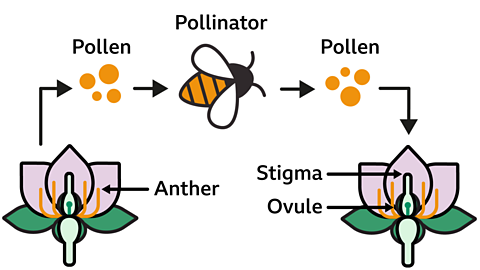
From here the pollen can fertilise the egg cell (ovule) to make a new seed.
Pollinators include lots of different types of bees, as well as moths, butterflies, hoverflies and beetles. You can learn more about pollinators with The Regenerators.
Bees are one of the most effective pollinators out there because they visit lots of plants and carry more pollen between them. In the UK, around 70 crops benefit from visits by bees – for example, broccoli, cabbages and apples.
Why are bees in trouble?
There are a few reasons why our pollinating friends are having a hard time at the moment.
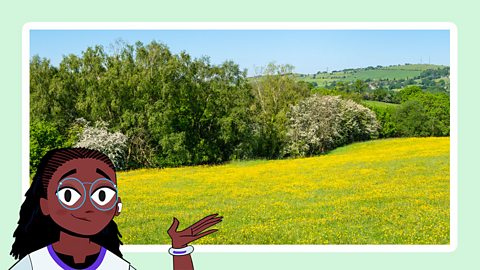
Image caption, Habitat loss
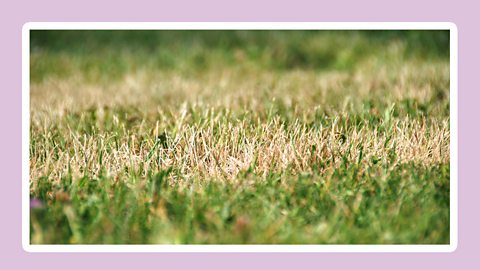
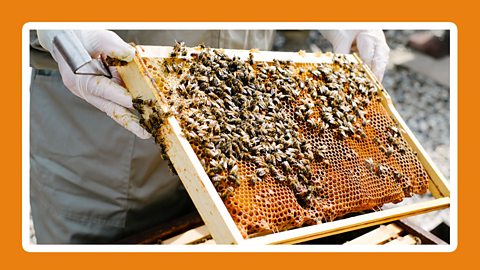
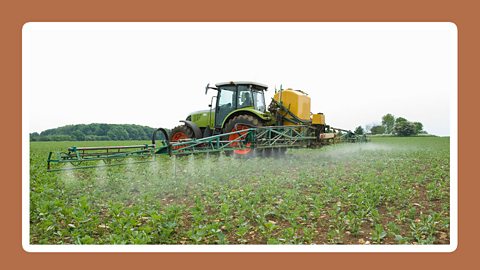
Bees love to live in natural green spaces, like meadows full of wildflowers and wooded areas. Some of these areas are being replaced by roads and buildings or are used for farming. This means that bees now have fewer places where they can make a home (called a habitat).
1 of 4
Spot the pollinator with a survey
Helping scientists and researchers to get more facts means they can learn and understand more about how to help bees. Watch how Maddie, Curtis and the Show Me the Honey kids do this below!
Back in Bee School, the kids use quadrats to survey how many pollinators are nearby. Why not follow their lead and try this fun activity yourself? Scientists love to get new information and you can help them by logging what you’ve surveyed online.
MADDIE: Hello beekeepers. Welcome back to Bee School. Before we start, Curtis, I got you something.
CURTIS: Who are those for?
MADDIE: These are for you. They're for you, I picked you some flowers.
CURTIS: They look like weeds to me.
MADDIE: Oh, um. I mean it depends on how you look at it. These are dandelions. Some gardeners look at these and consider them weeds so they get rid of them, but others call them wild flowers. But who else do we know loves dandelions?
CURTIS: I'm gonna say bees.
MADDIE: Spot on.
CURTIS: Bees are pollinators, they play a vital role in helping to produce the fruits and vegetables that we eat. Who else can name some pollinators?
BOY: Solitary bees.
ROCCO: Butterflies.
ASHRITA: Hover flies.
JISHNU: Birds.
DARCY-MAE: Bumblebee.
MADDIE: Absolutely. And all of them are really important to our food supply. However our pollinators are in danger. Their numbers are declining and that's not only bad news for them, but it's bad news for our food supplies too.
Research into pollinator numbers in the UK has revealed that two of the most important insects who visit our plants, wild bees and hover flies, have declined by a worrying thirty percent over the last few decades and sadly some wild bee species have already become extinct.
One of the reasons for this is loss of habitat, places where insects could visit flowers to feed, have been destroyed by human activity. We can do our bit to help try and boost numbers by planting wildflowers to encourage more pollinators.
BOY: I didn't really realise how important these pollinators were to our planet.
ASHRITA: And without them, we won't be able to exist properly.
MADDIE: One way we can all get involved in helping keep an eye on pollinator numbers is to do a survey. A survey can help us understand what the pollinator numbers are like in a specific area.
CURTIS: The more people who can do a survey, the more data scientists have to analyse.
MADDIE: So what do you think? Do you wanna do a pollinator survey?
CHILDREN: Yeah!
MADDIE: Great!
Beekeepers, we have split you into two teams. Each team has a quadrat and a mobile phone with a survey app already uploaded to it.
A quadrat is a tool we can use to help mark out a specific area and your quadrats are fifty centimetres by fifty centimetres.
This is the area your survey is going to take place in.
CURTIS: We want you to search the Bee School, find some flowers. These can be lavender, thistles, even dandelions.
MADDIE: Once you've found your patch of flowers, place the quadrat over the top and start the app.
Every time a pollinator lands on a flower, try to find the image of that pollinator and quickly tap it.
And you've got ten minutes.
CURTIS: And let's get surveying guys!
MADDIE: Go on, then. Go. Go. Go. Go, go!
Quadrat in hand, our beekeepers set out to survey. But which team will find the most pollinators?
DARCY-MAE: Oh, look. There's a fly and an ant.
ASHRITA: Oh yeah. Oh, there's another fly.
DARCY-MAE: There's another fly. In the pollinator survey, Ashrita and I put a quadrant on a patch of forget-me-nots, as we saw that they had loads of pollinators going into them.
CURTIS: Hi, girls. How are you getting on?
ASHRITA: Good, thanks.
CURTIS: OK, so what have you found so far?
DARCY-MAE: We've found a bumblebee.
CURTIS: Oh nice.
ASHRITA: Some honeybees.
DARCY-MAE: Found three flies and an ant.
ASHRITA: Yeah.
DARCY-MAE: Oh, there's another one there.
CURTIS: Busy bees.
DARCY-MAE AND ASHRITA: Yeah!
CURTIS: You know why are they call them busy, eh?
DARCY-MAE: The pollinators that we saw most were flies and honeybees. We also saw some bumblebees and ants.
MADDIE: While Darcy-Mae and Ashrita make like busy bees, let's see how the boys are getting on.
BOY: Oh, there's one bumblebee.
JISHNU: There it comes.
BOY: Bumblebee went in.
MADDIE: Hi guys, are we whispering? No? Pollinators aren't bothered?
BOY: In our survey the pollinators ranged from honeybees to even ants.
JISHNU: We found a lone bee.
ROCCO: Spiders, flies. Hoverflies and pillbugs.
BOY: So we found eight honeybees.
MADDIE: Eight? What?
BOY: Two hoverflies.
MADDIE: Yeah.
BOY: A fly.
MADDIE: Bee!
ROCCO: Oh, yeah we found two.
BOY: I really enjoyed the pollinator survey because usually when you're just walking by you don't really realise how many pollinators land there. And how important they are for our environment.
BOYS: Hi Hi.
DARCY-MAE: Hi guys, how'd you do?
BOY: We got thirty-one insects overall, how many did you guys get?
ASHRITA: We got forty-two.
MADDIE: What?
DARCY-MAE: No, just kidding, we got twenty-two.
BOY: Ah!
MADDIE: Okay let's go back and find Curtis.
Well done beekeepers. What you have done today is really important. All the data you've collected is going to be added to a much larger UK pollinator survey. Now though it's time to head home where we would love you to do another survey. You can do that in your garden or even a local park. But the important thing is we get as much data as possible.
Sound good?
CHILDREN: Yeah.
MADDIE: Alright then, buzz off! Go on. Head off.
How can we help?
By taking simple steps, we can help encourage bees to stay. Here are some things you could try!
Build a bee B&B
In Show Me the Honey, Curtis and Maddie set a challenge to build a home that attracts solitary bees, who don’t live in a nest or hive. Watch as Newsround show how to make a bee paradise for some helpful tips to make a B&B of your own.
Rewild
If you have a garden, ask an adult if they can leave some of the grass long. If you have a terrace or balcony, you can still help by planting a 'nectar café' – a group of bee-friendly plants, like bluebells or primrose in spring.
Help a thirsty bee
If a bee is on the ground moving very slowly, it might be a bit dehydrated. This tends to happen in summer when the weather is warmer. If it’s safe to do so, you can place a spoonful of sugar water near to it for it to drink. This should help it get back in the air soon.
Support your local beekeeper
Buying honey from a profucer where you live helps them to be able to look after their bees, keeping them healthy and thriving.
Lesson complete!
Well done, you've completed this lesson. Now let's see what you can remember.
There's more to learn
Explore more lessons and content from around the BBC.
Which pollinators visit my garden?
GREEN CLASSROOM
Year 3 - 6 and P4 - P7
GREEN CLASSROOM
More from The Regenerators
BBC BITESIZE