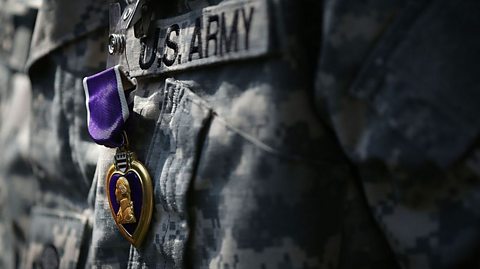
Bronze and purple in colour, featuring a tiny bust of George Washington, and barely 2 inches in size, purple heart medals are a small, yet important badge of honour. These medals are a good way for us to begin to understand the significance of Victory in Japan Day marks Japanese surrender and the end of World War Two for the world.
To this day the American military hands out Purple Hearts. They were originally meant for troops due to be involved in a full ground invasion of Japan in World War 2. A prospect which left America preparing for the worst.
“They thought the casualties they were going to take were so huge, they minted such a volume of these things, America is still issuing the same Purple Hearts.”
Dr James Bulgin is a historian from the Imperial War Museum. He told us fighting in Japan would have been of a ‘different order’ to what American troops had experienced so far in the war.
“The Japanese military had been trained to fight with a completely do or die attitude. They would either fight to the death or, certainly for Japanese officers, commit suicide rather than be taken,” he said.
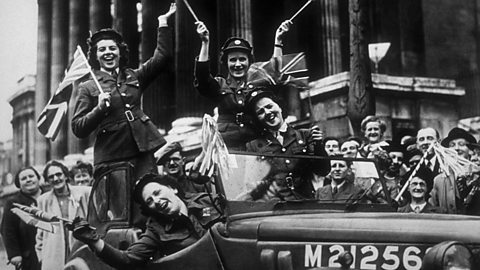
When Victory in Europe Day - was the day near the end of World War Two when the surrender of Nazi Germany was announced and fighting in Europe stopped happened in May 1945 Japan was showing no signs it would surrender. Many expected the war to continue and a full invasion of Japan to take place. It didn’t. By August 1945 Japan had fully surrendered and World War 2 was over. Once again the world was changed forever. In this article BBC Bitesize explores how.
Emperor Hirohito speaks
In July 1945 the leaders of America, Britain and China gave Japan an ultimatum. Surrender or America would attack with whatever means available. The deadline passed and America dropped two atomic bombs on the Japanese towns of Hiroshima (6 August) and Nagasaki (9 August) causing a massive loss of life.
At the same time Russia invaded the Japanese controlled area of Manchuria was under Japanese colonial rule from 1932-1945, encompassing provinces of modern day NE China, Mongolia and Russia. and declared war. “A really important development from Japan's perspective … the fact that the Soviet Union for the first time had entered the war against them amassing huge forces which were a real threat,” said Dr Bulgin.
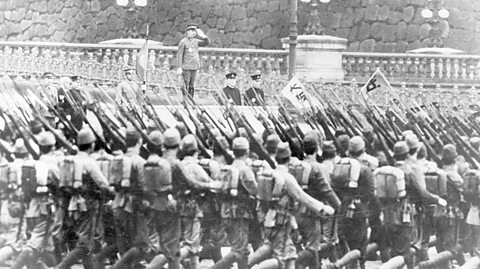
The Japanese Emperor and military were now faced with the possibility of ‘total annihilation’ and ‘catastrophic’ numbers of civilian casualties. Dr Bulgin believes this chain of events gave Emperor Hirohito of Japan “a way to accept the end of the war”.
At the time Emperor Hirohito was seen by his subjects as almost a divine being. The people of Japan had never even heard his voice. The first time they did, Dr Bulgin told us, the Emperor said to the Japanese people not surrendering would lead to their extinction.
Dealing with displaced people
As the people of Japan were hearing this and World War 2 ended, new challenges began to present themselves. The fighting and destruction meant tens of millions of people were displaced right across the world.
Germany is a good example of this. Dr Bulgin told us half of all German citizens were not where they wanted to be. “Forty five percent of dwellings were uninhabitable at the end of the war,” he said, “and there was this huge humanitarian crisis arising from the liberation of concentration camps".
Added to this, many German Jews had fled the Nazi’s during the war into Soviet territory. When the war ended “they came back towards Germany of all places, because the Allies were in control,” Dr Bulgin said. Nobody had expected this to happen and another 100,000 people were added to the millions already needing assistance.
A massive global aid effort began to try and provide essential care and figure out what to do next. Dr Bulgin explained that at the time there was no infrastructure to deal with any of these things. “The scale of displacement had no meaningful precedent in the modern era. Obviously wars always cause displacement, but the scale of this was something else,” he said.
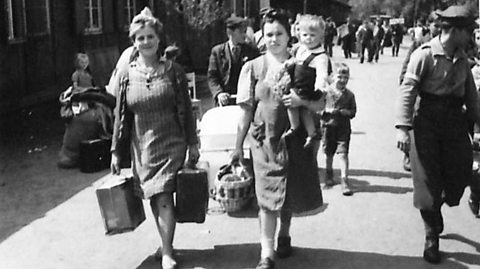
By 1947,An international relief agency established in 1943 to aid countries and individuals affected by World War Two, the United Nations Relief and Rehabilitation Administration, was running 800 resettlement camps, home to around seven million people. These camps were created in all sorts of places; factories, airports, hospitals, and even partly destroyed buildings. One camp was created within the grounds of Hamburg zoo.
Across Europe, countries faced the task of rebuilding and many were reluctant to take in more people, especially those too young, old or unwell to work. Plus there was the issue of immigration “all across the globe there's population shifting, moving, trying to realign,” Dr Bulgin told us.
Taking Britain as an example we can see how this shift, the movement of people, changed the world. Dr Bulgin says there are so many people, second or third generation now, who moved to Britain from all over because of the Holocaust and the war. “Britain's identity now … is a story of migration. It's a complex one because they would never have chosen to leave. They were obliged to leave because of what happened” he said.
The beginning of the end of Empire
One of the aims for the end of the war, as set out by America and Great Britain in 1941 in the Atlantic Charter, is as follows; “The wish to see sovereign rights and self-government restored to those who have been forcibly deprived of them.”
Since the late 19th Century, Japan had been an ‘aggressively imperial power’ a fact Dr Bulgin told us that is often forgotten. It’s surrender on VJ day saw empires in the east and west begin to crumble.
Colonial powers, including Britain, tried to reassert their version of authority in the Asia-Pacific region but Dr Bulgin told us “it was very fragile and not the same as it was before”. The colonial project simply could not survive World War Two.
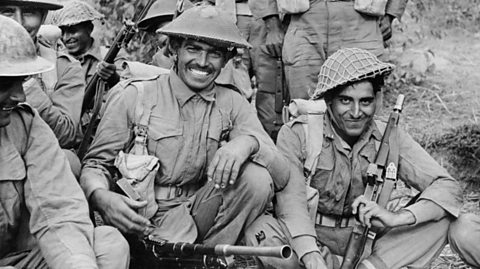
For example, millions of people from across the British Commonwealth had fought alongside Allied troops in WW2. Almost 2.5 million men volunteered from India alone plus 16,000 from across the Caribbean.
Once they’d fought for Britain in the war, many returned home expecting better living conditions and total independence from the British Empire. “It doesn't take long for it to start fracturing,” Dr Bulgin said.
On the second anniversary of VE Day in 1947, India gained independence and their first Prime Minister, Jawaharlal Nehru, was sworn in. A move followed by many other former colonial countries in the years to come.
“An iron curtain has descended across the Continent”
This famous quote is from a speech given by Winston Churchill in 1946 but a year before that, as World War 2 ended, there were already signs of the A period of political rivalry and tension between the US and the Soviet Union, plus their allies, that developed during the end of WW2 and ended in the 1990s that was to come.
Dr Bulgin pointed out people were keen to get away from Soviet Europe and so began moving west. But “the Soviets were trying to consolidate their own status and they didn't want people to do that” he said. So Germany “became the fault line for the Cold War."
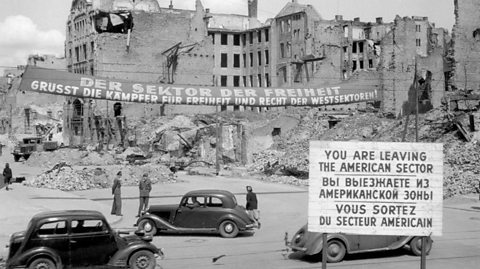
The Allies had worked together during the war as the big three (US, UK and Russia) but after VJ Day, relationships broke down pretty quickly. Germany was split into four areas governed by the US, UK, France and Soviet Union but the US, UK and France soon merged their area into one.
When they brought in a new currency, tensions increased. This led to the separate states of East and West Germany being created, complete with a heavily fortified and volatile border.
These huge power shifts weren’t only happening in Europe. VJ Day also changed China; “it did something to their sense of themselves and their desire to build themselves to be stronger,” Dr Bulgin said. “Their experience of occupation was really grim. They didn't want to put themselves in a position where they were vulnerable to that kind of thing again.”
And on the other side of the Pacific, America had changed too. America’s development into the global power as we understand it “is broadly speaking a product of the World War Two” according to Dr Bulgin. 100 years before the war America was “almost considered as an irrelevant European colony” he told us.
During the war “America brought the might of its industrial complex and the huge scale of the military that accompanied that” Dr Bulgin said, giving it it’s contemporary status. The seeds for the cold war, the new mind set in China, America’s ascendancy - “those dynamics were all established during that period”.
“This completely reshapes the identity of the world”
This period of history saw huge global shifts in international relations, things that affect us all to this day. These include the creation of NATO in the West and the Warsaw Pact across Eastern Europe. “These huge things are occurring, but all within the context of millions of people trying to root themselves or find somewhere to go,” said Dr Bulgin.
In Britain, for example, this led to immigration from across Europe and the Commonwealth including Windrush. “That was to do with Britain's need to rebuild,” Dr Bulgin explained. “What gets lost is that these people came because Britain wanted them to. They were coming to play their part.”
After VJ Day “the complexion of contemporary Britain was fundamentally altered,” Dr Bulgin said. And not just Britain. Countries right across the world and the relations between them were changed forever.
This article was published in August 2025
What is VJ Day and why is it so important?
What is VJ Day? And when is it celebrated? Find out this and more facts from BBC Bitesize.
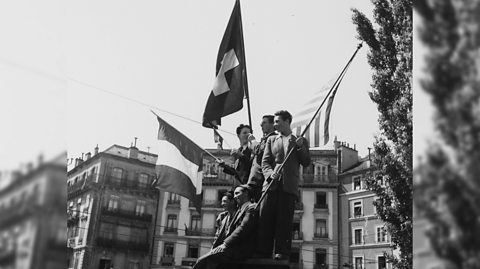
What was VE Day?
Find out more about VE Day with this history guide from BBC Bitesize.