
The word of film and fiction is full of evil technology, ready to ‘take-over’ the world. Deadly droids, battle-hardy bots, crafty computers, and yes even menacing mechanical dogs (see Wallace and Gromit’s earlier nemesis, Preston!)
In the real word, it’s a slightly different story. Robotics technology is being used more and more by scientists in their efforts to protect people and the planet against a range of environmental impacts.
From solar-powered surfboard-like bots at sea, to technology that helps to take out the trash, here are five robots tackling various environmental issues.

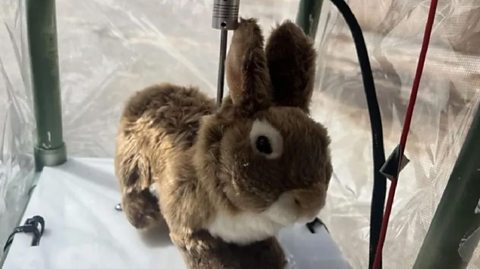 Image source, ROBERT MCCLEERY/UNIVERSITY OF FLORIDA
1. The bunny-bots taking on an invasive species of snake
Florida has a python problem, and in particular Burmese pythons. Owners are either accidentally, or deliberately releasing the 6 metre-long snakes into the wild, where they have no natural predators. The result, Burmese pythons are gorging themselves on everything from deer to marsh rabbits, birds to bobcats. Unlike pythons, these animals are native to the Florida wetlands. Now, their populations are plummeting as the hungry snakes fill their bellies.
To help tackle the issue, in summer 2025, biologists from the South Florida Water Management District released 120 robots, disguised as marsh rabbits, into the Everglades. The robots are solar-powered, with scent and heat emitters, helping them to resemble real python prey. The $4,000 decoys lure the pythons into areas monitored by cameras. This makes it much easier for wildlife teams to capture the snakes. All in the hope of restoring more native populations.
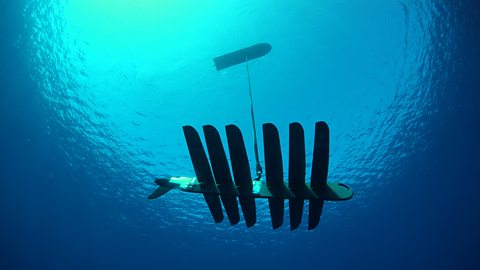 Image source, Liquid Robotics
2. Wave Gliders investigating our oceans
Understanding the effects of climate change in and around our oceans is important, but some places are simply too remote for scientists to get to.
Enter the Wave Glider, a robot designed by aircraft company Boeing. It can be dispatched to hard to reach places, and can operate for nearly an entire year without refuelling.
On the surface, they look like black surfboards, but inside is a computer system that can collect data about the ocean. Beneath, attached by a long cord, is a sub with six fins that uses the motion of the waves to propel the robot forward. There’s also a solar-powered thruster in case it needs to go faster. So far, these robots have collectively travelled more than 2.7 million nautical miles.
Scientists working in the seas around Hawaii have used Wave Gliders to help them learn about marine life. Oceanographers in the Pacific use them to gather information about the movement of tectonic plates. In the North Pacific, a Wave Glider was sent inside a strong typhoon to collect data to help forecast future storms.
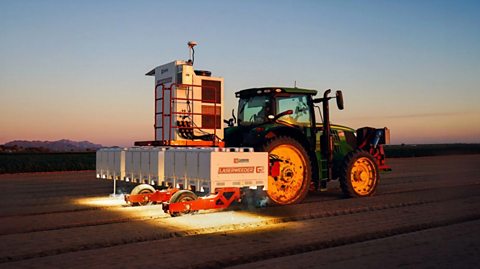 Image source, Carbon Robotics
3. Weed-zapping lasers
Pesticides that kill weeds, diseases and pests, may seem like a simple and cost-effective way for growers to protect their crops. Especially if they want to reduce insect damage and grow healthier yields. But according to the world health organisation, pesticides can potentially be toxic to humans. They can also be harmful to other nature and wildlife too.
LaserWeeder’s technology aims to cut the use of pesticides. It uses high resolution cameras to detect weeds. These weeds are then ‘zapped’ with a laser. The thermal energy from the laser explodes cell walls in the weed’s roots and shoots. This causes the weed to wither and die. The unit can be pulled by a tractor through a field to tackle the weeds. Carbon Robotics, the company behind the LaserWeeder, claim it kills 99% of weeds without damaging or touching crops.
4. The recycling robots that use AI for speedy sorting
Most of us conscientiously sort through our rubbish to make sure we are putting plastics, paper and other recyclable materials in the right bin. But have you ever thought about how it gets sorted at the other end?
Ensuring that plastic objects that are being recycled aren’t contaminated with other materials is much harder than it sounds. So some reprocessing plants have turned to AI to help with the challenge.
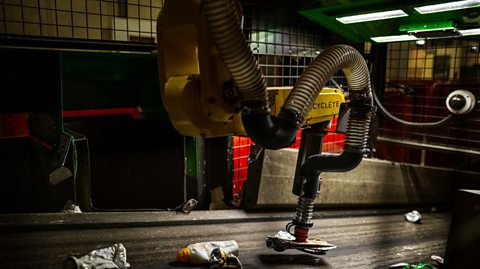
A 3D vision system attached to the top of a conveyor belt scans the items as they move along it. The system accurately works out what each object is made from. Then robotic arms sort through the rubbish.
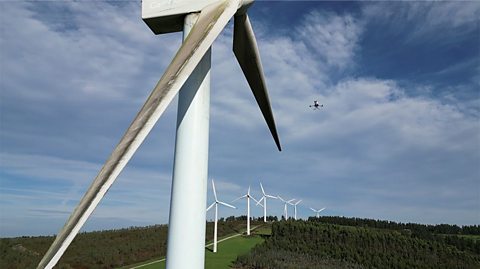 Image source, Perceptual Robotics
5. The drones inspecting giant wind turbines
There are more than 11,000 wind turbines in the UK, producing large amounts of the country’s electricity and powering many homes. However, at around 100 metres tall, and with massively long blades, manually inspecting turbines to ensure they are operating properly is no mean feat.
Bristol-based Perceptual Robotics have created a drone that can safely fly up to the top of each turbine. Once in position the drone can capture detailed images of their components and blades using high-resolution cameras and sensors. Then AI analyses the data for any problem such as structural defects, damage or erosion.
It takes between 10 and 25 minutes to capture images of the blades on a single turbine, with the drone flying at a safe distance of at least six metres away. It then takes the AI programme just a few minutes to analyse the pictures.
This article was published in October 2025
Six new inventions that could change the world
Supercomputers that could fight disease and a whole new way of carrying your shopping

From cute robots to dangerous machines – Six movies that explore AI
Think AI is something new? Films have been considering the impacts and potential of AI for nearly 100 years. BBC Bitesize takes a look at some of those films.

Five amazing biodegradable inventions which could potentially replace plastic
What is 'biodegradable' and what do these amazing inventions mean for the future of plastic?