Meet Balwant, 22, an aircraft engineer for British Airways at Heathrow Airport. Part of our Bitesize world of work series.
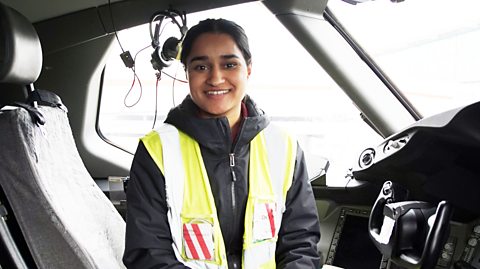
The hardest part was the interview process and getting onto the apprenticeship. From there, everyone just helps you work your way through.
What is your job?
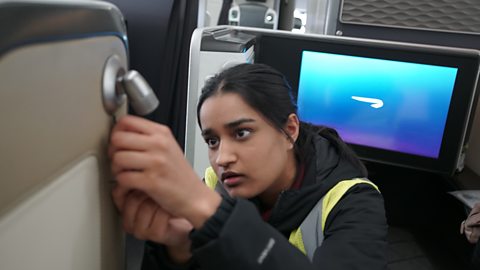
I work on line maintenance and we turn around planes when they come to Heathrow Airport. We get planes ready to go on their next flight by carrying out any maintenance needed. I work in the cabin engineering department, so we look after everything in the cabin. We carry out checks on things like seats, lights or in-flight entertainment, then we fix any problems.
What subjects did you study?
I took all required GCSEs and Food Technology, Music and Business Studies. I achieved A-levels in Maths, Chemistry, Music and English Literature. I use maths a lot in my job. It was part of the module that I studied to get my licence to carry out aircraft maintenance work. I’m also part of the Royal Air Force Air Cadets, so I have a BTEC in Aviation Studies and in Public Services.
Is this the job you always wanted to do?
I actually wanted to be a pilot. I realised that I was not as academic as I needed to be to become a pilot. So, I did work experience in engineering, and decided I loved it! My work experience at British Airways was not like the work experience I’d done elsewhere. I was actually given tools to work with. It was hands-on and that probably influenced my decision to take the route that I followed. I’m glad I chose this route – I'm really happy.
How did you get into your job?
I applied online for the British Airways Apprenticeship Programme. There was a one-to-one interview, a group interview and written exercises. Then we went off for a day of team working. I got a call two days before I finished my exams to say I had got the job!


Top tips
Try to get work experience. I know it’s hard but try to push for it
Try to do day visits and speak to people in the industry because they are the best people to ask for advice
In aviation, people think that a pilot is the only route to take – there’s so much more. When airlines have open days, go to them.

What to expect if you want to be an engineer
- How many people work in the engineering sector?
- What can you earn in different roles?
- What routes can you take to get in?
- Is the demand for engineers expected to grow in the future?
Watch the film to find out the answers to these questions, and much more!
Other resources
- See what type of engineering role might suit you with the meet the future you quiz
- Find out more about the different areas of engineering with this guide from Tomorrow's Engineers
- Learn more about roles in engineering with the National Careers Service explore careers tool
- Discover a practical new way to study via T-levels (England-only).
Emma-Louise Have you ever had an idea for an invention, something you thought would make your life easier? If so, you've taken your first steps into engineering something.
Frankie As an engineer, you apply scientific principles to design and help create all sorts of things like buildings, aircrafts, or bras.
Emma-Louise Traditionally, engineering falls in four main categories: chemical, civil, electrical, and mechanical engineering. And, within each of these, there are more specific types of engineering disciplines.
Frankie There were nearly 870,000 engineers in the UK [in 2020], with an estimated 4% growth of just under 40,000 more jobs by 2025.
Emma-Louise You could consider roles such as electrical engineer, chemical engineer, mechanical engineer, nuclear engineer, or software engineer. For electrical engineers,
Frankie people who design, build and maintain electrical systems and equipment,
Emma-Louise there is an expected job growth of just under 1,600 jobs by 2025. As of 2020, the median salary was just over £50,000 per year.
Frankie For civil engineers,
Emma-Louise people who design and manage construction projects, anything from bridges to sports stadiums,
Frankie there's an expected growth of approximately 2,800 jobs by 2025, with a median salary of around £44,500.
Emma-Louise And for mechanical engineers,
Frankie people who develop and design machines that are used in various industries from construction to farming,
Emma-Louise there's an expected growth of just under 2,600 jobs by 2025, with a salary of around £42,000. If you've got a curious mind and love problem solving, engineering could be a good career path for you.
Frankie There are many ways into engineering. The first thing to figure out might be what kind of engineering you're interested in.
Emma-Louise You could consider apprenticeships that are relevant to that role, like a Level 6 Manufacturing Engineer or a Level 6 Electro-mechanical Engineer apprenticeship. These typically take between four and six years to complete.
Frankie Of course, there are also many university courses you could look into. Courses such as Electro-mechanical Engineering, Applied Physics, or Aeronautical Engineering. You would usually need two or three A-levels or equivalent for these, and some of these courses will specify if you need particular A-levels, or the equivalent. Maths and Science subjects are sometimes required.
Emma-Louise There's now more choice as the new T-level qualification is available in England. These two-year courses are equivalent to three A-levels and involve 80% classroom learning and 20% industry placement.
Frankie You can also find out about courses accredited by professional engineering institutions from the Engineering Council.
Emma-Louise Engineers have valuable transferable skills that are handy for other job roles and everyday life, such as problem solving, critical thinking, and working through potential solutions.
Frankie If you've heard things in the past that have made you think engineering is not for you, it might be worth taking a deeper look. Engineers are working on some of the most exciting challenges we face, be it enhancing virtual reality or engineering better medicines. Let's hear from some professionals. Ben is an aerospace engineer. "I love interacting and working with people to find solutions to problems. I enjoy knowing that millions of people fly around the world every year on products that I have helped develop. There's a big push at the moment for more environmentally friendly solutions. Air travel is a massive contributor to global warming and so anything that the industry can do to reduce harmful gases being emitted will make a big impact."
Emma-LouiseDavid, an expert at the Institution of Engineering and Technology, says: "The most exciting thing about engineering and technology is that there will be roles in the next five to 10 years that don't exist yet. Artificial intelligence (AI), coding and ‘green jobs’ – those that work to combat climate change – will continue to evolve and be some of the most important roles within the sector in years to come. It's also really important that the engineering industry is inclusive and representative as engineers, design products and services for everyone."
Emma-Louise Engineering is creative, exciting and not to mention that it pays pretty well once you've worked your way up beyond junior roles. The median wage within the sector is over £41,000, compared to the median full-time salary in the UK which is around £28,500.
Frankie There's also particularly strong growth in software publishing and wireless communications.
Emma-Louise Engineering is also an industry where the gender mix isn't well balanced, although the research is unclear as to why.
Frankie The main shortfall here is engineers who identify as female. As of 2020, 88% of engineers identified as male. However, lots of employers are keen to change this, so there should be more and more opportunities coming up for engineers who identify as female.
Emma-Louise One thing that's for sure is that there are going to be lots of opportunities available in the engineering sector, with just under 40,000 new jobs expected by 2025. So, if this has piqued your interest, then it'll be worth doing some more research to see if this is right for you.
For careers advice in all parts of the UK visit: National Careers Service (England), nidirect (Northern Ireland), My World of Work (Scotland) and Careers Wales (Wales).


Work experience in your area
Find work experience placements with Workfinder.
Tips and advice
Help with interviews, writing a CV and all things work experience related.


How to become an engineer. collection
Find out more about the engineering sector and how those currently working in it got their foot in the door.

Ben: aerospace engineer
Ben's the co-founder of a company called StratoBooster. They test space launch systems.

Amy: Formula 1 engineer
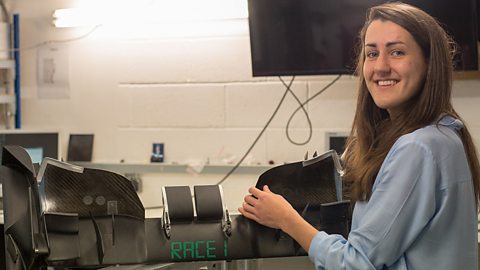
Amy helps develop ways to make racing cars go faster.