Sign up to the BBC Bitesize newsletter! External Link
For home education news and stories plus updates on the latest Bitesize content, register for our newsletter today.

You may or may not have come across the term before, but ‘strewing’ is a great technique for harnessing your child’s natural curiosity.
Whether you’re home educating your child or they’re at a school during the day, all you need is a little intention, some low-cost resources and a child with a teensy bit of curiosity.
What is strewing?
According to Collins dictionary: “To strew things somewhere, or to strew a place with things, means to scatter them there.”
‘Strewing’ is an activity that’s embraced by many home educators and unschooling parents but can be used by anyone. It means intentionally leaving or scattering objects and materials in your home for your child to discover, then seeing what they do or don’t do with them, as long as they’re safe from harm.
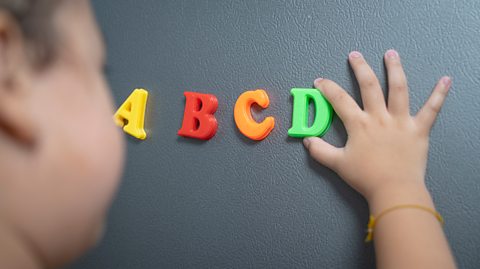
Emma from Gloucestershire home-educated both her children and used strewing: “Leave things around the house and see what interests your child. It could be a game or toy when they’re younger, or watching a programme you think might interest them. It’s putting out a range of things and seeing what gets picked up on.”
It can be as simple as leaving some bird feathers on the kitchen table or temporarily sticking some magnetic letters on your fridge. Your child may just walk by, they may stop and spell out some words on the fridge, or create a picture with the feathers.
How to do strewing
It’s up to you how you approach strewing. However, in its purest form, it’s about leaving something out for your child to discover, and then allowing them to enjoy their natural curiosity, exploring new things without any pressure, and taking ownership of what they’re doing, without you expecting any particular results.
You could leave out some playdough and child-safe tools if, for example, you know your child enjoys hands-on activities. You can observe what your child does with the dough, sit alongside them, ask them questions as they’re playing, or simply just potter in the background.
What is strewing in education?

Early years and younger children
In early years settings, staff use something which is similar to ‘strewing’ but with an intended learning outcome.
‘Continuous provision’ aims to embed children’s learning through exploration and play. Educators leave resources out long-term so children can access them during ‘free play’ time, enhancing what they’ve already learnt and boosting the child’s problem-solving, critical thinking and independent learning skills.
You could use the ‘continuous provision’ model at home in the following ways:
a dressing-up/role-play area that relates to a story or book you’re reading
a maths area with cups, jugs, measuring tapes, dominoes, number lines, etc
a creative area with paper, pens, paints, feathers, glue, etc
a small world area that could include a scene from a book, small dolls, animals, sand, pebbles, sticks or fabrics
a phonics area with flashcards, picture books and games
an ‘engineering’ area with building blocks, cardboard boxes, toilet paper tubes, etc
a reading area with a nice cushion or beanbag and books you think they’ll be interested in.
Older children
The above is more suited to children aged four to seven. For older children, you may choose to focus on their interests, or to ‘strew’ things relevant to the exam board specifications if they’re studying towards their GCSEs or equivalent. This could include:
literature they may enjoy, including books, plays, poetry, comics, newspapers and magazines
board games and card games
computer games that cover things like maths concepts, history, geography
modelling apparatus such as cardboard, foam board, wood, glue, parcel tape
art and design materials
science kits or apparatus
cooking equipment, ingredients and recipes
curated content on educational websites like BBC Bitesize, online video platforms, audiobooks, podcasts.
Parent Helen says: “My 11-year-old daughter doesn’t seem to enjoy reading but she loves history. I’ve noticed if I ‘strew’ history books, by leaving them on the counter where she eats breakfast, she’ll browse through them in the mornings.”

What’s another example of strewing?
Here’s how strewing can prompt unanticipated learning. Imagine you leave out some paper and pens on the kitchen table and your child comes into the room. You might assume your child will pick up the pens and start to draw with them.
Instead, your child might see the pens as a building object or as something they want to organise. They might use the pens to poke holes in four corners of the paper and then ‘prop’ it up like a tent. They might want to arrange the colours in rainbow order. Or they might decide the pens need tidying away and put them back where they normally belong.
In each scenario, the child is independently learning something, and all because you had the intention of ‘strewing’ an object out for them.
What are life skills and how does strewing help?
There are many different definitions and interpretations of ‘life skills’, and to an extent they depend on each individual’s needs and priorities. In essence, they’re the skills needed for the “overall development and empowerment” of an individual.
UNICEF, the United Nations agency for children, further outlines the three areas of life skills:
Foundational: literacy, numeracy and digital skills
Transferable: communication, creativity, problem-solving, empathy, respect for diversity and critical thinking
Job-specific: allows performance in a particular job.
‘Strewing’ can help with all of the above, but it can be particularly beneficial for developing transferable skills such as creativity, problem-solving and critical thinking.

Picture an eight-year-old who wants to be a train driver. You can leave out model trains, let them build train tracks, watch programmes, read books about trains (fact and fiction), provide drawing materials. That allows for creativity and independent learning.
Then, in conversation, you could ask a question like: ‘How do you think you become a train driver? What skills and training might you need? Do you think all people can become train drivers? What would a train driver who’s in a wheelchair need? What about a train driver who’s hard of hearing?’
Leave out research materials such as pen, paper, relevant books, stories and access to the internet (ensure you have parental controls on), and see where that takes them. This enhances your child’s critical thinking and problem-solving skills, as well as considering different people’s needs.
Where can I find more ideas for strewing?
Use these BBC Bitesize resources to prompt ideas for strewing at home:
An A to Z of fun things to do without leaving the house
BBC Bitesize early years learning resources
Where can I find more support for home education and parenting?

The BBC Bitesize home education collection is designed to support you and your child’s learning at home with free downloadable resources, advice articles and videos for children aged two-to-five years old, five-to-11 years old and 11-to-16+ years old.
Bitesize Parenting is the go-to place for the whole parenting community to find stories, expert advice and fun activities.
If your child has special educational needs or disabilities, be sure to check out the Parenting SEND collection. Bitesize has a collection of Sensory Stories, an immersive video series of unique sensory adventures for children with additional needs.
For more information about home education, this BBC News article covers the rise in families deciding to educate their children at home.
