Key points about describing life at school
Formed in the same way as regular ar/er/ir verbs but includes a reflexive pronoun (eg me, te, se). Often used to describe actions that we do to ourselves. are useful for talking about daily routine and are formed in the same way as ar, er and ir verbs.
Reflexive verbs are used with a A pronoun used with a reflexive verb, for example myself, yourself and himself. .
This guide contains a video as well as reading and listening practice.
Video - Talking about daily routine
Watch the video of Lolo talking about his daily routine.
Lolo talks about his daily routine using verbs in the present tense
Por la mañana me despierto temprano y me levanto para apagar la alarma.
Lo primero que hago es preparar el desayuno. Normalmente desayuno café, frutos secos y fruta. Después, me lavo los dientes y me visto. Antes de acostarme, pienso en qué ropa ponerme porque en la escuela no tenemos uniforme. Antes de salir, me peino, me pongo las lentillas y preparo todo para mi trabajo.
¡Buenos días! ¿Qué tal, chicos?
Lolo (de fondo): ‘¿Y esta persona, si este tiene miedo?'
Normalmente trabajo de 09:00 a 14:25 antes de tener mi primer descanso. Entonces, almuerzo algo ligero para después continuar trabajando.
Lolo (de fondo): 'Estás pensando demasiado, ¡muy bien!'
En España es normal almorzar entre las 14:30 y las 15:30 de la tarde. Es mucho más tarde que en otros países de Europa. Hoy, por ejemplo, voy a almorzar un poco de tortilla de patatas y un yogur.
Salgo de trabajar a las 18:00 de la tarde, la hora de la merienda en España. La merienda es algo pequeño para comer, como un bocadillo, galletas o fruta. Después de comer, me gusta ir al gimnasio.
Más tarde, me gusta pasear un poco con mi pareja, ver una serie cuando cenamos y leer en la cama antes de dormir.
Translation
In the morning, I wake up early and get up to turn off the alarm.
The first thing I do is prepare breakfast. I usually have coffee, nuts and fruit for breakfast. Afterwards, I brush my teeth and get dressed. Before going to bed, I think about what clothes to wear because I do not wear uniform at work. Before leaving, I comb my hair, put on my contact lenses and get everything ready for work.
Good morning! How are you doing, guys?
Lolo (in the background): ‘And this person, if this one is scared?’
I typically work from 09:00 to 14:25 before having my first break. Then, I have a light lunch before continuing to work.
Lolo (in the background): ‘You are thinking hard, well done!’
In Spain, it's common to have lunch between 14:30 and 15:30 in the afternoon. It is much later than in other European countries. Today, for example, I'm going to have some Spanish (potato) omelette and some yoghurt for lunch.
At night is when I have the most free time. I leave work at 18:00 in the evening, merienda time in Spain. A merienda in Spain is a snack, like a sandwich, biscuits or fruit.
After eating, I like to go to the gym. Later, I enjoy going for a little walk with my partner, watching a TV series during dinner and reading in bed before going to sleep.
Vocabulary - Describing daily routine and the school day
Useful verbs for describing daily routine and life at school include:
| Spanish | English | Spanish | English |
|---|---|---|---|
| Check your connection, refresh the page and try again. | to get up | Check your connection, refresh the page and try again. | to revise, review |
| Check your connection, refresh the page and try again. | to wake up | Check your connection, refresh the page and try again. | to start, begin |
| Check your connection, refresh the page and try again. | to go to bed | Check your connection, refresh the page and try again. | to begin, start |
| Check your connection, refresh the page and try again. | to comb one’s hair | Check your connection, refresh the page and try again. | to teach, show |
| Check your connection, refresh the page and try again. | to put | Check your connection, refresh the page and try again. | to learn |
| Check your connection, refresh the page and try again. | to participate | Check your connection, refresh the page and try again. | to work |
| Check your connection, refresh the page and try again. | to allow | Check your connection, refresh the page and try again. | to choose |
| Check your connection, refresh the page and try again. | to wear |
Grammar - How to use reflexive verbs and reflexive pronouns
Reflexive verbs are often used to describe actions that we do to ourselves. They are particularly useful when talking about daily routine.
For example:
Check your connection, refresh the page and try again. - to go to bed
Check your connection, refresh the page and try again. - to have a shower
Reflexive verbs are formed in the same way as regular ar, er and ir verbs but include a reflexive pronoun, eg me, te, se.
The reflexive pronoun is attached to the end of the Form of the verb that has not been conjugated. Usually translated with 'to' in English, eg to play.. For example:
Check your connection, refresh the page and try again. - to get up
Check your connection, refresh the page and try again. - to wake up
In the A verb that describes an action that is happening now or that happens regularly, eg I eat breakfast., the pronoun comes before the verb and changes according to the person. For example:
me levanto - I get up
nos levantamos - we get up
The table shows the reflexive pronouns in Spanish:
| Reflexive pronoun | Verb | English |
|---|---|---|
| Check your connection, refresh the page and try again. | Check your connection, refresh the page and try again. | I get up |
| Check your connection, refresh the page and try again. | Check your connection, refresh the page and try again. | you (singular informal) get up |
| Check your connection, refresh the page and try again. | Check your connection, refresh the page and try again. | he/she get us/you (singular formal) get up |
| Check your connection, refresh the page and try again. | Check your connection, refresh the page and try again. | we get up |
| Check your connection, refresh the page and try again. | Check your connection, refresh the page and try again. | you (plural informal) get up |
| Check your connection, refresh the page and try again. | Check your connection, refresh the page and try again. | they/you (plural formal) get up |
For example:
Check your connection, refresh the page and try again. - I get dressed.
Check your connection, refresh the page and try again. - He/she/you (singular formal) has a bath.
Check your connection, refresh the page and try again. - They go to bed.
Reflexive verbs in Spanish - Mini quiz
Fill in the gap with the correct word using the infinitive ducharse.
________ a las siete.
I have a shower at seven o’clock.
Me ducho a las siete.
The reflexive pronoun to go with 'I' is me.
The verb ending for ‘I’ with an ar verb is o.
The sentence is in the present tense, so the reflexive pronoun goes before the verb.
Fill in the gap with the correct word using the infinitive acostarse.
________ a las diez.
We go to bed at ten o’clock.
Nos acostamos a las diez.
The reflexive pronoun used with ‘we’ is nos.
The verb ending for ‘we’ with an ar verb is amos.
Find about more about using reflexive verbs in the Reflexive verbs in the present tense in Spanish guide.
Reading practice
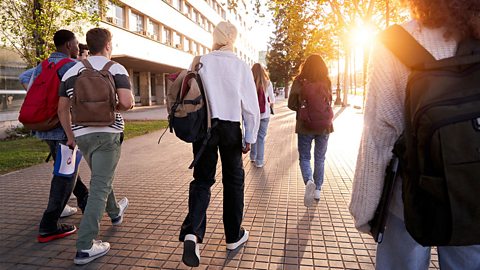
Read the following excerpts of interviews with Luisa, Amira and Miguel and answer the questions that follow.
Luisa
Voy al colegio a pie, está cerca de mi casa. Mi asignatura preferida es la geografía pero no me gusta el inglés.
Amira
Mis profesores son trabajadores. Me gusta hacer mis deberes porque saco buenas notas, sobre todo en ciencias.
Miguel
Los deberes son difíciles y encuentro que mis profesores no son simpáticos. Son demasiado estrictos.
- Who walks to school?
Luisa
- Who finds homework hard?
Miguel
- Who gets good marks?
Amira
- Who does not like English?
Luisa
- Who has a negative opinion of the teachers?
Miguel
Click or tap on the Show more button to read the translations of what Luisa, Amira and Miguel say.
Luisa
Voy al colegio a pie, está cerca de mi casa. Mi asignatura preferida es la geografía pero no me gusta el inglés.
I walk to school as it is near my house. My favourite subject is geography but I do not like English.
Amira
Mis profesores son trabajadores. Me gusta hacer mis deberes porque tengo éxito en mis pruebas, sobre todo en ciencias.
My teachers are hardworking. I like doing my homework because I do well in tests, especially in science.
Miguel
Los deberes son difíciles y encuentro que mis profesores no son simpáticos. Son demasiado estrictos.
Homework is difficult and I do not find my teachers kind. They are too strict.
Vocabulary - Describing life at school
More useful vocabulary to use when describing life at school includes:
| Spanish | English | Spanish | English |
|---|---|---|---|
| Check your connection, refresh the page and try again. | school subject | Check your connection, refresh the page and try again. | break |
| Check your connection, refresh the page and try again. | course | Check your connection, refresh the page and try again. | strict |
| Check your connection, refresh the page and try again. | project | Check your connection, refresh the page and try again. | uniform |
| Check your connection, refresh the page and try again. | (primary) school | Check your connection, refresh the page and try again. | homework |
| Check your connection, refresh the page and try again. | lunchtime | Check your connection, refresh the page and try again. | mark, grade |
| Check your connection, refresh the page and try again. | facilities | Check your connection, refresh the page and try again. | opportunity |
| Check your connection, refresh the page and try again. | secondary school | Check your connection, refresh the page and try again. | compulsory |
Useful vocabulary to use when describing transport to and from school includes:
| Spanish | English |
|---|---|
| Check your connection, refresh the page and try again. | on foot |
| Check your connection, refresh the page and try again. | by bus |
| Check your connection, refresh the page and try again. | by train |
| Check your connection, refresh the page and try again. | by car |
All vocabulary listed in this guide can be found on the vocabulary sheet below.
Listening practice
Click or tap on the purple Start button to listen to a podcast about what students think about school. Listen to each speaker and answer the questions.
Vocabulary sheet
Click or tap on the image below for a list of useful vocabulary to use when describing life at school.

Now you have revised the important vocabulary and key grammar points for describing life at school why not have a look at the Festivals, customs and celebrations guide?
Careers advice and tips from BBC Bitesize
Future careers, further studies and the world of work - we're here to help with advice from experts and from young people who've found their path.

More on Education and work
Find out more by working through a topic
- count3 of 4

- count4 of 4

- count1 of 4