Football can have a huge impact on people’s lives - and on the environment.
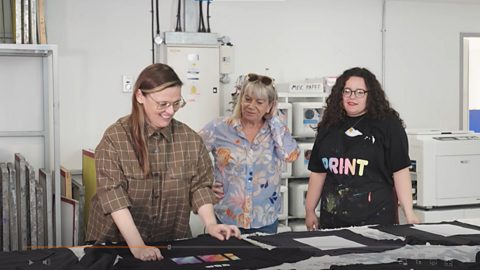
That’s why three women, Jacqui, Jean and Millie, have joined forces to work on an upcycling project that highlights the need for sustainability in the worlds of football and fashion. Between them, they have designed and reworked everything from scarfs to coats, without buying anything new.
BBC Bitesize visited Liverpool John Moores University to discuss why sustainability in football is important to them and how anyone can upcycle items they may already have at home.
The role of upcycling in women’s football
So, why upcycling, particularly in women’s football? Jean is a women’s football historian and the 2023 tournament will be her seventh Women’s World Cup.
Jean told BBC Bitesize: “Upcycling is an alternative view of things that you might already have in your wardrobe, that with a big of imagination - opposed to lots of cash - can be turned into something that’s a very personal piece for you.”
She explained that a lack of merchandise for women’s football throughout the years has resulted in a self-made culture, where fans have used their own creativity to celebrate the players, teams and game they love.
Jacqui trained as a fashion designer before becoming a senior lecturer in fashion communications and also uses upcycling as a form of self-expression. “I think we’re really aware of the damage, particular that’s caused by fashion, to the planet.”
Her football upcycling journey began in Women’s World Cup in 2019, when she started to make small accessories, such as pin badges, as well as A small magazine that is produced cheaply by one person or a small group of people. The success of the Women’s Euros in 2022 led to growing interest in her project.
One of Jacqui’s upcycled garments is a coat made entirely from England scarves - inspired by former Arsenal manager Arsène Wenger. “Like most ideas, it started as a concept.” She said, explaining all the scarfs were donated by a shop in Manchester. “We didn’t buy anything new to make it.”
All the ends which weren’t used in the coat will be made into a scarf in time for the World Cup. The coat was taken to the Women’s Euros final, where it was worn by fans on Wembley Way, and if that wasn’t enough, Jacqui and Jean will be taking the coat to the World Cup in Australia - where luckily it will be winter!
Jacqui: We are really aware at the moment of the damage done by fashion, particularly to the planet. Part of it as well is all about, you know, trying to maybe encourage in some way kind of self made clothing. You know everything's mass produced now, but it adds that certain amount of personality, I think to kind of what you're wearing.
Kim: Yeah, I think you've hit the nail on the head there isn't it, is find out what you can do to play your part. It doesn't have to be massive, but just somehting to sort of you know, do your bit when it comes to helping the environment, sustainability and obviously still enjoying your sport and your football. You love football and you've found a way to make it sustainable.
Jacqui: I love football, and I started playing football, after the Euros.
Kim: Had you never played football before then?
Jacqui: No I'd never played it, so I play for a grassroots team.
Kim: I love that, so you were inspired.
Jacqui: Yeah and I think the Euros has inspired so many people to create, to play and I think with this project and this collaboration where that's what we're thinking about.
Jean: Women's football has always been very much a self made culture. The fans have made their own things just forever because there wasn't that much merchandise out there.
Kim: What would you like to see in the future when it comes to sustainability in the sport?
Jean: Yeah, I think we have to be mindful when we host these big mega events as they're called in World Cups, about what that's doing to tourism, as well as to what would be consumed on site and I think this is just a very small message, no more than that you can be mindful about your use of resource.
Kim: What is it like for you when you can do something around a big topical moment like the Women's World Cup, is that something that you really look forward to doing?
Millie: Yeah, definitely. I've been really excited for the World Cup, because it inspires me.
Kim: And if someone was kind of inspired by you, and what you do, and they wanted to created something like this at some at home, because the whole point is upcycling, right? It's making things relevant again. What would you say to them, if they wnated to give it a go?
Millie: So you could just take some markers or pens or biro. Take a t-shirt that you want to sort of upcycle and draw whatever you want on it and yeah, it'll look fabulous.
Kim: So guys, obviously it would be rude to not have a parting shot of you repping the creations that you've all made. So Jean, you've got Millie's beautiful illustration on here. How does it feel?
Jean: It's absolutely beautiful. I think it's a stunning portrait and just an example of what a really talent young artist can do, so it's great to see it work out on the T-shirt.
Kim: Yeah, couldn't agree more and obviously we've upcycled an old BBC T-shirt there to give it its full use. Millie what's it like for you when you see your creations come to life like this?
Millie: Oh it's always really exciting. Yeah I love creating things and seeing them out in the world.
Kim: Then Jacqui, we've got an upcycled scarf here. Just talk to us about what this one is.
Jacqui. Yeah, So this is just an England scarf that I had at home and then we've put some kind of like vinyl lettering on there with a heat press.
Kim: Are you all really pumped up for the summer, where are you at with that?
Jacqui: Absolutely, also what you might find, what you might see, who's wearing what, you know, how it evolves is the exciting bit definitely.
Millie: What is gonna inspire you, cause there's always something exciting that happens in a tournament.
Jacqui: Yeah, what's the take away from the tournament?
Kim: Yeah, well we'll have to wait and see won't we. Watch this space.
Upcycling to make history
Jean and Jacqui have received funding from Liverpool John Moores University and The Art Fund Jonathan Ruffer grant to go to the 2023 Women’s World Cup in Australia and New Zealand. They will be doing some contemporary collecting for the National Football Museum. This means that the football items they come across in Australia can become documented and exhibited as pieces of history for those in the future.
The pair will also be working alongside the Football Supporters Association (FSA), where they hope to be running upcycling workshops with fans.
It can be challenging to live in a sustainable way. The air miles involved in travelling across the world to watch a World Cup and the mass-production of clothing, such as football shirts, pose important environmental questions.
But Jean believes that upcycling is also a small way to bring sustainability and accessibility to the football world. Millie, a Liverpool John Moores University graduate, echoes this sentiment. “I don’t like to waste things. With art supplies I try and change them into something new. For example, I’ll try to re-use pens by dipping them into ink.”
How can you start upcycling?
It may feel hard to know where to start when it comes to upcycling. Millie first got involved with the upcycling project when Jacqui spotted her drawing football players in her university studio.
She first began drawing footballers when she went to watch a match and became engrossed by the colours and the movement. She now uses these illustrations to transform items into something that has personal meaning, whether that be flags, banners or clothing.
What final tips do Jacqui, Jean and Millie have for people interested in beginning an upcycling project of their own?
Jacqui told us that one of the important things about upcycling is experimentation. “Before thinking of buying something new, definitely go into the wardrobe to see what you’ve got and what you can breathe life into.”
Millie agrees with this, adding, “Don’t overthink it, just do it. It’ll create a good impact no matter what you do.”
Jean credits the women’s game, particularly the success of the Euros, for allowing people to unlock their own creativity in new and exciting ways. “I think with this project and this collaboration that’s what we’re thinking about - how these things we make might live again.
“Whether it’s a fan wearing it, or it inspires someone to draw or make clothes in a more sustainable way.”
This article was published in July 2023
Five things you didn't know about the women's Champions League
Who has scored the most goals? And which team has taken home the most trophy titles?
In need of some revision motivation? Top tips from the Lionesses
BBC Bitesize asked some of the Lionesses what they'd like to say to their Year 11 self.

An all-round legend: Meet Enid, the 82-year-old cricketer
Get to know an utter legend of English cricket, the all-rounder Enid Bakewell who is still playing at the age of 82.