If you want to know the weather forecast, it's unlikely you'll decide to ask a beloved animal.
But that's exactly what happens on Groundhog Day every year.
Best known for the 1993 film of the same name, where actor Bill Murray’s character is forced to relive the same day over and over again, Groundhog Day itself is completely real.
It’s marked every 2 February in Pennsylvania, USA, and its celebrations are seen as a means of predicting the upcoming weather. But it’s not necessarily the most reliable method of forecasting temperatures.
BBC Bitesize takes a look at five classic weather myths and urban legends.
Groundhog Day
So what actually happens on Groundhog Day?
There are different events across North America, but the best known takes place in Punxsutawney in Pennsylvania.
A groundhog, named Punxsutawney Phil, emerges from his burrow to the south of the town. If he sees his shadow and returns to his hole, he predicts another six weeks of winter. If he doesn’t see his shadow, he believes an early spring is on its way.

The tradition is thought to have evolved from German celebrations of Candlemas on 2 February. Known as Dachstag, or Badger Day, it was believed that if a badger refused to emerge from its home, locals were in for four more weeks of snow.
As the German-speaking Pennsylvanian Dutch settled in America, the tradition moved stateside with a groundhog replacing the badger. Punxsutawney Phil made his forecasting debut at the first official Groundhog Day in 1887 - and despite the average lifespan of a groundhog being around 6-10 years, local officials insist that there's only ever been one Punxsutawney Phil.
But if you’re looking for a reliable way of forecasting the weather for February and March, it’s perhaps best not to listen to Phil, whose predictions have got much worse in his second century.
The US-based National Centers for Environmental Information has compared Phil’s predictions between 2015 and 2024 and found that he was right just 30% of the time.
So whatever is forecast this Groundhog Day may not be entirely accurate, if history repeats itself.
Rain on St Swithin’s Day
15 July is St Swithin’s Day – supposedly an important day if you have plans for a long hot summer.
St Swithin was the Bishop of Winchester and died in 862. It’s said he was a humble man and requested to be buried in the graveyard and not within the cathedral itself.
It’s claimed his body was moved, on 15 July several years later, to within the cathedral and his spirit was so offended, there was a great storm for 40 days.

Some people now believe that if it rains on St Swithin’s Day, the same will happen – 40 more days of rainfall. No precipitation on 15 July would mean a rain-free summer.
Unsurprisingly, this one isn’t true either.
According to the Met Office, since records began, there have never been 40 wet or dry days in a row following St Swithin's – even if it might feel like it during some of the less sunny British summers.
Cows lying down means rain
It’s only natural given our weather in the UK, that several of our weather myths are about rain - and here’s another one where we take the word of our animal friends.
The story goes, that when cows lie down, it means it’s going to rain but once again, there’s no real evidence to back this up.
Cows do tend to lie down when it’s cooler so they can keep their stomachs warm, as illustrated in a 2013 study by the University of Arizona and Missouri.
And while it’s true that cooler weather does increase the chance of rain, it’s not a hard and fast rule – particularly as further bovine research shows that cows mostly just really like lying down.
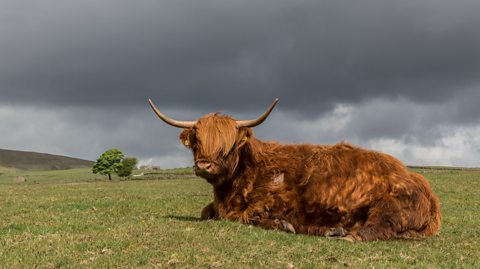
Cows generally spend around a third of their time sleeping, which would account for much of their lying down. It also helps their digestion and more often than not, if one of them heads to the ground, the rest of the herd follows. So while it may seem like there’s a connection, cows forecasting rain is probably nothing more than a coincidence.
Too cold to snow
If your hands have ever been freezing while building a snowman, were you surprised it had snowed at all in such cold conditions?
According to a 2017 Met Office report, 62% of us believe that it can get too cold to snow – but that’s not true here in the UK.
As well as colder temperatures, snow needs water vapour in the air in order to produce snowflakes and the colder it gets, the less water there is.
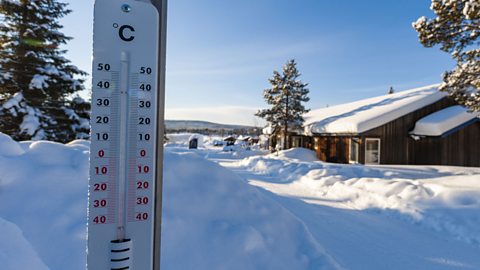
The Met Office say that even at temperatures of -20°C, the likelihood of snow is much, much smaller but not impossible – and that it is extremely unlikely we would ever experience temperatures here that were cold enough to stop it from snowing as the UK is surrounded by water.
Too cold to snow? No – but definitely too dry to snow on occasions.
Fry an egg on the pavement
On those blisteringly hot days each summer, you’re bound to hear someone say that it’s so hot, you could fry an egg on the pavement.
Firstly, it’s probably not the most hygienic place to cook. Secondly, it’s not actually possible to do.
One of the earliest references to this unconventional cooking practice dates back to 1899 in a newspaper in Atlanta, Georgia in the USA.

The minimum temperature to fry an egg is 55°C – albeit it would take around 20 minutes to cook at such a low heat – and the hottest temperature ever recorded on Earth was 56.7°C in Death Valley, California in 1913.
So in theory, could this be possible? Unfortunately, pavements were not designed with cooking in mind. Concrete is not a good heat conductor and lighter-coloured pavements will reflect more heat than they absorb. The addition of the egg also cools the pavement upon impact as well.
If you’re desperate for a fried egg while you’re out and about in very high temperatures, you can, in theory, crack it onto the bonnet of a car as the metal surface conducts heat much, much better – but you’re probably better off using a traditional kitchen hob or sticking to an ice cream.
This article was published in January 2021 and updated in January 2026
How to survive and thrive out in the winter weather
We’re all told getting outside is good for us what ever the weather. We've tips from a mountain rescue leader, a sleep expert, a beautician and even a Postie
The history and science of snowmen
Building snowmen is a staple part of a snowy winter - but why and how do we do it?
Six of the most naturally colourful places in the world
From blood-red lakes to emerald-green fields, we explore some of the world's most colourful natural locations