Dinosaurs have delighted, amazed, and sometimes even terrified humans for centuries. Every new discovery creates shockwaves around the world. This summer alone has seen the unearthing of a “punk rock” dinosaur with metre long spikes, in Morocco. While closer to home, huge dinosaur tracks were revealed in a quarry in Oxfordshire.
Discoveries like these help us to understand the prehistoric world and also the natural world we inhabit today.
One man who knows this more than most is palaeontologist Dr Diego Pol. The Argentine was part of the team that discovered one of the largest dinosaurs to ever roam the planet.
Diego recently spoke to Witness History about the discovery, and BBC Bitesize couldn’t help but listen in.

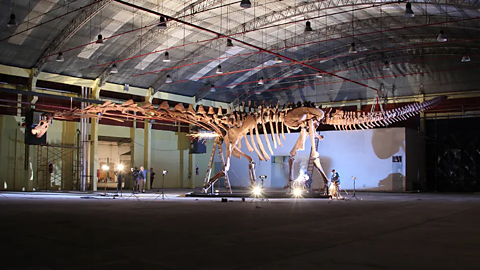 Image source, Diego Pol/MEF
Where was the largest dinosaur found?
Laying claim to be the largest dinosaur ever is complicated, with research evolving all the time. But it’s fair to say that a chance discovery of a bone at a farm in Patagonia, Argentina, in 2012, led to the unearthing of one of the largest dinosaurs that ever lived.
The bone that sparked Diego’s delight was happened upon by Aurelio Hernández - a shepherd working on a ranch near La Flecha, located about 250km west of Trelew. He was out looking for sheep, but instead found something much more exciting.
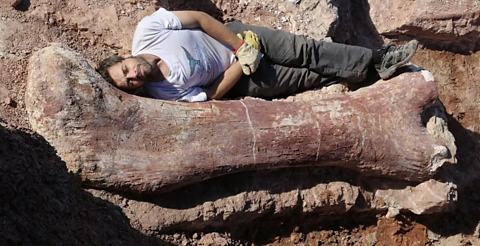 Image source, Freddy, Kit, Zella Anderson
'You learn to be cautious with reports'
The area where the bone was found is renowned for fossil finds. There are strict rules to follow if one is found. So, the farm’s owner got in touch with the Museum of Palaeontology Egidio Feruglio in Trelew. That’s when Diego got involved.
Diego explains that the museum “probably gets between ten and fifteen reports a year”. With so many reports being called in, initially the team “were not super excited” when they heard about this latest one.
In fact, they didn’t head to the site for close to a year, and only did so after the land-owners, the Mayo family, had called them again.
Soon after, the museum sent a small team to the site.
'Maybe we should come back and start digging'
Quickly Diego and the team were met with what he describes as “a pretty big bone sitting out of the ground”. They thought it could belong to a titanosaur, increasing their excitement and intrigue.
The team decided they should come back to the site to determine exactly what they were dealing with. They were keen to find out if it was just a fragment of a bone “or something even more impressive”.
They returned shortly after, and began to open up the ground beneath them.
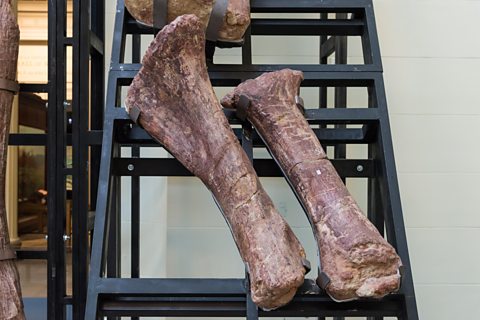
“As soon as they started opening, they saw that the big bone was the tip of the femur,” explains Diego. The work was so meticulous, and the specimen so large, that the team spent an entire week digging out a single bone.
This thigh bone measured approximately 2.4 metres in length. Diego says it was “likely the largest dinosaur bone ever found” and “a big deal”.
'Just the tip of the iceberg'
As the team dug out the bone they quickly realised that there were others in the ground too.
They stayed at the farm site for 18 months, with colleagues from all over the world coming to join in the dig. Sir David Attenborough even joined in as research continued - flying in to film a documentary about this remarkable find.
Diego says that the site was “massive”. He explains that the team “ended up collecting 150 bones belonging to six gigantic dinosaurs that died in the area”.
While the number of bones was exciting, something even more incredible was developing. The team believed they were uncovering a whole new species. In 2014 they made their announcement to the world.
Then, in 2017, five years after Hernández found that first bone, the species was named - Patagotitan mayorum.
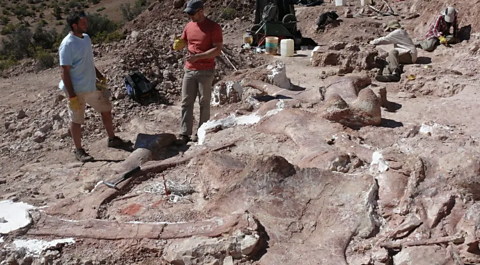 Image source, A.Garrido/PA Wire
'It was like completing a jigsaw'
Estimating the size of a creature that lived hundreds of millions of years ago can be difficult. Researchers require as much evidence as possible. But Diego and the team struck it lucky. “We ended up collecting bones that represent about 70 percent of the skeleton of this new species,” Diego explains.
This allowed the team to create pretty much “an entire body plan”. They were able to tell how both the forward and hind limbs were built, the tailbone, and neck.
It also helped them to determine just how big this dinosaur was.
As Diego explains: “This is not the only really really huge dinosaur, there were other ones, like Argentinosaurus… but there were only five bones known from that specimen."
What was the Patagotitan mayorum?
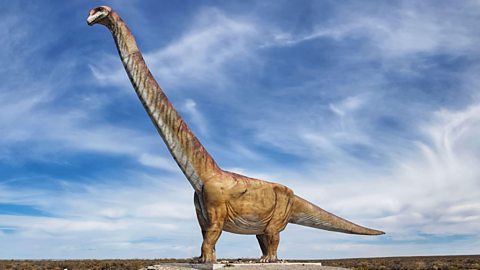
The name of this giant very large herbivores that walked on four legs, had long necks, small heads, and long tails.refers to two different things. Patagonia, where the discovery was made, and the Mayo family who owned the land where the dinosaurs were found.
How long ago did the Patagotitan mayorum live?
Researchers believe the dinosaur was alive around 100,000,000 (that's one hundred million) years ago, during the Early Cretaceous period. The Cretaceous period was also when Tyrannosaurus Rex and Tricerotops lived. Though they evolved millions of years after the Patagotitan mayorum, in the Late Cretaceous period.
How big was the Patagotitan mayorum?
Describing the sheer size of the dinosaur, Diego says: “It’s really impressive when you stand by one of these bones, you feel really tiny.” By measuring the circumference and length of that first discovered bone, the team initially estimated that the dinosaur weighed 77 tonnes - about the same weight as 14 African elephants.
Continued research resulted in this estimation being scaled down slightly but still left the Patagotitan mayorum as one of the largest dinosaurs ever discovered. It belonged to a group of huge dinosaurs called titanosaurs.
What’s a titanosaur?
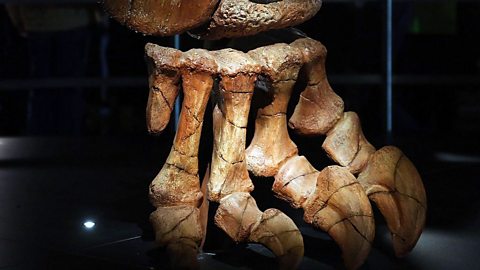
Diego explains that titanosaurs include “the largest of the four-limbed animals” with a big belly, a long tail, long neck and a small head.
These dinosaurs were herbivores. Diego describes them as “bulk feeders that were not very selective”.
According to the palaeontologist, titanosaurs often formed breeding colonies. He explains that they would lay between 20-30 eggs in a nest. Their eggs could be the size of a football, and often with shells ten times thicker than a chicken’s egg.
From one farm, to the world
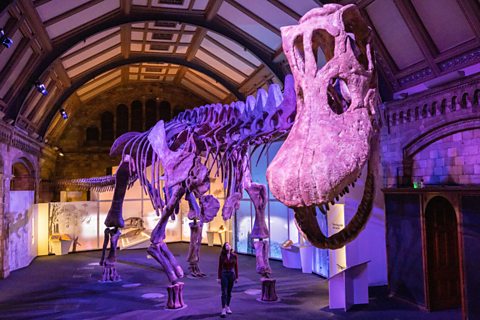
People have since been able to see replicas of the Patagonia Mayorum in various museums around the world.
One replica was created within four years of the first bone discovery, an achievement that Diego says he is very proud of.
To this day you can still see both a replica of the skeleton of the dinosaur, as well as some of uncovered bones, at the Museum of Palaeontology Egidio Feruglio.
Diego was speaking to the BBC World Service series Witness History. You can listen to the full interview here as well as exploring other episodes.
This article was written in November 2025
Walking With Dinosaurs: What do we get wrong about these amazing creatures?
Professor Emily Bamforth explains to BBC Bitesize that there are still a lot of things we get wrong about dinosaurs.
Dinosaurs: The Final Day quiz
How much do you know about the prehistoric creatures in the new David Attenborough documentary?
Five amazing prehistoric sites you can visit today in the UK
Find out more about the interesting stories behind these locations in the UK