When you hear the word ‘elevator’ or ‘lift’, what do you think of?
Maybe a fairly industrial looking contraption, often grey in colour? A mirror on the back wall, possibly some old carpet, a few buttons, and not a lot of space?

But away from hotel lobbies, offices, and other everyday locations, lifts can actually be pretty incredible on the eye, and amazing feats of engineering.
BBC Bitesize takes a look at some of the most extreme and intriguing lifts out there.
The Hundred Dragons Elevator
Deep in Hunan province, China, lies Zhangjiajie Forest National Park, the country’s first national park. It’s a jaw dropping area of natural beauty, dominated in part by huge pillars and peaks of quartzite sandstone. It’s like something from another world and it’s thought the area inspired the floating mountains in the world of Pandora from the Avatar movies.
Hiking the peaks here is no mean feat given the size and scale of them. But for those daring enough, there is a slightly speedier way to scale one summit - hitching a lift on the park’s Bailong Elevator, also known as the Hundred Dragons Elevator.
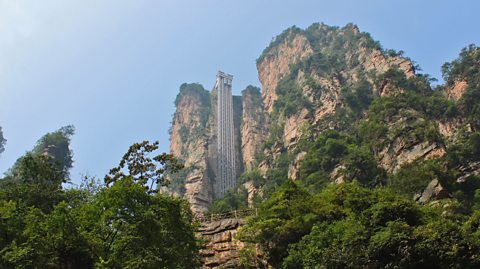
Built into a particularly strong cliff - this lift is a record breaker. It holds the Guinness World Record as the tallest outdoor elevator. It takes each of the three double-decker carriages around two minutes to climb over 320m (1050ft), carrying up to 50 people in each.
Construction of this feat of engineering started in 1999 amidst some controversy - installing a massive steel structure into a UNIESCO World Heritage Site was not universally welcomed. But by 2002, the elevators, which feature large, presumably vertigo-enducing windows, were lifting people to the peak.
The Paternoster Lift
While our next lift isn’t recognised by UNESCO, it’s no less spectacular.
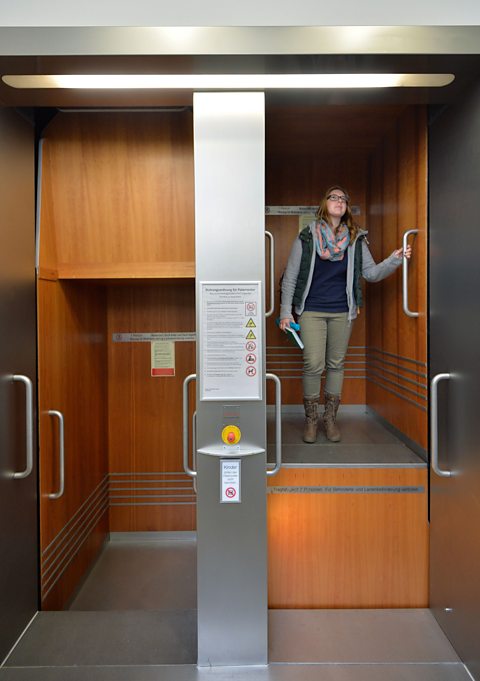
The concept of a lift being located in a university building is of course nothing ground-breaking. But in the University of Sheffield’s twenty-two-storey tall Arts Tower, is a lift with a difference.
Unlike traditional elevators, the university’s paternoster lift is a constantly moving loop system - no need to press a call button here. The only buttons to press on this elevator are for emergency stops.
Students looking to get to their lectures simply hop onto a moving platform, stay onboard until they reach their desired floor, and then hop off. They can of course use the stairs, or regular lifts if they don’t want to risk being late to class.
Built over 45 years ago, the paternoster features 38 platforms (or cars) which can each hold two people, meaning a maximum of 76 people can use the lift at any one time. It takes just 13 seconds to travel between floors.
Paternoster lifts were invented in the 1860s by Peter Ellis, an architect from Liverpool. They grew in popularity during the 1950s and 1960s before a ban on any new ones came into effect during the 1970s over safety concerns.
This ban means there are very few paternosters still in use in the UK - Sheffield’s is believed to be only one of three still in operation, but there are also several still used today across Germany.
The Falkirk Wheel
Scotland is home to some beautiful historic canals. This includes the Union Canal which flows between Edinburgh and Falkirk, plus the Forth and Clyde Canal which provides a cross-country link between two of Scotland’s iconic rivers.
The combined distance of these two waterways is roughly sixty or so miles which sounds like an idyllic trip on a canal boat – but there’s a problem. Although they meet near Falkirk, these stretches of water don’t flow into each other. The Union canal sits nearly 35 metres above the Forth and Clyde canal.
For a long time, any attempt to transfer from one to the other was a physical test involving navigating a series of eleven canal locks. But in 2002, the opening of the first, and only, rotating boat lift in the world, the Falkirk Wheel, changed everything.
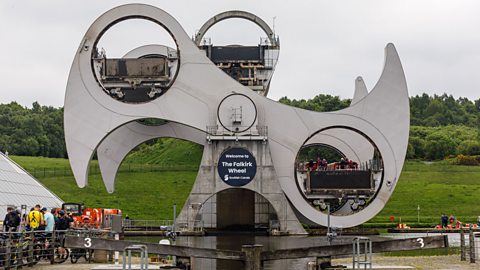
The wheel is an impressive feat of engineering that involves over 15,000 bolts and is rooted in Archimedes’ principle of displacement. The iconic structure has two gondolas, each filled with up to 500,000 litres of water. This allows for two vessels at a time to transfer between the two canals - one from the top and the other from the bottom.
A half-turn of the wheel takes just five minutes. At the top passengers can take a quick glimpse over the central belt of Scotland before continuing on their journey to Edinburgh - in a slightly less exhausted manner than their predecessors.
Hammetschwand Lift
If there was a prize for elevators that look like something from a fairytale, the Hammetschwand Lift, which overlooks Lake Lucerne in Switzerland, would certainly be a contender. But this lift boasts an altogether more impressive accolade - it is Europe’s highest outdoor elevator.
First opened in 1905, at a time when lift technology was still seen as something of a modern invention, the lift takes riders up to the Bürgenstock mountain ridge, at an altitude of 1,132m (3714ft). From here, visitors can take in stunning views of the lake below, before riding back down and continuing on their travels.
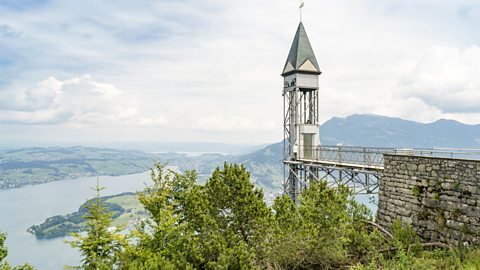
While the altitude is impressive, the actual journey in the lift is just over 150m (492ft), though at that elevation, it’s still not one for anyone who doesn’t care for heights! When it was first built, the lift took three minutes to reach the top of the Bürgenstock - but renovations in the early 1990s increased the lift’s speed so a journey to the top now takes less than a minute.
Tauchgondel
While most elevators in our collection provide a practical purpose, this particular lift serves a slightly more frivolous function. But that shouldn't take away from its impressive engineering. After all, a ride on a Tauchgondel, or diving-gondola, allows people to explore close to the sea floor without the need for any scuba-diving gear.
Found spread along the north-east coast of Germany, on the Baltic Sea, are four of these underwater elevators that take tourists down to the depths; around 4m (13ft) below the surface to be exact. The first opened in 2006, on the edge of a pier in the resort of Zinnowitz.
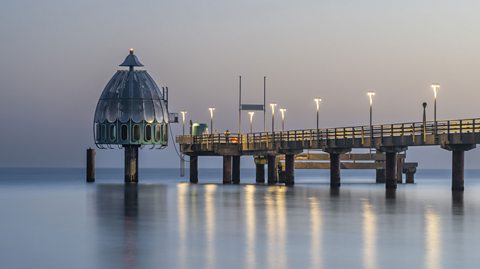
If you’re concerned at the thought of going down into the deep without strapping an oxygen tank to your back, don’t be. Each elevator has 6cm thick windows made of safety glass, a ventilation system that provides fresh air at all times, and emergency exit shafts. Plus, a quick release of the gondola’s holding-brake would see the elevator swiftly return to the surface should anything dramatic unfold.
Perhaps the only drawback of taking a trip onboard is not the contraption itself, but the water it operates in. Unlike some of the world’s seas, the Baltic Sea can be pretty murky, making spotting any marine life tricky. Thankfully the team onboard always have some films on hand to show tourists what might be lurking in the deep.
This article was published in March 2026
Six of the most naturally colourful places in the world
From blood-red lakes to emerald-green fields, we explore some of the world's most colourful natural locations
Natural shapes around the world
Circles, hexagons, rectangles and more are all around us in nature

Four incredible theatres around the world
The world's only active double-decker theatre, a floating stage and more.