William Shakespeare once famously wrote, “All the world’s a stage.”
The iconic line from As You Like It lives on today and was used to represent the blurring of the lines between drama and real life – but there is an element of literal truth to the phrase as well.
All across the world, there are hundreds and thousands of theatres – all celebrated, along with their art forms on World Theatre Day on 27 March.
BBC Bitesize takes a look at four unique theatres around the world.
The Elgin and Winter Garden Theatre, Toronto, Canada
You’ve almost certainly heard of a double-decker bus, but chances are you’re not too familiar with a double-decker theatre.
That’s because there’s only one still operating anywhere in the world.
Toronto’s Elgin and Winter Garden Theatre was originally opened in 1913. It’s called a double-decker theatre because the two, separate spaces, are built on top of each other.
It was designed in this way to cater to different groups of people - at the time, venues would typically have standard seating and separate, more expensive areas for higher society. The lower, Elgin Theatre is decorated in traditional red and gold and would show vaudeville acts and films at an affordable price.
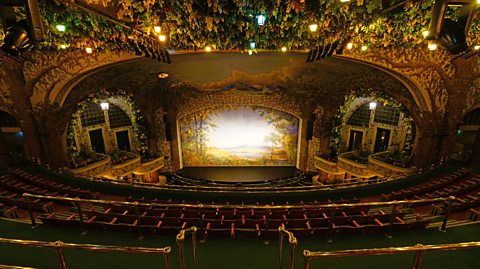
The upper chamber, the Winter Garden, was built with high society and premium ticket prices in mind and was intended to resemble an atmospheric country garden – with real plant life on the walls alongside murals.
Both theatres were closed for a spell before being restored in the late 1980s and have been named national historic sites in Canada.
Seebühne, Bregenz, Austria
Around 30,000 people live in the city of Bregenz on the east of Lake Constance in Austria – the home of the annual Bregenz Festival.
The showpiece venue for this cultural gathering is a floating stage known as the Seebühne.
The venue is a 7,000 seater open-air amphitheatre that hosts the festival’s larger events, typically operas. The stage itself is located on the lake – with elaborate sets often taking advantage of the water as extensions to the scenery.
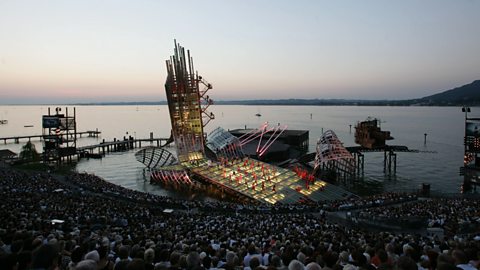
The Seebühne evolved from orchestral performances in 1946 that took place on barges in the water. Due to the complexity of the staging, each opera has a two-year season. For the 2014 performance of Mozart’s The Magic Flute, crews worked for 215 days to construct the set.
The stage also featured in the 2008 James Bond film, Quantum of Solace – with Daniel Craig’s 007 pursuing villains during a production of Tosca.
Teatro Amazonas, Manaus, Brazil
The Brazilian city of Manaus is the seventh largest in the South American country but is probably best known for being in the Amazon rainforest. The striking Teatro Amazonas has stood in the city for more than 125 years.
In the late 19th Century, the region was one of the world’s leading rubber exporters, with wealthy plantation owners settling in Manaus. They wanted to recreate the lavish lifestyle enjoyed by many in European cities and the idea of building an opera house was proposed.
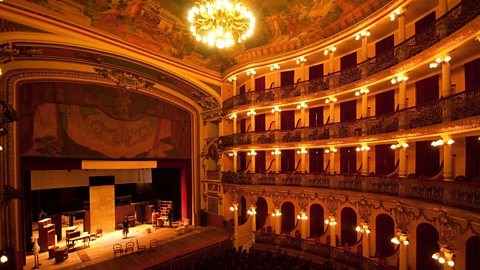
Work began on this grand project in 1884 with the inauguration on New Year’s Eve in 1896. But despite the theatre’s initial popularity, the invention of artificial rubber in the early 20th Century meant that Manaus lost its main source of income, and the wealthy left town.
The theatre stood empty for 90 years before the government decided to revive it in 2001. The decadent opera house, which seats 701 people, now plays home to some of the world’s most talented musicians on a regular basis.
Thang Long Water Puppet Theatre, Hanoi, Vietnam
One of Vietnam’s most popular tourist attractions is the Thang Long Water Puppet Theatre in Hanoi. The theatre itself opened in 1969 but the art form of water puppetry dates much further back.
It began around a thousand years ago in the country’s rice paddies. After they had been flooded, puppeteers would come to perform to local workers, amusing them by telling traditional stories of farmers, fisherman and mythical tales of dragons.
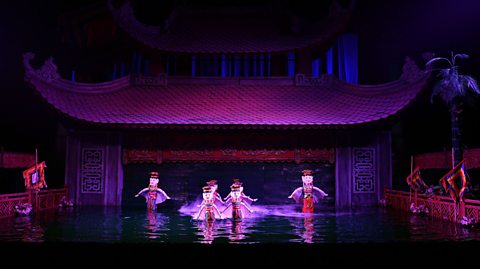
The modern day performances follow similar themes. The stage at the Thang Long Water Puppet Theatre is filled with waist-high water – puppeteers are hidden behind a screen to operate the handcrafted, wooden puppets.
They’re some of the hardest working people in theatre – with multiple performances every day of the year. Each hour long show features around 17 different short sketches, all accompanied by traditional Vietnamese orchestral music.
More than 150,000 people see the show each year – with those in the front row likely to get somewhat drenched by the mischievous dragon puppets.
This article was published in March 2022

Four replicas of iconic landmarks around the world
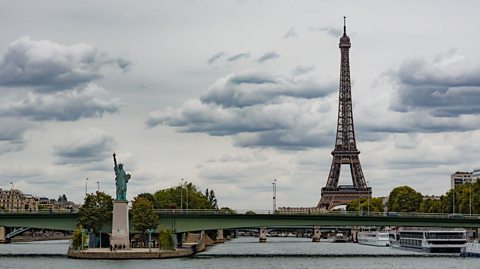
There's a Colosseum in China and a stateside Stonehenge.
Five amazing sculptures from around the world
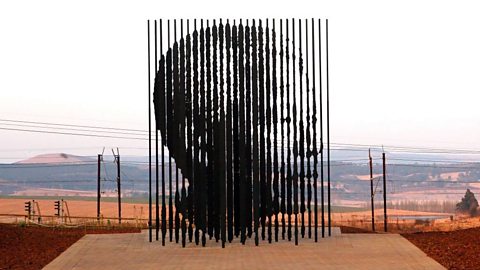
From the world's largest bird and equine sculptures to the face of Nelson Mandela, there's something to inspire everyone.
Four fascinating places we’re not allowed to set foot in
Why an island of snakes, a seed bank and a spiritual rock formation are all off limits.