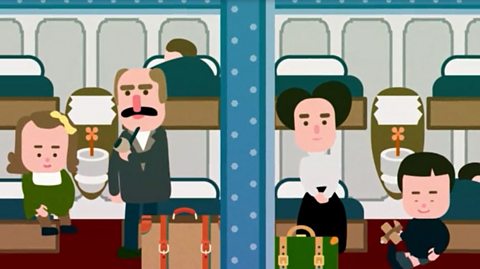
What are some of the key facts about Titanic?
- Titanic was a very big ship at 269 metres long, 28 metres wide, and over 53 metres tall.
- It was the same height as Nelson's Column in London.
- The ship burned over 600 tonnes of coal daily with 175 'firemen' working in shifts.
- Titanic carried nearly 3500 sacks of mail, including letters and packages.

Titanic was the biggest and most luxurious passenger ship of its time. It was 269 metres long, 28 metres wide and more than 53 metres tall, which is the same height as Nelson's Column in London and Belfast City Hall.
It had ten decks, three engines and its furnaces burnt through over 600 tonnes of coal. 175 'firemen' shovelled the coal by hand and worked in shifts 24 hours a day. Although Titanic had four funnels, only three were functional - the fourth one was just for show.
Titanic's full title was RMS Titanic as it was a Royal Mail ship carrying nearly 3500 sacks of mail including all sorts of letters and packages.
Find out the science and engineering behind how Titanic was built.
Have you ever wondered how something as huge as Titanic could sail?
It was 53 metres tall, the same size as Nelson's column in London, and weighed 52,310 tonnes when fully loaded.
That's the same weight as 9750 African elephants.
How do ships float? It’s all to do with something called ‘displacement’ that was discovered over 2000 years ago by Greek mathematician Archimedes.
Archimedes realised that when you get into a full bath, the water that spills onto the floor is equal to the amount of space your body took up. The water is displaced.
You can see it when someone dives into the swimming pool from the top diving board.
Now think of a piece of plasticine. If you make it into a tight ball and drop it into a basin of water, it sinks.
However, if you take the same piece of plasticine and make it boat shaped, it floats. The plasticine weighs the same as before, but the change of shape displaces more water.
An object floats if it weighs less than the amount of water it displaces. Passenger ships are designed to displace huge amounts of water.
That's why they are built wide and flat, and they are hollow inside to make them lighter. The wider they are, the more support can be provided from the sea by something called ‘buoyant force’.
This explains why huge passenger ships like Titanic float while dropping 9750 elephants into the sea is a bad idea.
How did big ships like Titanic float?
How can we talk about Titanic in numbers?
Titanic's construction cost was £1.5 million, which is around £170 million in today's money. It took around three years to build. The wages of those on board varied greatly depending on position - Captain Smith earned £105 per month (about £11,000 today) whereas a stewardess earned £3 10 shillings per month (around £375 today).
There were 2200 people on board Titanic on its maiden voyage. 1300 passengers and 900 crew. The ship wasn't full and could have had another 1100 people on board.
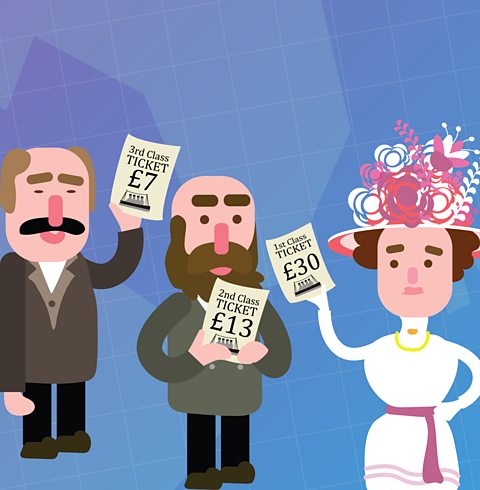
Titanic was a luxurious ship and tickets were expensive. A third class ticket cost around £7 in 1912 which is nearly £800 in today's money. A second class ticket cost around £13 or nearly £1500 today and a first class ticket would have set you back a minimum of £30 or more than £3300 today.
Times tables 1-12!
Practise the times tables with our songs, videos and quizzes
More on Titanic
Find out more by working through a topic
- count1 of 4

- count3 of 4