Though it may appear as one of the most inhospitable places in the world, in the middle of a desert, you might find an oasis.
No, not Liam and Noel Gallagher but a pool of water, often surrounded by luscious plants - that somehow survive the incredible heat. Most oases are formed by water stored beneath the desert sands in aquifers, layers of underground rock that store water, rising to the surface.
Join BBC Bitesize as we travel around the world to look at five of the most outstanding oases.
Crescent Lake Oasis, China
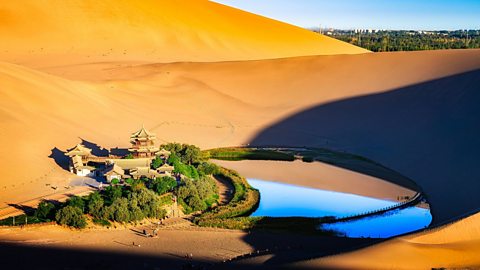
Nestled amidst the golden dunes of the Gobi Desert in Gansu Province, China, Crescent Lake (also known as Moon Crescent Spring) looks like an oasis from a picture book. The pool is tiny and its waters are crystal clear.
The oasis is estimated to be 2,000 years old and was an important rest stop for travellers on the ancient Silk Road trading route. But recently it has been in danger of being swallowed up by the surrounding desert. In the 1990s, it was discovered that the average water level had dropped from five metres (16.4ft) to just one metre (3.3ft).
Thankfully, in 2006, efforts were made to refill the lake and preserve its stunning beauty.
Huacachina Oasis, Peru
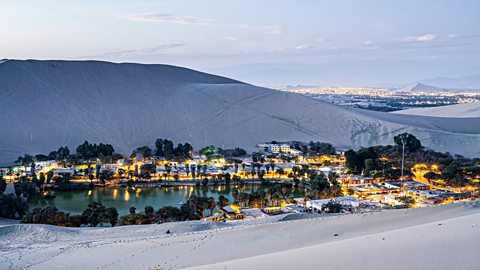
Huacachina Oasis is the only oasis on the South American continent. Located in Southern Peru, its name roughly translates as ‘weeping woman’ and is a reference to a local myth that tells of a beautiful Incan princess who lost her lover and whose tears of grief created the oasis.
Like many oases around the world, Huacachina is under threat from increasing local demands for water. Drilling wells nearby and evaporation during hot summers has caused the water level to fall, and recently the lagoon has had to be maintained by pumping additional water in.
The oasis only has about 100 permanent residents but it is a popular tourist attraction, with many drawn by the spectacular scenery.
Wadi Bani Khalid, Oman
‘Wadi’ is an Arabic word that refers to a river bed that is either dry or which is filled only sporadically by rainfall, creating pools of standing water along its course.
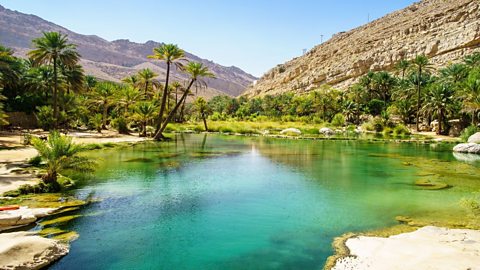
Wadi Bani Khalid in the Wahiba Desert, Oman, is fed both by rainwater and by hot springs located in the nearby Muqal Caves. Its beautiful lakes, pools and lush vegetation stand out against the arid desert landscape.
The earliest inhabitants of the region were Bedouin tribes but these days the region is popular with visitors, some who come to explore the caves, others to bathe in the naturally warmed pools.
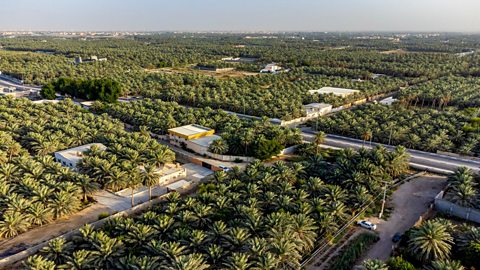
Al-Ahsa Oasis, Saudi Arabia
Many oases are not much more than small lakes or ponds. But Al-Ahsa Oasis in Saudi Arabia is a giant. Measuring around 33mi² (85km²) it is the largest oasis in the world.
The fertile region is spread over 30,000 acres, with over 2.5 million date palm trees. It also features caves, canals, ancient forts and mosques. Archeological evidence has indicated that the area has been inhabited since prehistoric times.
In 2018, the oasis was added to UNESCO’s world-heritage list as an "exceptional example of human interaction with the environment".
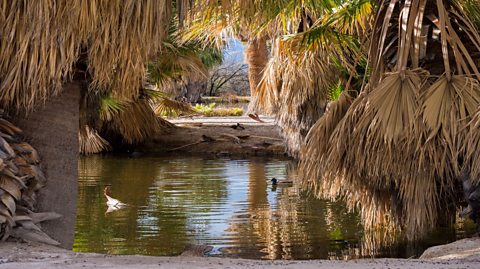
Agua Caliente Oasis, USA
Agua Caliente Oasis is located in Arizona, USA, in the Sonoran Desert near to the town of Tucson. As it is fed by a natural hot spring, the oasis was originally named ‘Sec-he’ (meaning sound of boiling water) by the Cahuilla tribe of Native Americans who have inhabited the region for 5,000 years.
The Spanish renamed it ‘Agua Caliente’ (meaning hot water) when they colonised the region in the late 18th Century.
There were originally two springs feeding the ponds, which are surrounded by palm trees and are the home to wildlife including turtles and birds. In the 1930s, in an attempt to increase water flow, the springs were blown up, and this resulted in the springs collapsing into each other.
This article was published in January 2025
Looking for quizzes, amazing stories and fun facts?
Bitesize Topical has it all!

Have you tried these traditional foods recognised by UNESCO?
BBC Bitesize looks at four food delicacies and culinary practices have been celebrated by UNESCO.
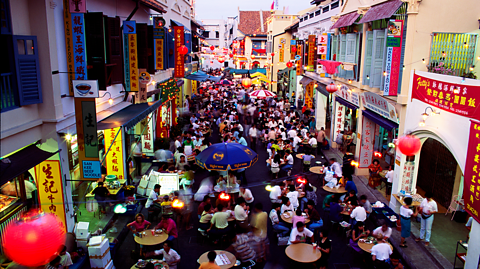
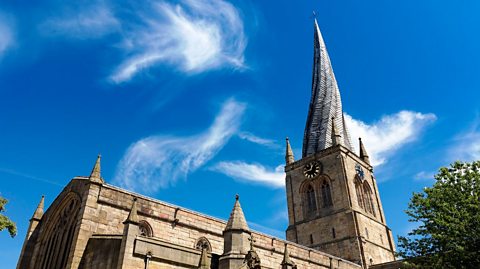
Six wonky buildings from around the world
Do you ever look at a building and think 'how did that become so tilted'? BBC Bitesize takes a look at six wonky buildings from across the world and the stories behind them
Can you guess where you are in the world from the short description?
Can you tell some of the world's most famous cities apart from description alone? Test your knowledge in this location-based quiz.