When we talk about buildings that tilt captivatingly, you might immediately think of the Leaning Tower of Pisa in Italy.
But there are lots of buildings that slope, some quite alarmingly, around the world.
From tilted Chinese pagodas to English church steeples that are rumoured to have been kicked by the devil, BBC Bitesize tracked down some of the world’s most unusual wonky structures.
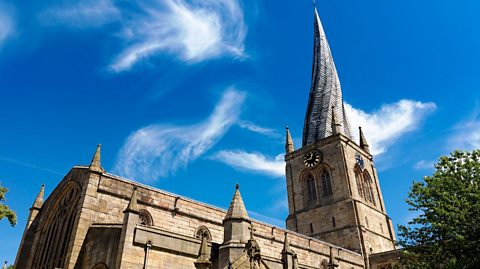
The Crooked Spire, UK
The crooked spire sits on top of St Mary & All Saints church in Chesterfield, UK. Not only does it lean to one side, but it is also twisted, resembling a giant corkscrew.
There are a number of legends about how the spire came to be so crooked. One has the devil kicking the top of the spire as he flew over.
The more likely reason for the spire’s odd shape is that it was originally constructed with wooden shingles. At some point these were replaced with lead, which is harder wearing but is much heavier and this was too much for the wooden frame to bear.
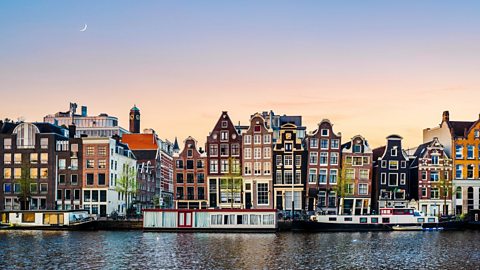
The Dancing Houses, Netherlands
Amsterdam’s Dancing Houses are one of the city’s most famous landmarks. Located on the Damrak waterfront, the colourful dwellings lean at pronounced angles, often seeming to prop each other up.
The houses were built deliberately with a forward tilt. This was because winches and pulleys on the outside of the houses were used to move large or heavy items to the upper floors, and the incline meant they could be pulled up unobstructed.
The houses also lean at crazy angles from one side to the other. This is likely caused by subsidence. The houses were originally built on wooden stilts in soft, waterlogged ground. Over time, the houses have sunk from their original foundations, often leaning over against each other in the process.

Tiger Hill Pagoda, China
The Tiger Hill Pagoda is sometimes called ‘China’s Leaning Tower of Pisa’. It is located on Huqiu Mountain in Jiangsu province, Eastern China.
It opened during the Song Dynasty (959-961 AD), making it older than the Leaning Tower of Pisa, which was completed in the 14th Century. Though it is constructed of stone, its design echoes the traditional design of a wooden pagoda, a tower that is often associated with a Buddhist temple complex.
One reason for the lean is likely due to the fact that the tower was built on two different kinds of surface. Another is that some of the brick pillars that the pagoda is built on have cracked. Luckily, engineers have attempted to reinforce the foundations so that the building doesn’t fall over.
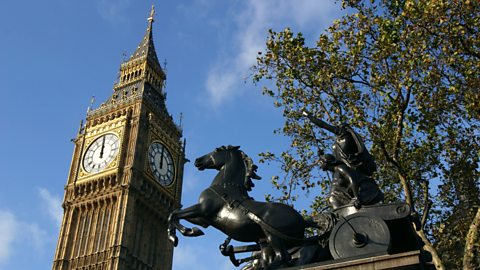
Elizabeth Tower, UK
Elizabeth Tower (often mistakenly called Big Ben - that’s the name of the bell inside) is one of the Houses of Parliament’s most famous - and photographed - features, but the tower is in fact tilting, albeit so slightly that you can’t easily spot it with the naked eye.
The tower tilts ever so slightly by 0.26 degrees to the north-west. At the top, the tower is out of alignment by about half a metre.
Nobody is sure exactly why the building is tilted but it’s not an emergency. "We have been monitoring it since 1999, so we've got some pretty good data,” told Mike McCann, Keeper of the Great Clock, to BBC London in 2011. "Our resident expert believes it will be between 4,000 and 10,000 years before it becomes a problem.”
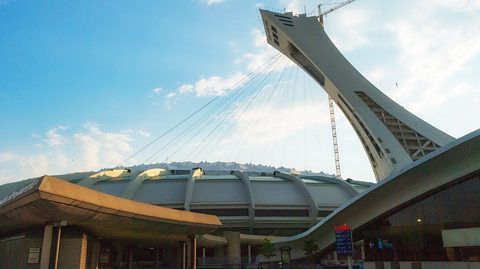
Montreal Tower, Canada
Most of the leaning towers we have seen have tilted by accident. But sometimes architects deliberately design buildings that lean, occasionally to an alarming degree.
One of the most spectacular is the Olympic Park Stadium in Montreal with its main tower which is 165 metres tall and leans at 45 degree angle (in comparison to the Leaning Tower Of Pisa’s tilt which is four degrees).
Built to host the 1976 Olympics, the stadium was barely completed in time and the tower’s viewing platform only opened in 1987. The tower remained empty for decades. In the late 2010s, it underwent a conversion into commercial space, and has space for 1,000 office workers.
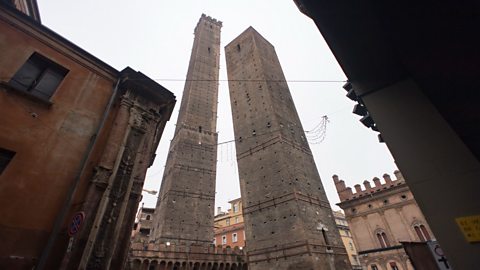
The Two Towers, Italy
The Garisenda and Asinelli towers in Bologna, Italy, were originally built in the 12th Century. They are believed to have been built by two rival families who were competing to display their wealth and prestige.
The towers began to tilt, probably because of land subsidence, sometime during the 14th Century. During this time the Garisenda tower was shortened and is now only half as tall as its neighbour at 154ft (46.9m) and has a tilt of about four degrees.
The taller Asinelli tower has a less alarming tilt of just 1.3 degrees. In 2023, the Garisenda Tower was sealed off over fears it may collapse.
This article was published in January 2025
Looking for quizzes, amazing stories and fun facts?
Bitesize Topical has it all!

Six beauty hacks that rocked the ancient world
From seaweed to saffron, thanaka to aloe vera, BBC Bitesize looks at six beauty secrets from the ancient world.

Six beautiful libraries from around the world
From life-like wooden carvings to rom-com film settings, join BBC Bitesize as we explore six magnificent libraries from around the world.
Three incredible ancient frescoes that aren’t in Pompeii
From Egypt to Italy to India, join BBC Bitesize as we explore three stunning ancient frescoes that aren't in Pompeii.