On 25 January, couples across Wales will be celebrating St Dwynwen's Day or in Welsh, Dydd Santes Dwynwen. Cards will be sent, romantic meals will be eaten and lovespoons will be given to lovers.
But why is this day celebrated in Wales? BBC Bitesize takes a look at who Dwynwen was and why she's considered to be the patron saint of lovers in Wales.

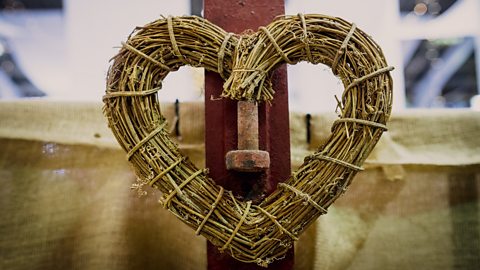
Dwynwen, daughter of Brychan Brycheiniog
You may be surprised to hear that Dwynwen herself was not lucky in love!
Dwynwen lived in the fifth century and like so many popular old tales there are several versions of her story. It is said that Dwynwen was the daughter of a Welsh king called Brychan Brycheiniog and came from Brecon. Some accounts say that Brychan had 24 daughters while others claim he had 36. Dwynwen was considered to be the most beautiful of them all - so quite an honour!
Three wishes
Dwynwen fell in love with Maelon, the son of another king. They wanted to get married but her father had other ideas. Brychan Brycheiniog had already arranged for Dwynwen to marry someone else. Dwynwen ran to the forest, distraught, and prayed to God to release her from love. An angel came to visit her and gave her a potion to make her forget about Maelon and to turn him to ice. After this, God appeared to her and gave her three wishes.
- First, Dwynwen wished that Maelon was thawed.
- Secondly, she wished that God would help all true lovers.
- Finally, she wished that she would never be married.
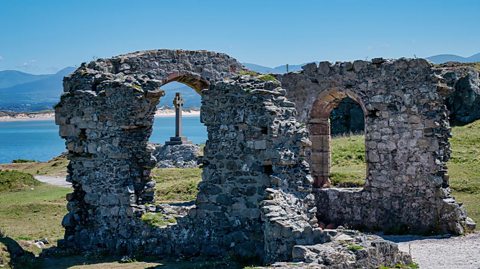
Ynys Llanddwyn
After the wishes were granted Dwynwen became a nun and established a convent on an island, Ynys Llanddwyn, just off the coast of Anglesey. 'Ynys' means island in Welsh, 'Llan' means 'church' and 'dwyn' comes from the name 'Dwynwen'.
According to the story, there was a fish, who lived in a well near the church, that could predict the future of couples. If a couple went there and the water bubbled then the couple would have good luck. As a result the church and well became a place of pilgrimage in the middle ages. The ruins of the convent can still be seen on the island.

So if you are celebrating Saint Dwynwen's day by giving a card, a love spoon or sharing a romantic meal, spare a thought for Dwynwen on Ynys Llanddwyn.
This article was updated in January 2026
Spooky Wales - Noson Calan Gaeaf
Noson Calan Gaeaf, which means ‘'Winter’s Eve’, is an Ysbrydnos or ‘Spirit Night’, a time when spirits can roam the world of the living.
Seven wonderful places of worship around the world
Whether you’re a religious person or not, places of worship can often be awe inspiring.

Five mystical UK lakes that are not Loch Ness
We dip our toes in the waters of ponds, lakes and lochs with tales linked to mythical creatures and happenings of the past.