Whether you’re a religious person or not, places of worship can often be awe inspiring. Churches, temples, mosques, synagogues or even sites of ancient rituals, many were built and adapted to create a sense of wonder, drama or serenity.
Some holy places welcome visitors as well as worshippers. BBC Bitesize suggests if you find yourself in these neck areas, do pop by and take a look, respectfully of course.

1: Salt Cathedral, Colombia
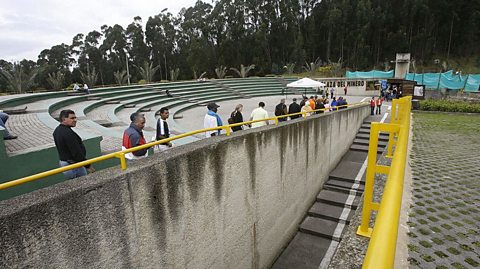
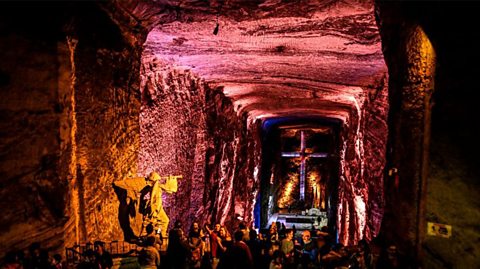
The Salt Cathedral of Zipaquirá in Colombia is a Roman Catholic church, built 180 metres underground in the tunnels of a salt mine.
It is thought halite, or rock salt, has been mined in this area north of the capital Bogota since the 5th Century BC. By modern times, in the 1930s, miners used makeshift altars to pray for safety before starting their shifts and descending down into the mine. Then the idea came to build a permanent place of worship and in 1954 the Salt Cathedral was inaugurated and services began.
Carved out of rock and salt within an active mine, safety concerns and structural problems built up and it was shut in 1992. But with government investment and an ambitious (and safer) design, a new improved version of the cathedral was opened in 1995. It’s now a major tourist attraction, welcoming more than 600,000 visitors a year.
You can listen to the BBC World Service’s interview with the engineer behind it, Jorge Enrique Castelblanco, on Witness History
2. Hagia Sophia, Turkey
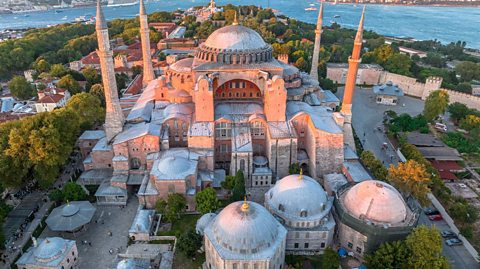
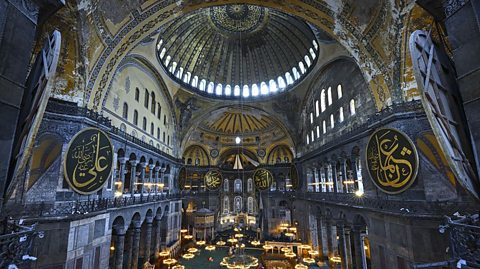
The Hagia Sophia sits on a site overlooking the Bosphorus River in Istanbul, where worshippers from different faiths have come and gone over millennia.
The current building was originally built as a church, on top of an ancient pagan temple, in 537CE. Istanbul was called Constantinople then, and lay at the centre of the Christian Byzantine Empire that ruled over parts of Europe and northern Africa. When the city was captured by Ottoman sultan Mehmed II in 1453, the church was converted to a mosque but retained some symbols of it’s Christian history.
Although Islam does not allow figurative art in religious contexts, Mehmed ll didn’t order the Christian imagery to be covered or destroyed. A century later the then ruler did have them plastered over, but in the 1930s when the building was renovated, the full decorative splendour was revealed.
Now the orginal Christian mosaics, showing saints and Byzantine rulers, can be seen today alongside Islamic calligraphy, called Hüsn-i Hat, displaying the names of Allah, the prophet Mohammed and the four caliphs, the leaders of Islam following the death of Mohammed.
3. El Ghriba Synagogue, Tunisia
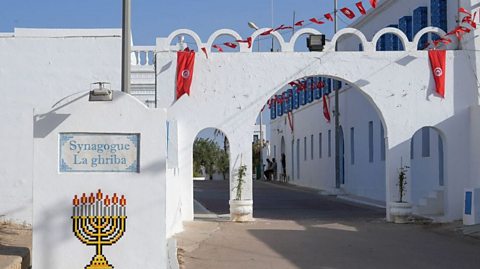
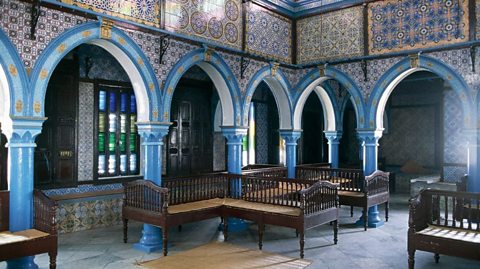
The oldest synagogue in Africa, El Ghriba Synagogue can be found on the island of Djerba off the coast of Tunisia.
Jewish people are said to have arrived in Tunisia along with the Phoenicians who founded Carthage in the 10th Century BC. But popular local legend says that high priests settled on Djerba after fleeing the destruction of Soloman’s Temple by the Babylonians in Jerusalem, back in 586 BC.
A synagogue has existed on this site for centuries but the current building was built in the 19th Century, combining traditional features of a Jewish place of worship with local Tunisian architecture. From the outside, the modest, unadorned whitewashed exterior follows other buildings on the island, designed to deflect the hot sun. But the bright interior features similar geometric patterns and colours - vibrant blue, green and yellow - found across Tunisia.
No longer used for regular weekly worship, visitors are welcomed and every spring, El Ghriba becomes a popular Jewish pilgrimage destination.
4: Churches of Göreme, Turkey
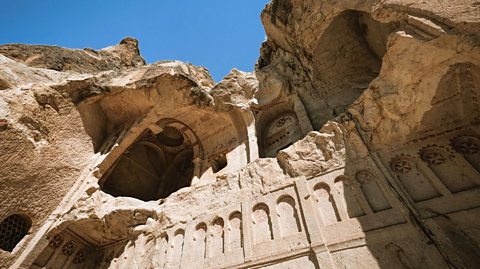
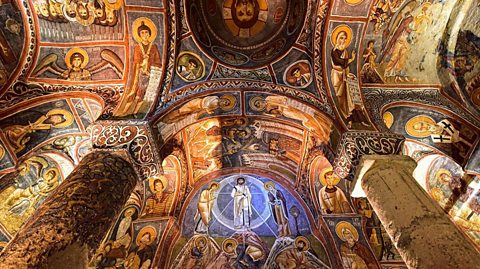
When Mount Erciyes in Turkey erupted over two and a half million years ago, the resulting flows of lava and ash created an unique landscape. In Cappadocia in the central Anatolian region of modern day Turkey, as the softer rock eroded it left behind caves, hillsides and other worldly ‘fairy chimneys’ or towers of harder rock.
Ancient humans discovered they could carve shelters within this landscape and as far back as 6th Century BC, records show people lived in dwellings underground or inside the rock. From the 4th Century AD, Christianity arrived and with it the desire for places of worship, so churches were also carved out of the rock.
The Dark Church or Karanlık Kilise was created in the 11th Century to serve a grand monastry, at the head of Göreme Valley. After the Greek-Turkish war ended in 1922 and the subsequent population exchange, local Turkish farmers closed up the main entrance to use the church as a pigeon coop. When renovations of the Dark Church (and lots of cleaning up of pigeon poo) took place about 60 years later, some of the most ornate and well preserved religious frescos in all Cappadocia were discovered.
5: Batu Caves Temple, Malaysia
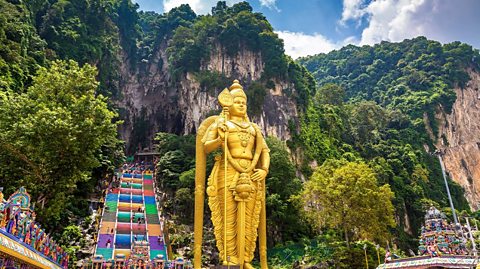
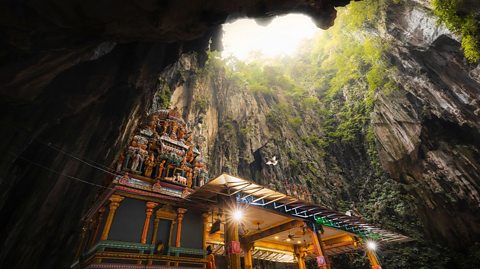
Continuing the cave theme, the Batu Caves Temple can be found within a limestone mountain near Kuala Lumpur, in Malaysia.
These ancient rock formations are thought to be 400 million years old and have been used as shelter by the indigenous Temuan people since before records began. But it wasn’t until an American naturalist William Hornaday ‘discovered’ the site in 1878 that the idea for a temple came about. Prominent Malaysian-Tamil businessman K. Thamboosamy began promoting the caves as a site of Hindu worship, building a series of shrines dedicated to Lord Murugan - the Hindu god of war and victory - which opened in 1890.
A huge golden statue of Lord Murugan, at 43 metres high, welcomes visitors to climb the 272 colourful steps at the entrance to the caves. There are four large cavern systems with around 20 inter-connected chambers. The largest, the Cathedral Cave, has natural openings that let light through, illuminating the numerous shrines. These feature bright and intricate murals and carvings depicting scenes from Hindu legends. The Batu Caves are open to visitors and are the focal point for the annual Tamil Hindu festival of Thaipusam in Malaysia.
6: Sanctuary of Madonna della Corona, Italy
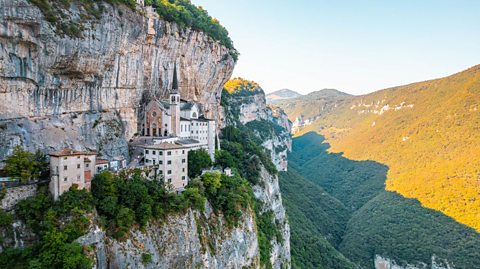
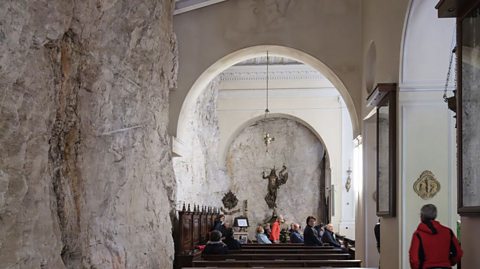
You'll also need to climb a lot of steep steps to reach our next place of worship, the Santuario Madonna della Corona (Sanctuary of the Lady of the Crown), in northern Italy.
The chapel appears to be clinging on to the cliff face of Mount Baldo but it was actually built on a thin rock ledge, over 600 metres above sea level. Holy men linked to a monastry in Verona visited the site as early as the 11th Century and it is thought that the first version of the church was built there in the 1500s.
Extensions and replacements have been made but it still draws visitors and pilgrims to its peaceful but dramatic location. As you approach, in the courtyard, are Bronze casts by the Veronese architect Raffaele Bonente and inside, white Cararra marble sculptures portraying St John Evangelist and St Mary Magdalene by artist Ugo Zannoni.
7. The Bahá’í House of Worship, or Lotus Temple, India
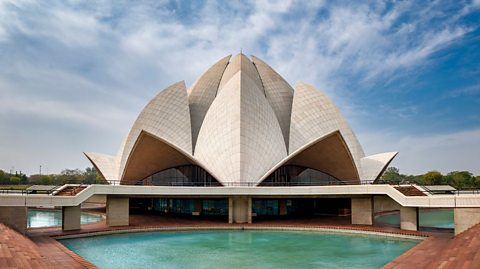
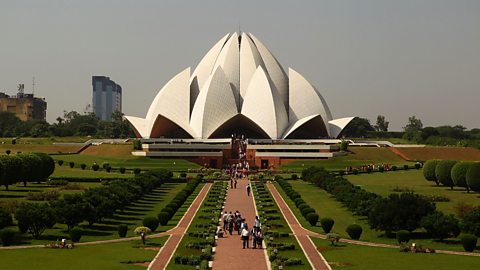
The Bahá’í House of Worship, popularly known as the Lotus Temple, in New Delhi, India is the most modern on our list.
Opened in 1986, the striking building was created to resemble a half-open lotus flower floating on water by Iranian-American architect Fariborz Sahba. Each component of the temple is repeated nine times - nine pools, nine clusters of free-standing ‘petal’ buildings, nine sides with nine doors leading indoors to the central hall. The hall is 34 metres high and can hold up to 1,300 people.
There are a growing number of Bahá’í Houses of Worship around the world, some including this one have won awards for their architecture. All visitors are welcomed with these words on the website; “this magnificent structure stands for the principle of the oneness of humankind. People of all racial, religious, national backgrounds, are welcomed to pray and meditate within its precincts.”
This article was published in January 2026
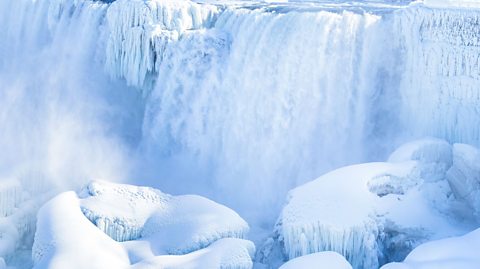
Five incredible and icy 'frozen' waterfalls
Take a look at these wintery waterfalls from around the world, exploring how some appear to 'freeze'
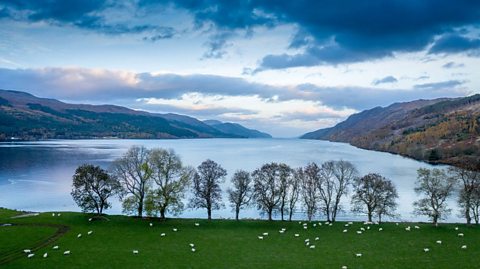
Five mystical UK lakes that are not Loch Ness
We dip our toes in the waters of ponds, lakes and lochs with tales linked to mythical creatures and happenings of the past.
Do you know about the super powers that actually exist?
Ever wondered if super powers were real? BBC Bitesize looks at five real-life super powers that exist in our universe.