Ways to learn Spanish fast
Approximately 7% of the world can communicate in Spanish and it is the second most spoken language in the world. When learning any language, knowing where to start can be a challenge. However, it is important to build on your vocabulary and grammar knowledge.
The best way to do this is by practising your understanding in four main areas: speaking, reading, writing and listening. By focusing on these skills, you can easily identify which aspects are your strongest and which need improvement.
Read on for some tips on how to learn Spanish by using these four key skills.
Speaking in Spanish
The ability to speak fluently in your target language is a no small feat. However, by practising with native speakers and other people learning Spanish, you can greatly improve your pronunciation.
No partner? The Spanish phrase for no problem!
One way to practise your pronunciation is by incorporating Spanish vocabulary into your everyday routine. For example, you could label things around your home with the Spanish translation and speak the word aloud when you see them.
You can also practise your speaking skills by reading Spanish texts aloud. Bitesize has a pronunciation guide that you can use to perfect your vowel sounds.
Stick with us and you'll know how to hablar Español in no time!
Reading in Spanish
The fastest way to pick up on new Spanish vocabulary is reading. Start small with Spanish children’s books, short stories and bilingual books. You could even try a book you’ve already read in your native language. To make the most of your vocabulary, keep a log of the words you needed to look up in the dictionary, as you go.
The key to learning is to have fun. If you hate sci-fi, fantasy or classic literature in English, reading these genres in Spanish will only make you miserable! Stick to your favourites.
Need some tips on using a Spanish Dictionary? Use the handy Bitesize guide!
Reading the news on BBC Mundo will also help you stay informed on what’s happening in Spanish-speaking countries.
Listening in Spanish
Listening skills go hand in hand with speaking skills – you’ll need both for a good conversation! Why not trying listening to a Spanish audiobook OR watching a Spanish television programme to tune your ears to the rhythm of the language. You can even listen to some Spanish radio stations online for a musical twist!
Bitesize also has a variety of listening exercises and games for you to test yourself.
Writing in Spanish
Practising your writing in a new language can really help you master it.
To practise writing in Spanish, You could start a blog or a daily journal to get consistent use of the language. We’ve also got a bunch of handy writing guides you can use to improve your writing skill.
You could even add a Spanish language keyboard to a device such as a phone and practise typing messages in that language. You could even imagine you're talking to a Spanish pen pal.
However, learning a language doesn’t end there! You also need to understand the grammar and expand your vocabulary. The Spanish word for 'let's go!'

How to learn Spanish vocabulary
Trying to learn a language without any vocabulary is like trying to drive a car without an engine…you won’t get very far! To get you moving along, you could get started with a list of the most common words in the language, or focus on the topics that interest you most.
This BBC Bitesize page has a list of phrases that you can memorise in order to express your opinion on various topics - ¿Muy utíl, no?
You can also have fun making flashcards to test yourself, or take turns with a fellow language learner.
Another way to test your Spanish vocabulary is to try and write your shopping lists in Spanish. Before you know it, instead of getting ice cream from the supermarket, you’ll be buying helado from the supermercado!
How to study Spanish grammar
Spanish grammar rules can be challenging. Luckily, it’s easier to learn the rules of conjugation, rather than memorising the different variations of every single word.
Our handy table below gives you an all you need to know a guide to conjugating regular verbs in the present tense.
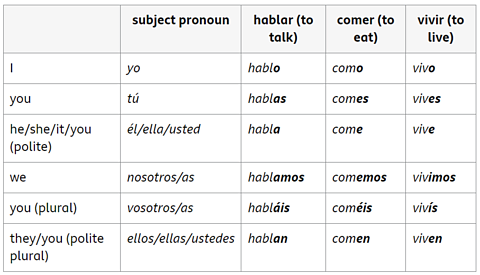
The verb ending reveals who did the action and when it happened. It is important to note how each verb ends, whether in -AR, -ER, or -IR, as this will affect how the verb is conjugated.
Don’t panic! This may seem overwhelming, but with practice conjugation will become easier. Try to focus on mastering the present tense before getting weighed down with the irregular verbs or other tenses. Knowing how to conjugate is half the battle of learning Spanish.
How long does it take to learn Spanish?
It is believed that learning Spanish can take around 500 hours of study to reach an intermediate level.
However, it is important to know that there are different levels of fluency, as defined by CEFR (Common European Framework of Reference for Languages). These are: A1, A2, B1, B2, C1, C2; with A1 being a beginner level, and C2 denoting a perfect understanding and mastery of the language.
The fast way to learn Spanish is via immersion. Practice is key! This means surrounding yourself with as much Spanish as possible in your day-to-day life. By doing this, you can combine all four key components of language learning and use each one as much as possible consistently in real life.
Want to know more about Spanish?
If you’re an Español aficionado, we offer a lot of resources about all things Spanish. Check them out below.
